Multi-functional bioactive hydrogel based on CCM-Co-ZIF-8 nanoparticles for chronic wound healing: Synergistic antibacterial, antioxidant, and anti-inflammatory therapy
Qi Tao , Hang Yao , Zehao Gu , Xiaofei Yang , Junli Shi , Dong-An Wang , Hui Chong
{"title":"Multi-functional bioactive hydrogel based on CCM-Co-ZIF-8 nanoparticles for chronic wound healing: Synergistic antibacterial, antioxidant, and anti-inflammatory therapy","authors":"Qi Tao , Hang Yao , Zehao Gu , Xiaofei Yang , Junli Shi , Dong-An Wang , Hui Chong","doi":"10.1016/j.eurpolymj.2025.113824","DOIUrl":null,"url":null,"abstract":"<div><div>The treatment of chronic wounds are characterized by a local tissue with issues such as the accumulation of free radicals and persistent inflammation, which contribute to delayed wound healing. Thus, it has emerged as a significant global challenge, profoundly impacting patients’ quality of life and even posing threats to their lives. In this study, we fabricted a CCM (Curcumin)–Co-ZIF-8 nanoparticle (CCZ)@oxidized ammonium alginate (OSA)/carboxymethyl chitosan (CMCS)/tannic acid (TA) composite multifunctional bioactive hydrogel. This nanocomposited double-crosslinked network hydrogel dressing exhibits excellent mechanical properties and self-healing abilities. Additionally, the hydrogel shows good biocompatibility. Due to the formation of dynamic Schiff base bonds between oxidized sodium alginate and CMCS, the hydrogel-TA spray system possesses injectability upon applied to a wound model in mice, allowing better adaptation to irregular wound shapes. Furthermore, it could promote synergistic antibacterial, antioxidant, and anti-inflammatory effects, thereby accelerating wound healing. Our findings highlight the potential of this multifunctional hydrogel system as an advanced therapeutic option for chronic wound management.</div></div>","PeriodicalId":315,"journal":{"name":"European Polymer Journal","volume":"228 ","pages":"Article 113824"},"PeriodicalIF":6.3000,"publicationDate":"2025-03-19","publicationTypes":"Journal Article","fieldsOfStudy":null,"isOpenAccess":false,"openAccessPdf":"","citationCount":"0","resultStr":null,"platform":"Semanticscholar","paperid":null,"PeriodicalName":"European Polymer Journal","FirstCategoryId":"92","ListUrlMain":"https://www.sciencedirect.com/science/article/pii/S0014305725001120","RegionNum":2,"RegionCategory":"化学","ArticlePicture":[],"TitleCN":null,"AbstractTextCN":null,"PMCID":null,"EPubDate":"2025/2/11 0:00:00","PubModel":"Epub","JCR":"Q1","JCRName":"POLYMER SCIENCE","Score":null,"Total":0}
引用次数: 0
Abstract
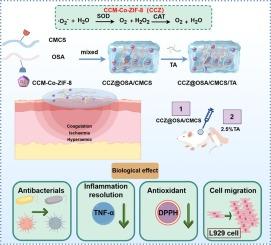
The treatment of chronic wounds are characterized by a local tissue with issues such as the accumulation of free radicals and persistent inflammation, which contribute to delayed wound healing. Thus, it has emerged as a significant global challenge, profoundly impacting patients’ quality of life and even posing threats to their lives. In this study, we fabricted a CCM (Curcumin)–Co-ZIF-8 nanoparticle (CCZ)@oxidized ammonium alginate (OSA)/carboxymethyl chitosan (CMCS)/tannic acid (TA) composite multifunctional bioactive hydrogel. This nanocomposited double-crosslinked network hydrogel dressing exhibits excellent mechanical properties and self-healing abilities. Additionally, the hydrogel shows good biocompatibility. Due to the formation of dynamic Schiff base bonds between oxidized sodium alginate and CMCS, the hydrogel-TA spray system possesses injectability upon applied to a wound model in mice, allowing better adaptation to irregular wound shapes. Furthermore, it could promote synergistic antibacterial, antioxidant, and anti-inflammatory effects, thereby accelerating wound healing. Our findings highlight the potential of this multifunctional hydrogel system as an advanced therapeutic option for chronic wound management.
期刊介绍:
European Polymer Journal is dedicated to publishing work on fundamental and applied polymer chemistry and macromolecular materials. The journal covers all aspects of polymer synthesis, including polymerization mechanisms and chemical functional transformations, with a focus on novel polymers and the relationships between molecular structure and polymer properties. In addition, we welcome submissions on bio-based or renewable polymers, stimuli-responsive systems and polymer bio-hybrids. European Polymer Journal also publishes research on the biomedical application of polymers, including drug delivery and regenerative medicine. The main scope is covered but not limited to the following core research areas:
Polymer synthesis and functionalization
• Novel synthetic routes for polymerization, functional modification, controlled/living polymerization and precision polymers.
Stimuli-responsive polymers
• Including shape memory and self-healing polymers.
Supramolecular polymers and self-assembly
• Molecular recognition and higher order polymer structures.
Renewable and sustainable polymers
• Bio-based, biodegradable and anti-microbial polymers and polymeric bio-nanocomposites.
Polymers at interfaces and surfaces
• Chemistry and engineering of surfaces with biological relevance, including patterning, antifouling polymers and polymers for membrane applications.
Biomedical applications and nanomedicine
• Polymers for regenerative medicine, drug delivery molecular release and gene therapy
The scope of European Polymer Journal no longer includes Polymer Physics.



 京公网安备 11010802042870号
京ICP备2023020795号-1
京公网安备 11010802042870号
京ICP备2023020795号-1

 分享
分享
 求助内容:
求助内容: 应助结果提醒方式:
 扫码关注我们
