Silvana Martén-Rodríguez, Edson Jacob Cristobal-Pérez, Martín Hesajim de Santiago-Hernández, Guillermo Huerta-Ramos, Lucero Clemente-Martínez, Gary Krupnick, Orley Taylor, Martha Lopezaraiza-Mikel, Francisco Javier Balvino-Olvera, Eugenia M. Sentíes-Aguilar, Sergio Díaz-Infante, Armando Aguirre Jaimes, Samuel Novais, Jorge Cortés-Flores, Jorge Lobo-Segura, Eric J. Fuchs, Oliverio Delgado-Carrillo, Ilse Ruiz-Mercado, Roberto Sáyago-Lorenzana, Karen Pérez-Arroyo, Mauricio Quesada
{"title":"Untangling the Complexity of Climate Change Effects on Plant Reproductive Traits and Pollinators: A Systematic Global Synthesis","authors":"Silvana Martén-Rodríguez, Edson Jacob Cristobal-Pérez, Martín Hesajim de Santiago-Hernández, Guillermo Huerta-Ramos, Lucero Clemente-Martínez, Gary Krupnick, Orley Taylor, Martha Lopezaraiza-Mikel, Francisco Javier Balvino-Olvera, Eugenia M. Sentíes-Aguilar, Sergio Díaz-Infante, Armando Aguirre Jaimes, Samuel Novais, Jorge Cortés-Flores, Jorge Lobo-Segura, Eric J. Fuchs, Oliverio Delgado-Carrillo, Ilse Ruiz-Mercado, Roberto Sáyago-Lorenzana, Karen Pérez-Arroyo, Mauricio Quesada","doi":"10.1111/gcb.70081","DOIUrl":null,"url":null,"abstract":"<p>Climate change is expected to affect the morphological, physiological, and life-history traits of plants and animal pollinators due to more frequent extreme heat and other altered weather patterns. This systematic literature review evaluates the effects of climate change on plant and pollinator traits on a global scale to determine how species responses vary among Earth's ecosystems, climate variables, taxonomic groups, and organismal traits. We compiled studies conducted under natural or experimental conditions (excluding agricultural species) and analyzed species response patterns for each trait (advance vs. delay or no change for phenology, decrease vs. increase or no change for other traits). Climate change has advanced plant and animal phenologies across most Earth's biomes, but evidence for temporal plant–pollinator mismatches remains limited. Flower production and plant reproductive success showed diverse responses to warming and low water availability in Alpine and Temperate ecosystems, and a trend for increased or neutral responses in Arctic and Tropical biomes. Nectar rewards mainly experienced negative effects under warming and drought across Alpine and Temperate biomes, but scent emissions increased or changed in composition. Life form (woody vs. nonwoody species) did not significantly influence trait response patterns to climate change. Pollinator fecundity, size, life-history, developmental, and physiological traits mostly declined with warming across biomes; however, animal abundance and resource acquisition traits showed diverse responses. This review identified critical knowledge gaps that limit our understanding of the impacts of climate change, particularly in tropical/subtropical biomes and southern latitudes. It also highlights the urgent need to sample across a greater range of plant families and pollinator taxa (e.g., beetles, wasps, vertebrates). The diversity of climate change effects should be assessed in the context of other anthropogenic drivers of global change that threaten critically important pollination interactions.</p>","PeriodicalId":175,"journal":{"name":"Global Change Biology","volume":"31 2","pages":""},"PeriodicalIF":12.0000,"publicationDate":"2025-02-25","publicationTypes":"Journal Article","fieldsOfStudy":null,"isOpenAccess":false,"openAccessPdf":"https://onlinelibrary.wiley.com/doi/epdf/10.1111/gcb.70081","citationCount":"0","resultStr":null,"platform":"Semanticscholar","paperid":null,"PeriodicalName":"Global Change Biology","FirstCategoryId":"93","ListUrlMain":"https://onlinelibrary.wiley.com/doi/10.1111/gcb.70081","RegionNum":1,"RegionCategory":"环境科学与生态学","ArticlePicture":[],"TitleCN":null,"AbstractTextCN":null,"PMCID":null,"EPubDate":"","PubModel":"","JCR":"Q1","JCRName":"BIODIVERSITY CONSERVATION","Score":null,"Total":0}
引用次数: 0
Abstract
Climate change is expected to affect the morphological, physiological, and life-history traits of plants and animal pollinators due to more frequent extreme heat and other altered weather patterns. This systematic literature review evaluates the effects of climate change on plant and pollinator traits on a global scale to determine how species responses vary among Earth's ecosystems, climate variables, taxonomic groups, and organismal traits. We compiled studies conducted under natural or experimental conditions (excluding agricultural species) and analyzed species response patterns for each trait (advance vs. delay or no change for phenology, decrease vs. increase or no change for other traits). Climate change has advanced plant and animal phenologies across most Earth's biomes, but evidence for temporal plant–pollinator mismatches remains limited. Flower production and plant reproductive success showed diverse responses to warming and low water availability in Alpine and Temperate ecosystems, and a trend for increased or neutral responses in Arctic and Tropical biomes. Nectar rewards mainly experienced negative effects under warming and drought across Alpine and Temperate biomes, but scent emissions increased or changed in composition. Life form (woody vs. nonwoody species) did not significantly influence trait response patterns to climate change. Pollinator fecundity, size, life-history, developmental, and physiological traits mostly declined with warming across biomes; however, animal abundance and resource acquisition traits showed diverse responses. This review identified critical knowledge gaps that limit our understanding of the impacts of climate change, particularly in tropical/subtropical biomes and southern latitudes. It also highlights the urgent need to sample across a greater range of plant families and pollinator taxa (e.g., beetles, wasps, vertebrates). The diversity of climate change effects should be assessed in the context of other anthropogenic drivers of global change that threaten critically important pollination interactions.
期刊介绍:
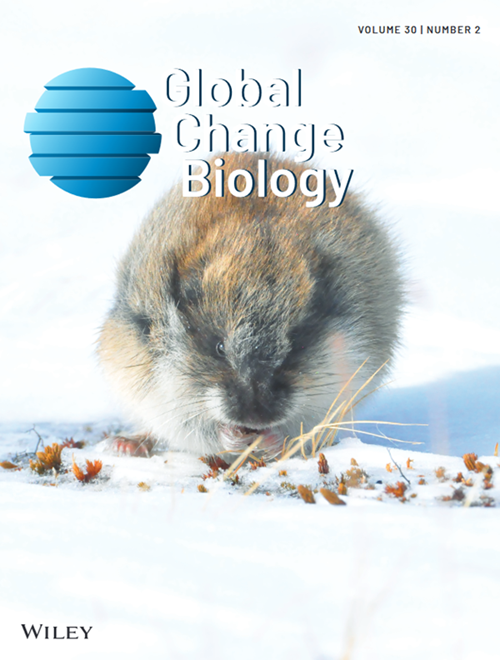
Global Change Biology is an environmental change journal committed to shaping the future and addressing the world's most pressing challenges, including sustainability, climate change, environmental protection, food and water safety, and global health.
Dedicated to fostering a profound understanding of the impacts of global change on biological systems and offering innovative solutions, the journal publishes a diverse range of content, including primary research articles, technical advances, research reviews, reports, opinions, perspectives, commentaries, and letters. Starting with the 2024 volume, Global Change Biology will transition to an online-only format, enhancing accessibility and contributing to the evolution of scholarly communication.




 京公网安备 11010802042870号
京ICP备2023020795号-1
京公网安备 11010802042870号
京ICP备2023020795号-1

 分享
分享
 求助内容:
求助内容: 应助结果提醒方式:
 扫码关注我们
