Immunoregulatory Neuro-Vascularized Osseointegration Driven by Different Nano-Morphological CaTiO3 Bioactive Coatings on Porous Titanium Alloy Scaffolds
Dongmei Yu, Zhen Tang, Shusen Bao, Shuo Guo, Changchen Chen, Qi Wu, Mo Wang, Zenghui Zheng, Pengfei Cao, Bin Xu, Hao Wu, Ning Wang, Hai Huang, Chaozong Liu, Xiaokang Li, Zheng Guo
{"title":"Immunoregulatory Neuro-Vascularized Osseointegration Driven by Different Nano-Morphological CaTiO3 Bioactive Coatings on Porous Titanium Alloy Scaffolds","authors":"Dongmei Yu, Zhen Tang, Shusen Bao, Shuo Guo, Changchen Chen, Qi Wu, Mo Wang, Zenghui Zheng, Pengfei Cao, Bin Xu, Hao Wu, Ning Wang, Hai Huang, Chaozong Liu, Xiaokang Li, Zheng Guo","doi":"10.1002/adhm.202404647","DOIUrl":null,"url":null,"abstract":"<p>Up to now, how to implement the optimal regenerative repair of large load-bearing bone defects using artificial bone prosthesis remains to be an enormous challenge in clinical practice. Titanium-based alloys, especially Ti6Al4V, are applied as artificial bone grafts due to their favorable mechanical property and biocompatibility, assisted by personalized customization of 3D-printing to completely match with the bone defect. However, their bioinert peculiarity restricts osteointegration at the interface between bone and titanium-based implants and bone growth into porous titanium-based scaffolds, for lack of bone regeneration with the aid of blood vessels and neural networks. Of note, ample blood delivery and integral innervation are pivotal to the survival of artificially tissue-engineered bones. Herein, the functionalized surface of 3D printed titanium alloy scaffolds driven immunoregulatory neuro-vascularized osseointegration is delved. Bone-like micro/nano morphology and chemical composition of calcium-rich formula are scrutinized to accelerate the process of bone defect repair, including inflammatory response, angiogenesis, neurogenesis, and osseointegration. Micro/nano-topographic calcium titanate (CaTiO<sub>3</sub>) coating, especially 10%H<sub>2</sub>O<sub>2</sub>-Ca, driven immunoregulatory neuro-vascularized osseointegration is validated and its underlying mechanism is attributed to the signaling pathway of TNF-α /oxidative phosphorylation, providing an effective tactic of the bone tissue-engineered scaffold with surface functionalization-driven immunoregulatory neuro-vascularized osseointegration for clinical large segmental bone defects.</p>","PeriodicalId":113,"journal":{"name":"Advanced Healthcare Materials","volume":"14 9","pages":""},"PeriodicalIF":9.6000,"publicationDate":"2025-02-24","publicationTypes":"Journal Article","fieldsOfStudy":null,"isOpenAccess":false,"openAccessPdf":"","citationCount":"0","resultStr":null,"platform":"Semanticscholar","paperid":null,"PeriodicalName":"Advanced Healthcare Materials","FirstCategoryId":"5","ListUrlMain":"https://advanced.onlinelibrary.wiley.com/doi/10.1002/adhm.202404647","RegionNum":2,"RegionCategory":"医学","ArticlePicture":[],"TitleCN":null,"AbstractTextCN":null,"PMCID":null,"EPubDate":"","PubModel":"","JCR":"Q1","JCRName":"ENGINEERING, BIOMEDICAL","Score":null,"Total":0}
引用次数: 0
Abstract
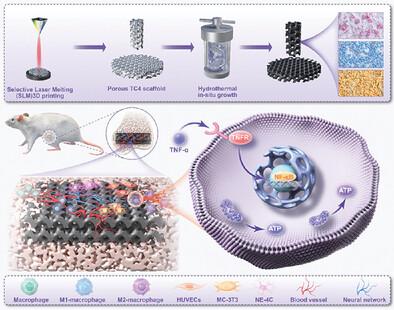
Up to now, how to implement the optimal regenerative repair of large load-bearing bone defects using artificial bone prosthesis remains to be an enormous challenge in clinical practice. Titanium-based alloys, especially Ti6Al4V, are applied as artificial bone grafts due to their favorable mechanical property and biocompatibility, assisted by personalized customization of 3D-printing to completely match with the bone defect. However, their bioinert peculiarity restricts osteointegration at the interface between bone and titanium-based implants and bone growth into porous titanium-based scaffolds, for lack of bone regeneration with the aid of blood vessels and neural networks. Of note, ample blood delivery and integral innervation are pivotal to the survival of artificially tissue-engineered bones. Herein, the functionalized surface of 3D printed titanium alloy scaffolds driven immunoregulatory neuro-vascularized osseointegration is delved. Bone-like micro/nano morphology and chemical composition of calcium-rich formula are scrutinized to accelerate the process of bone defect repair, including inflammatory response, angiogenesis, neurogenesis, and osseointegration. Micro/nano-topographic calcium titanate (CaTiO3) coating, especially 10%H2O2-Ca, driven immunoregulatory neuro-vascularized osseointegration is validated and its underlying mechanism is attributed to the signaling pathway of TNF-α /oxidative phosphorylation, providing an effective tactic of the bone tissue-engineered scaffold with surface functionalization-driven immunoregulatory neuro-vascularized osseointegration for clinical large segmental bone defects.
期刊介绍:
Advanced Healthcare Materials, a distinguished member of the esteemed Advanced portfolio, has been dedicated to disseminating cutting-edge research on materials, devices, and technologies for enhancing human well-being for over ten years. As a comprehensive journal, it encompasses a wide range of disciplines such as biomaterials, biointerfaces, nanomedicine and nanotechnology, tissue engineering, and regenerative medicine.





 京公网安备 11010802042870号
京ICP备2023020795号-1
京公网安备 11010802042870号
京ICP备2023020795号-1

 分享
分享
 求助内容:
求助内容: 应助结果提醒方式:
 扫码关注我们
