Effects of protein-rich multi-nutrient intervention on bone mineralization and development: insights from a randomized controlled trial in prepubertal children and a zebrafish experiment†
Xiaolong Xing, Xinyang Li, Yi Guo, Wentao Gu, Qisijing Liu, Jianhua Ma, Li Su, Yu Wang, Yanrong Zhao and Shuo Wang
{"title":"Effects of protein-rich multi-nutrient intervention on bone mineralization and development: insights from a randomized controlled trial in prepubertal children and a zebrafish experiment†","authors":"Xiaolong Xing, Xinyang Li, Yi Guo, Wentao Gu, Qisijing Liu, Jianhua Ma, Li Su, Yu Wang, Yanrong Zhao and Shuo Wang","doi":"10.1039/D4FO04240A","DOIUrl":null,"url":null,"abstract":"<p >High-protein foods and physical activity are crucial for bone growth in early life. This study first examined whether a protein-rich multi-nutrient intervention combined with rope-skipping training could prevent bone loss during winter in prepubertal children. A 10 week randomized controlled trial involving 120 children aged 9–12 years in rural northwestern China was conducted. Participants were assigned to a treatment group (protein-rich multi-nutritional drink plus rope-skipping training) or a control group (rope-skipping training only). Forearm bone mineral density (BMD) was measured at the baseline and week 10 of the trial, along with serum calcium, parathyroid hormone (PTH), insulin-like growth factor 1 (IGF-1), and bone turnover biomarkers. Second, we estimated the effects of three protein sources enriched in the drink, milk protein concentrates (MPC), collagen peptides (CP), and whey protein hydrolysates (WPH), on zebrafish backbone development. In children, BMD decreased in both groups, but the treatment group showed a smaller reduction and a positive intervention effect (relative change: 0.023 g cm<small><sup>−2</sup></small>, <em>P</em> = 0.037). The treatment group also had a smaller increase in PTH (relative change: −8.53 ng L<small><sup>−1</sup></small>, <em>P</em> = 0.012) and a smaller decrease in IGF-1 (relative change: 20.75 ng mL<small><sup>−1</sup></small>, <em>P</em> = 0.076). No significant differences were found in bone turnover biomarkers. In zebrafish, MPC, CP, and WPH individually and synergistically promoted bone growth without adverse effects, as shown by dose-dependent increases in the backbone fluorescence intensity. These findings suggest that protein-rich multi-nutrient supplementation combined with rope-skipping training could prevent bone loss in prepubertal children during winter, potentially through changes in serum PTH and IGF-1, and highlight the synergistic effects of these proteins on bone development.</p>","PeriodicalId":77,"journal":{"name":"Food & Function","volume":" 6","pages":" 2335-2346"},"PeriodicalIF":5.4000,"publicationDate":"2025-02-12","publicationTypes":"Journal Article","fieldsOfStudy":null,"isOpenAccess":false,"openAccessPdf":"","citationCount":"0","resultStr":null,"platform":"Semanticscholar","paperid":null,"PeriodicalName":"Food & Function","FirstCategoryId":"97","ListUrlMain":"https://pubs.rsc.org/en/content/articlelanding/2025/fo/d4fo04240a","RegionNum":1,"RegionCategory":"农林科学","ArticlePicture":[],"TitleCN":null,"AbstractTextCN":null,"PMCID":null,"EPubDate":"","PubModel":"","JCR":"Q1","JCRName":"BIOCHEMISTRY & MOLECULAR BIOLOGY","Score":null,"Total":0}
引用次数: 0
Abstract
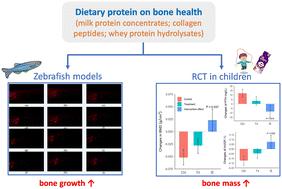
High-protein foods and physical activity are crucial for bone growth in early life. This study first examined whether a protein-rich multi-nutrient intervention combined with rope-skipping training could prevent bone loss during winter in prepubertal children. A 10 week randomized controlled trial involving 120 children aged 9–12 years in rural northwestern China was conducted. Participants were assigned to a treatment group (protein-rich multi-nutritional drink plus rope-skipping training) or a control group (rope-skipping training only). Forearm bone mineral density (BMD) was measured at the baseline and week 10 of the trial, along with serum calcium, parathyroid hormone (PTH), insulin-like growth factor 1 (IGF-1), and bone turnover biomarkers. Second, we estimated the effects of three protein sources enriched in the drink, milk protein concentrates (MPC), collagen peptides (CP), and whey protein hydrolysates (WPH), on zebrafish backbone development. In children, BMD decreased in both groups, but the treatment group showed a smaller reduction and a positive intervention effect (relative change: 0.023 g cm−2, P = 0.037). The treatment group also had a smaller increase in PTH (relative change: −8.53 ng L−1, P = 0.012) and a smaller decrease in IGF-1 (relative change: 20.75 ng mL−1, P = 0.076). No significant differences were found in bone turnover biomarkers. In zebrafish, MPC, CP, and WPH individually and synergistically promoted bone growth without adverse effects, as shown by dose-dependent increases in the backbone fluorescence intensity. These findings suggest that protein-rich multi-nutrient supplementation combined with rope-skipping training could prevent bone loss in prepubertal children during winter, potentially through changes in serum PTH and IGF-1, and highlight the synergistic effects of these proteins on bone development.
高蛋白食物和身体活动对早期的骨骼生长至关重要。这项研究首先检查了富含蛋白质的多种营养素干预结合跳绳训练是否可以预防青春期前儿童冬季骨质流失。对中国西北农村地区120名9-12岁儿童进行了为期10周的随机对照试验。参与者被分配到治疗组(富含蛋白质的多营养饮料加跳绳训练)或对照组(仅跳绳训练)。在基线和试验第10周测量前臂骨矿物质密度(BMD),以及血清钙、甲状旁腺激素(PTH)、胰岛素样生长因子1 (IGF-1)和骨转换生物标志物。其次,我们估计了饮料中富含的三种蛋白质来源,乳蛋白浓缩物(MPC),胶原蛋白肽(CP)和乳清蛋白水解物(WPH)对斑马鱼脊柱发育的影响。儿童骨密度两组均有下降,但治疗组下降幅度较小,干预效果为正(相对变化:0.023 g cm-2, P = 0.037)。治疗组PTH升高幅度较小(相对变化:-8.53 ng mL-1, P = 0.012), IGF-1降低幅度较小(相对变化:20.75 ng mL-1, P = 0.076)。骨转换生物标志物未发现显著差异。在斑马鱼中,MPC、CP和WPH分别并协同促进骨生长而无副作用,正如骨干荧光强度的剂量依赖性增加所示。这些研究结果表明,富含蛋白质的多种营养素补充结合跳绳训练可能通过改变血清PTH和IGF-1来预防冬季青春期前儿童的骨质流失,并强调了这些蛋白质对骨骼发育的协同作用。
期刊介绍:
Food & Function provides a unique venue for physicists, chemists, biochemists, nutritionists and other food scientists to publish work at the interface of the chemistry, physics and biology of food. The journal focuses on food and the functions of food in relation to health.



 京公网安备 11010802042870号
京ICP备2023020795号-1
京公网安备 11010802042870号
京ICP备2023020795号-1

 分享
分享
 求助内容:
求助内容: 应助结果提醒方式:
 扫码关注我们
