{"title":"Patients with multiple mpMRI region of interests: should we omit targeted biopsies of secondary lesions?","authors":"Fei Qin, Changwei Yuan, Jianguo Ma, Haodong Li, Jilong Zhang, Yi Liu, Zheng Zhao","doi":"10.1007/s00261-025-04854-7","DOIUrl":null,"url":null,"abstract":"<div><h3>Purpose</h3><p>To assess the value of secondary lesion-targeted biopsy (SLx) in detecting prostate cancer (PCa) among patients with multifocal disease.</p><h3>Methods</h3><p>A total of 298 biopsy-naïve patients with 612 lesions (all with Prostate Imaging Reporting and Data System [PI-RADS] v2.1 ≥ 3) underwent cognitive fusion-targeted biopsy (TB) combined with systematic biopsy (SB). Our primary endpoints were to compare the detection rates of PCa and clinically significant PCa (csPCa) across different biopsy strategies (Index lesion-targeted biopsy [ILx] vs. ILx + SLx and ILx + SB vs. ILx + SLx + SB) and to define potential indications for SLx using PI-RADS and PSA density (PSAD). Secondary endpoint was to evaluate the predictive performance of index lesion (IL)- and SL-based multivariate logistic regression (MVA) models for csPCa.</p><h3>Results</h3><p>The overall detection rates for PCa and csPCa were 71% and 60%, with ILx + SLx + SB as the gold standard. Adding SLx to ILx modestly increased detection rates for PCa (63% vs. 65%, <i>P</i> = 0.016) and csPCa (55% vs. 58%, <i>P</i> = 0.004), but offered no significant advantage over ILx + SB. Stratification by PI-RADS and PSAD revealed that focusing on 80% intermediate- to high-risk lesions detected 39% csPCa while reducing 20% low-risk SLx at the cost of missing 1.6% csPCa. IL-based models outperformed SL-based models in predicting csPCa (Hosmer-Lemeshow <i>P</i> = 0.653 vs. 0.461).</p><h3>Conclusion</h3><p>SLx provides limited benefit in csPCa detection when ILx and SB have already been performed. Combining PI-RADS scores and PSAD helps identify patients who could benefit from SLx while avoiding unnecessary procedures in low-risk cases.</p><h3>Clinical trial registration</h3><p>No. 2016 − 1252, January 2017.</p></div>","PeriodicalId":7126,"journal":{"name":"Abdominal Radiology","volume":"50 9","pages":"4259 - 4267"},"PeriodicalIF":2.2000,"publicationDate":"2025-02-24","publicationTypes":"Journal Article","fieldsOfStudy":null,"isOpenAccess":false,"openAccessPdf":"","citationCount":"0","resultStr":null,"platform":"Semanticscholar","paperid":null,"PeriodicalName":"Abdominal Radiology","FirstCategoryId":"3","ListUrlMain":"https://link.springer.com/article/10.1007/s00261-025-04854-7","RegionNum":3,"RegionCategory":"医学","ArticlePicture":[],"TitleCN":null,"AbstractTextCN":null,"PMCID":null,"EPubDate":"","PubModel":"","JCR":"Q2","JCRName":"RADIOLOGY, NUCLEAR MEDICINE & MEDICAL IMAGING","Score":null,"Total":0}
引用次数: 0
Abstract
Purpose
To assess the value of secondary lesion-targeted biopsy (SLx) in detecting prostate cancer (PCa) among patients with multifocal disease.
Methods
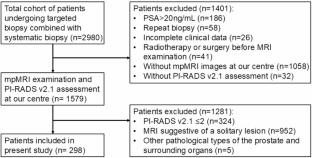
A total of 298 biopsy-naïve patients with 612 lesions (all with Prostate Imaging Reporting and Data System [PI-RADS] v2.1 ≥ 3) underwent cognitive fusion-targeted biopsy (TB) combined with systematic biopsy (SB). Our primary endpoints were to compare the detection rates of PCa and clinically significant PCa (csPCa) across different biopsy strategies (Index lesion-targeted biopsy [ILx] vs. ILx + SLx and ILx + SB vs. ILx + SLx + SB) and to define potential indications for SLx using PI-RADS and PSA density (PSAD). Secondary endpoint was to evaluate the predictive performance of index lesion (IL)- and SL-based multivariate logistic regression (MVA) models for csPCa.
Results
The overall detection rates for PCa and csPCa were 71% and 60%, with ILx + SLx + SB as the gold standard. Adding SLx to ILx modestly increased detection rates for PCa (63% vs. 65%, P = 0.016) and csPCa (55% vs. 58%, P = 0.004), but offered no significant advantage over ILx + SB. Stratification by PI-RADS and PSAD revealed that focusing on 80% intermediate- to high-risk lesions detected 39% csPCa while reducing 20% low-risk SLx at the cost of missing 1.6% csPCa. IL-based models outperformed SL-based models in predicting csPCa (Hosmer-Lemeshow P = 0.653 vs. 0.461).
Conclusion
SLx provides limited benefit in csPCa detection when ILx and SB have already been performed. Combining PI-RADS scores and PSAD helps identify patients who could benefit from SLx while avoiding unnecessary procedures in low-risk cases.
期刊介绍:
Abdominal Radiology seeks to meet the professional needs of the abdominal radiologist by publishing clinically pertinent original, review and practice related articles on the gastrointestinal and genitourinary tracts and abdominal interventional and radiologic procedures. Case reports are generally not accepted unless they are the first report of a new disease or condition, or part of a special solicited section.
Reasons to Publish Your Article in Abdominal Radiology:
· Official journal of the Society of Abdominal Radiology (SAR)
· Published in Cooperation with:
European Society of Gastrointestinal and Abdominal Radiology (ESGAR)
European Society of Urogenital Radiology (ESUR)
Asian Society of Abdominal Radiology (ASAR)
· Efficient handling and Expeditious review
· Author feedback is provided in a mentoring style
· Global readership
· Readers can earn CME credits



 京公网安备 11010802042870号
京ICP备2023020795号-1
京公网安备 11010802042870号
京ICP备2023020795号-1

 分享
分享
 求助内容:
求助内容: 应助结果提醒方式:
 扫码关注我们
