Kingsley O. Ojima, Sachini H. Dayarathne, Michael T. Kelly, Bin Zhao
{"title":"Quaternary Ammonium-Containing Polyelectrolyte Brush Particles for Removal of Perrhenate Anion From Water: Effect of N-Substituents","authors":"Kingsley O. Ojima, Sachini H. Dayarathne, Michael T. Kelly, Bin Zhao","doi":"10.1002/marc.202401087","DOIUrl":null,"url":null,"abstract":"<p>Radioactive pertechnetate (TcO<sub>4</sub><sup>−</sup>) from the nuclear fuel cycle presents a severe risk to the environment due to its large solubility in water and non-complexing nature. By utilizing the chaotropic properties of TcO<sub>4</sub><sup>−</sup> and its nonradioactive surrogate perrhenate (ReO<sub>4</sub><sup>−</sup>) and the principle of chaotropic interactions, a series of quaternary ammonium-containing polyelectrolyte brush-grafted silica particles are designed and applied to remove ReO<sub>4</sub><sup>−</sup> from water. These cationic hairy particles (HPs) are synthesized by surface-initiated atom transfer radical polymerization of 2-(<i>N</i>,<i>N</i>-dimethylamino)ethyl methacrylate and subsequent quaternization with various halogen compounds. Dynamic light scattering (DLS) studies showed that the HPs with sufficiently long <i>N</i>-alkyl and <i>N</i>-benzyl substituents underwent sharp size reduction transitions in water when titrated with a KReO<sub>4</sub> solution, indicating strong chaotropic interactions between the brushes and ReO<sub>4</sub><sup>−</sup>. All the HPs exhibited fast adsorption kinetics; the HPs with longer <i>N</i>-alkyl and <i>N</i>-benzyl substituents showed higher capabilities of removing ReO<sub>4</sub><sup>−</sup> than those with shorter <i>N</i>-alkyls. Moreover, the brush particles with longer <i>N</i>-substituents displayed a significantly stronger ability in selective adsorption of ReO<sub>4</sub><sup>−</sup> than the particles with shorter <i>N</i>-substituents in the presence of competing anions, such as F<sup>−</sup>, Cl<sup>−</sup>, NO<sub>3</sub><sup>−</sup>, and SO<sub>4</sub><sup>2−</sup>. This work opens a new avenue to design high-performance adsorbent materials for TcO<sub>4</sub><sup>−</sup> and ReO<sub>4</sub><sup>−</sup>.</p>","PeriodicalId":205,"journal":{"name":"Macromolecular Rapid Communications","volume":"46 10","pages":""},"PeriodicalIF":4.3000,"publicationDate":"2025-02-24","publicationTypes":"Journal Article","fieldsOfStudy":null,"isOpenAccess":false,"openAccessPdf":"","citationCount":"0","resultStr":null,"platform":"Semanticscholar","paperid":null,"PeriodicalName":"Macromolecular Rapid Communications","FirstCategoryId":"92","ListUrlMain":"https://onlinelibrary.wiley.com/doi/10.1002/marc.202401087","RegionNum":3,"RegionCategory":"化学","ArticlePicture":[],"TitleCN":null,"AbstractTextCN":null,"PMCID":null,"EPubDate":"","PubModel":"","JCR":"Q2","JCRName":"POLYMER SCIENCE","Score":null,"Total":0}
引用次数: 0
Abstract
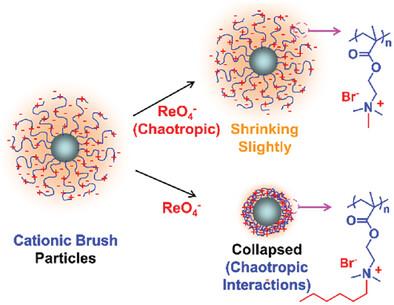
Radioactive pertechnetate (TcO4−) from the nuclear fuel cycle presents a severe risk to the environment due to its large solubility in water and non-complexing nature. By utilizing the chaotropic properties of TcO4− and its nonradioactive surrogate perrhenate (ReO4−) and the principle of chaotropic interactions, a series of quaternary ammonium-containing polyelectrolyte brush-grafted silica particles are designed and applied to remove ReO4− from water. These cationic hairy particles (HPs) are synthesized by surface-initiated atom transfer radical polymerization of 2-(N,N-dimethylamino)ethyl methacrylate and subsequent quaternization with various halogen compounds. Dynamic light scattering (DLS) studies showed that the HPs with sufficiently long N-alkyl and N-benzyl substituents underwent sharp size reduction transitions in water when titrated with a KReO4 solution, indicating strong chaotropic interactions between the brushes and ReO4−. All the HPs exhibited fast adsorption kinetics; the HPs with longer N-alkyl and N-benzyl substituents showed higher capabilities of removing ReO4− than those with shorter N-alkyls. Moreover, the brush particles with longer N-substituents displayed a significantly stronger ability in selective adsorption of ReO4− than the particles with shorter N-substituents in the presence of competing anions, such as F−, Cl−, NO3−, and SO42−. This work opens a new avenue to design high-performance adsorbent materials for TcO4− and ReO4−.
期刊介绍:
Macromolecular Rapid Communications publishes original research in polymer science, ranging from chemistry and physics of polymers to polymers in materials science and life sciences.



 京公网安备 11010802042870号
京ICP备2023020795号-1
京公网安备 11010802042870号
京ICP备2023020795号-1

 分享
分享
 求助内容:
求助内容: 应助结果提醒方式:
 扫码关注我们
