{"title":"Determination of iodide in concentrated chloride springs by reversed-phase high-performance liquid chromatography with ultraviolet detection","authors":"Tomoko Kemmei, Azusa Yudo, Shuji Kodama, Atsushi Yamamoto, Yoshinori Inoue, Shigehiro Kagaya, Kazuichi Hayakawa","doi":"10.1007/s44211-025-00732-w","DOIUrl":null,"url":null,"abstract":"<div><p>We developed a convenient and simple reversed-phase high-performance liquid chromatographic (RP-HPLC) method for analysis of iodide in concentrated chloride springs. Using a C18 column, the iodide and chloride peaks were well separated. Setting the wavelength at 240 nm allows direct ultraviolet (UV) detection of iodide without any UV or Schlieren effect due to the high chloride concentration. The high ionic strength of spring samples containing high levels of sodium chloride broadens the iodide peak. Iodide was quantified based on the peak areas of standard solutions of iodide, in which 100 mM sodium chloride was added to match the saline matrixes with the samples. The detection limit of iodide at a signal-to-noise ratio of 3 was 0.0003 mM. The detector response was linear over the concentration ranges of 0.001–0.1 mM. The proposed RP-HPLC/UV method was successfully applied to determine iodide in some concentrated chloride spring samples.</p><h3>Graphical abstract</h3><div><figure><div><div><picture><source><img></source></picture></div></div></figure></div></div>","PeriodicalId":7802,"journal":{"name":"Analytical Sciences","volume":"41 6","pages":"885 - 890"},"PeriodicalIF":2.0000,"publicationDate":"2025-02-23","publicationTypes":"Journal Article","fieldsOfStudy":null,"isOpenAccess":false,"openAccessPdf":"","citationCount":"0","resultStr":null,"platform":"Semanticscholar","paperid":null,"PeriodicalName":"Analytical Sciences","FirstCategoryId":"92","ListUrlMain":"https://link.springer.com/article/10.1007/s44211-025-00732-w","RegionNum":4,"RegionCategory":"化学","ArticlePicture":[],"TitleCN":null,"AbstractTextCN":null,"PMCID":null,"EPubDate":"","PubModel":"","JCR":"Q3","JCRName":"CHEMISTRY, ANALYTICAL","Score":null,"Total":0}
引用次数: 0
Abstract
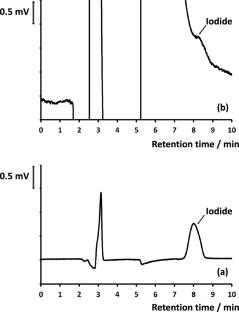
We developed a convenient and simple reversed-phase high-performance liquid chromatographic (RP-HPLC) method for analysis of iodide in concentrated chloride springs. Using a C18 column, the iodide and chloride peaks were well separated. Setting the wavelength at 240 nm allows direct ultraviolet (UV) detection of iodide without any UV or Schlieren effect due to the high chloride concentration. The high ionic strength of spring samples containing high levels of sodium chloride broadens the iodide peak. Iodide was quantified based on the peak areas of standard solutions of iodide, in which 100 mM sodium chloride was added to match the saline matrixes with the samples. The detection limit of iodide at a signal-to-noise ratio of 3 was 0.0003 mM. The detector response was linear over the concentration ranges of 0.001–0.1 mM. The proposed RP-HPLC/UV method was successfully applied to determine iodide in some concentrated chloride spring samples.
期刊介绍:
Analytical Sciences is an international journal published monthly by The Japan Society for Analytical Chemistry. The journal publishes papers on all aspects of the theory and practice of analytical sciences, including fundamental and applied, inorganic and organic, wet chemical and instrumental methods.
This publication is supported in part by the Grant-in-Aid for Publication of Scientific Research Result of the Japanese Ministry of Education, Culture, Sports, Science and Technology.



 京公网安备 11010802042870号
京ICP备2023020795号-1
京公网安备 11010802042870号
京ICP备2023020795号-1

 分享
分享
 求助内容:
求助内容: 应助结果提醒方式:
 扫码关注我们
