Francesco Di Pierro, Fazle Rabbani, Meherullah Tareen, Roohi Nigar, Amjad Khan, Nicola Zerbinati, Maria L Tanda, Massimiliano Cazzaniga, Alexander Bertuccioli, Paolo Falasca, Gabriele Damiani, Nicola Villanova
{"title":"Potential pharmacological effect of Quercetin Phytosome™ in the management of hyperuricemia: results from real-life clinical studies.","authors":"Francesco Di Pierro, Fazle Rabbani, Meherullah Tareen, Roohi Nigar, Amjad Khan, Nicola Zerbinati, Maria L Tanda, Massimiliano Cazzaniga, Alexander Bertuccioli, Paolo Falasca, Gabriele Damiani, Nicola Villanova","doi":"10.3389/fnut.2025.1519459","DOIUrl":null,"url":null,"abstract":"<p><strong>Background: </strong>Hyperuricemia is associated with several metabolic and cardiovascular disorders, and traditional treatments, such as xanthine oxidase (XO) inhibitors, often have limitations, such as severe hypersensitivity reactions or ineffectiveness in achieving target serum urate levels in some patients. Quercetin, a naturally occurring flavonoid, has shown potential as a hypouricemic agent through XO inhibition.</p><p><strong>Objective: </strong>This study aims to evaluate the potential hypouricemic effect of Quercetin Phytosome™ (QP) supplementation across three cohort studies involving healthy adults with various metabolic health profiles, exploring its potential as a safe, effective intervention for hyperuricemia.</p><p><strong>Methods: </strong>Clinical data collected in various clinics in Italy between September 2021 and April 2024 under real-life clinical settings from three distinct cohort studies, were analyzed. Cohort 1 consisted of 164 healthy participants (87 QP-treated, 77 probiotic <i>Streptococcus salivarius (S. salivarius)</i> K12-treated) who were monitored for 90 days. Cohort 2 included 22 mildly hyperuricemic adults with metabolic disorders receiving QP, while Cohort 3 comprised 64 obese adults with hypercholesterolemia, further divided into moderately hyperuricemic QP-treated group (<i>n</i> = 20), a moderately hyperuricemic Berberine Phytosome™ and monacolins (BM)-treated group (<i>n</i> = 22), and a normouricemic BM-treated group (<i>n</i> = 22). QP was administered at 400 mg of quercetin daily in all cohorts. Primary endpoints were reductions in serum uric acid levels, while secondary outcomes included effects on lipid profile, glycemia, liver enzymes, and treatment tolerability.</p><p><strong>Results: </strong>In Cohort 1, QP significantly reduced uric acid levels by 15.2% in males and 13.8% in females, with no significant changes observed in the probiotic group. Cohort 2 showed a significant 13.1% reduction in uric acid (<i>p</i> < 0.01) and a concurrent 10.2% reduction in triglycerides (<i>p</i> < 0.05). In Cohort 3, QP led to a 13.7% decrease in uric acid and a 20.8% reduction in triglycerides (<i>p</i> < 0.01), with no significant uric acid changes in the BM-treated group. QP was well tolerated across all cohorts, with minimal, transient side effects.</p><p><strong>Conclusion: </strong>QP supplementation demonstrates a significant hypouricemic effect. Additionally, triglyceride-lowering benefits were evident, particularly in metabolically compromised individuals (Cohorts 2 and 3), where these effects were statistically significant. With high tolerability, these findings highlight Quercetin Phytosome™'s potential as a safe adjunctive therapy for hyperuricemia management, meriting further investigation in larger, randomized trials to confirm its efficacy and safety.</p><p><strong>Clinical trial registration: </strong>clinicaltrials.gov, identifier NCT06652035.</p>","PeriodicalId":12473,"journal":{"name":"Frontiers in Nutrition","volume":"12 ","pages":"1519459"},"PeriodicalIF":4.0000,"publicationDate":"2025-02-07","publicationTypes":"Journal Article","fieldsOfStudy":null,"isOpenAccess":false,"openAccessPdf":"https://www.ncbi.nlm.nih.gov/pmc/articles/PMC11844220/pdf/","citationCount":"0","resultStr":null,"platform":"Semanticscholar","paperid":null,"PeriodicalName":"Frontiers in Nutrition","FirstCategoryId":"97","ListUrlMain":"https://doi.org/10.3389/fnut.2025.1519459","RegionNum":2,"RegionCategory":"农林科学","ArticlePicture":[],"TitleCN":null,"AbstractTextCN":null,"PMCID":null,"EPubDate":"2025/1/1 0:00:00","PubModel":"eCollection","JCR":"Q2","JCRName":"NUTRITION & DIETETICS","Score":null,"Total":0}
引用次数: 0
Abstract
Background: Hyperuricemia is associated with several metabolic and cardiovascular disorders, and traditional treatments, such as xanthine oxidase (XO) inhibitors, often have limitations, such as severe hypersensitivity reactions or ineffectiveness in achieving target serum urate levels in some patients. Quercetin, a naturally occurring flavonoid, has shown potential as a hypouricemic agent through XO inhibition.
Objective: This study aims to evaluate the potential hypouricemic effect of Quercetin Phytosome™ (QP) supplementation across three cohort studies involving healthy adults with various metabolic health profiles, exploring its potential as a safe, effective intervention for hyperuricemia.
Methods: Clinical data collected in various clinics in Italy between September 2021 and April 2024 under real-life clinical settings from three distinct cohort studies, were analyzed. Cohort 1 consisted of 164 healthy participants (87 QP-treated, 77 probiotic Streptococcus salivarius (S. salivarius) K12-treated) who were monitored for 90 days. Cohort 2 included 22 mildly hyperuricemic adults with metabolic disorders receiving QP, while Cohort 3 comprised 64 obese adults with hypercholesterolemia, further divided into moderately hyperuricemic QP-treated group (n = 20), a moderately hyperuricemic Berberine Phytosome™ and monacolins (BM)-treated group (n = 22), and a normouricemic BM-treated group (n = 22). QP was administered at 400 mg of quercetin daily in all cohorts. Primary endpoints were reductions in serum uric acid levels, while secondary outcomes included effects on lipid profile, glycemia, liver enzymes, and treatment tolerability.
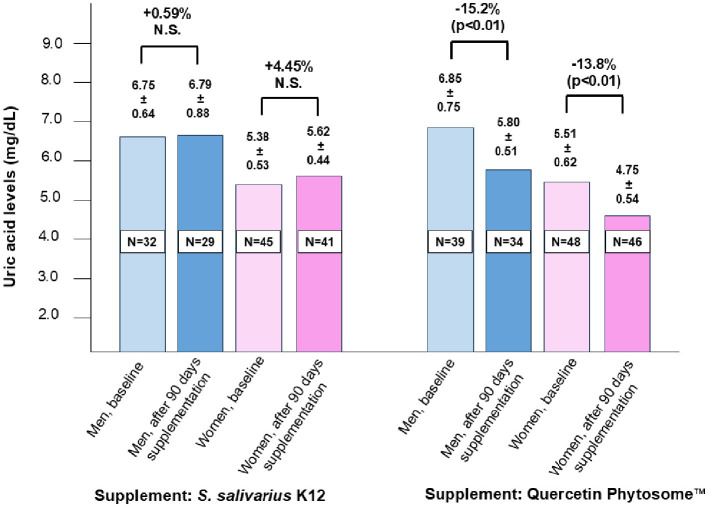
Results: In Cohort 1, QP significantly reduced uric acid levels by 15.2% in males and 13.8% in females, with no significant changes observed in the probiotic group. Cohort 2 showed a significant 13.1% reduction in uric acid (p < 0.01) and a concurrent 10.2% reduction in triglycerides (p < 0.05). In Cohort 3, QP led to a 13.7% decrease in uric acid and a 20.8% reduction in triglycerides (p < 0.01), with no significant uric acid changes in the BM-treated group. QP was well tolerated across all cohorts, with minimal, transient side effects.
Conclusion: QP supplementation demonstrates a significant hypouricemic effect. Additionally, triglyceride-lowering benefits were evident, particularly in metabolically compromised individuals (Cohorts 2 and 3), where these effects were statistically significant. With high tolerability, these findings highlight Quercetin Phytosome™'s potential as a safe adjunctive therapy for hyperuricemia management, meriting further investigation in larger, randomized trials to confirm its efficacy and safety.
期刊介绍:
No subject pertains more to human life than nutrition. The aim of Frontiers in Nutrition is to integrate major scientific disciplines in this vast field in order to address the most relevant and pertinent questions and developments. Our ambition is to create an integrated podium based on original research, clinical trials, and contemporary reviews to build a reputable knowledge forum in the domains of human health, dietary behaviors, agronomy & 21st century food science. Through the recognized open-access Frontiers platform we welcome manuscripts to our dedicated sections relating to different areas in the field of nutrition with a focus on human health.
Specialty sections in Frontiers in Nutrition include, for example, Clinical Nutrition, Nutrition & Sustainable Diets, Nutrition and Food Science Technology, Nutrition Methodology, Sport & Exercise Nutrition, Food Chemistry, and Nutritional Immunology. Based on the publication of rigorous scientific research, we thrive to achieve a visible impact on the global nutrition agenda addressing the grand challenges of our time, including obesity, malnutrition, hunger, food waste, sustainability and consumer health.



 京公网安备 11010802042870号
京ICP备2023020795号-1
京公网安备 11010802042870号
京ICP备2023020795号-1

 分享
分享
 求助内容:
求助内容: 应助结果提醒方式:
 扫码关注我们
