M Methuen, V F Kukkonen, V Anttonen, S Mikkonen, J Väistö, S Soininen, M Närhi, T A Lakka, A L Suominen, A-M Eloranta
{"title":"Dietary Factors and Dental Caries among Adolescents: Eight-Year Follow-up Study.","authors":"M Methuen, V F Kukkonen, V Anttonen, S Mikkonen, J Väistö, S Soininen, M Närhi, T A Lakka, A L Suominen, A-M Eloranta","doi":"10.1177/23800844251314856","DOIUrl":null,"url":null,"abstract":"<p><strong>Objective: </strong>The aim of this study was to conduct a longitudinal investigation of the associations between changes in dietary factors and changes in caries experience among Finnish children and adolescents participating in the Physical Activity and Nutrition in Children (PANIC) study.</p><p><strong>Methods: </strong>Among 487 children included at baseline at the age of 6 to 8 y, 406 were reexamined at 2-y follow-up and 202 at 8-y follow-up. Food consumption, nutrient intake, and eating frequency were assessed using 4-d food records; diet quality was assessed using the Baltic Sea Diet Score; and eating behavior was evaluated using the Children's and Adult's Eating Behaviour Questionnaires. At baseline and 2-y follow-up, caries findings were recorded using the World Health Organization guidelines and at 8-y follow-up using the International Caries Detection and Assessment System criteria. Generalized linear mixed-effects regression analyses were used.</p><p><strong>Results: </strong>Over 8 y from childhood to adolescence, improved diet quality (β = -0.017, P = 0.046) and increased consumption of butter and butter-oil mixtures (β = -0.009, P = 0.044) were associated with decreased caries experience. Increased number of snacks (β = 0.072, P = 0.032), increased consumption of sour milk products (β = 0.001, P = 0.039) and salty snacks (β = 0.006, P = 0.010), and increased calcium intake (β = 2.41 × 10<sup>-4</sup>, P = 0.022) were associated with increased caries experience. However, the latter association was explained by the consumption of sour milk products (β = 1.88 × 10<sup>-4</sup>, P = 0.090). Increased enjoyment of food was associated with decreased caries experience (β = -0.121, P = 0.046), and increased slowness in eating (β = 0.113, P = 0.051) and food fussiness (β = 0.140, P = 0.009) were associated with increased caries experience.</p><p><strong>Conclusions: </strong>A healthy diet is vital for oral health among children and adolescents. Dietary behaviors developing from childhood to adolescence seem to be associated with caries experience in adolescence. Dietary counseling aimed at improving dental health from childhood to adolescence should include avoiding frequent snacking, strengthening healthy eating behavior, and composing good overall diet quality.Knowledge Transfer Statement:Results of this longitudinal study showed how crucial a healthy diet is for oral health among growing children. Eating behaviors and enjoyment of food play also a role in maintaining good oral health. Research results can be used when planning dietary recommendations and health education for children and adolescents.</p>","PeriodicalId":14783,"journal":{"name":"JDR Clinical & Translational Research","volume":" ","pages":"40-52"},"PeriodicalIF":2.2000,"publicationDate":"2026-01-01","publicationTypes":"Journal Article","fieldsOfStudy":null,"isOpenAccess":false,"openAccessPdf":"https://www.ncbi.nlm.nih.gov/pmc/articles/PMC12634907/pdf/","citationCount":"0","resultStr":null,"platform":"Semanticscholar","paperid":null,"PeriodicalName":"JDR Clinical & Translational Research","FirstCategoryId":"1085","ListUrlMain":"https://doi.org/10.1177/23800844251314856","RegionNum":0,"RegionCategory":null,"ArticlePicture":[],"TitleCN":null,"AbstractTextCN":null,"PMCID":null,"EPubDate":"2025/2/24 0:00:00","PubModel":"Epub","JCR":"Q2","JCRName":"DENTISTRY, ORAL SURGERY & MEDICINE","Score":null,"Total":0}
引用次数: 0
Abstract
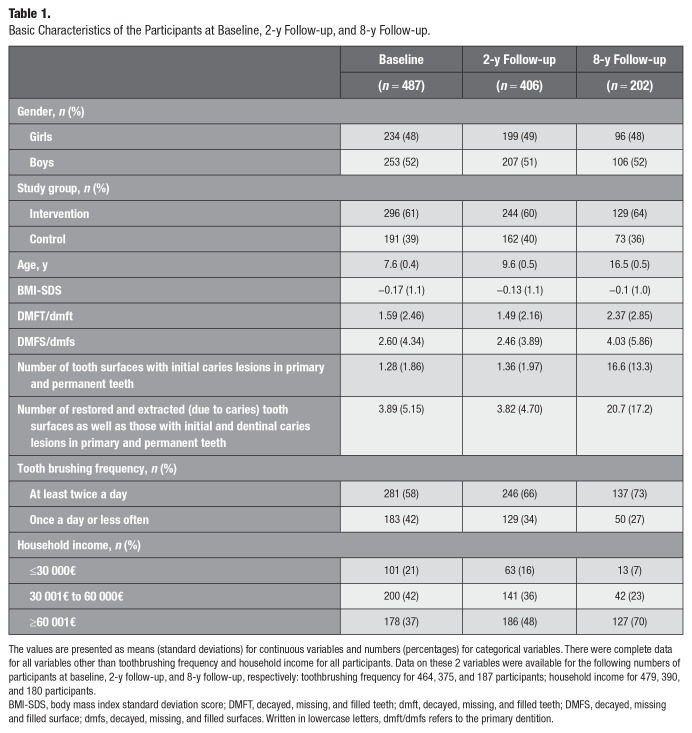
Objective: The aim of this study was to conduct a longitudinal investigation of the associations between changes in dietary factors and changes in caries experience among Finnish children and adolescents participating in the Physical Activity and Nutrition in Children (PANIC) study.
Methods: Among 487 children included at baseline at the age of 6 to 8 y, 406 were reexamined at 2-y follow-up and 202 at 8-y follow-up. Food consumption, nutrient intake, and eating frequency were assessed using 4-d food records; diet quality was assessed using the Baltic Sea Diet Score; and eating behavior was evaluated using the Children's and Adult's Eating Behaviour Questionnaires. At baseline and 2-y follow-up, caries findings were recorded using the World Health Organization guidelines and at 8-y follow-up using the International Caries Detection and Assessment System criteria. Generalized linear mixed-effects regression analyses were used.
Results: Over 8 y from childhood to adolescence, improved diet quality (β = -0.017, P = 0.046) and increased consumption of butter and butter-oil mixtures (β = -0.009, P = 0.044) were associated with decreased caries experience. Increased number of snacks (β = 0.072, P = 0.032), increased consumption of sour milk products (β = 0.001, P = 0.039) and salty snacks (β = 0.006, P = 0.010), and increased calcium intake (β = 2.41 × 10⁻⁴, P = 0.022) were associated with increased caries experience. However, the latter association was explained by the consumption of sour milk products (β = 1.88 × 10⁻⁴, P = 0.090). Increased enjoyment of food was associated with decreased caries experience (β = -0.121, P = 0.046), and increased slowness in eating (β = 0.113, P = 0.051) and food fussiness (β = 0.140, P = 0.009) were associated with increased caries experience.
Conclusions: A healthy diet is vital for oral health among children and adolescents. Dietary behaviors developing from childhood to adolescence seem to be associated with caries experience in adolescence. Dietary counseling aimed at improving dental health from childhood to adolescence should include avoiding frequent snacking, strengthening healthy eating behavior, and composing good overall diet quality.Knowledge Transfer Statement:Results of this longitudinal study showed how crucial a healthy diet is for oral health among growing children. Eating behaviors and enjoyment of food play also a role in maintaining good oral health. Research results can be used when planning dietary recommendations and health education for children and adolescents.
期刊介绍:
JDR Clinical & Translational Research seeks to publish the highest quality research articles on clinical and translational research including all of the dental specialties and implantology. Examples include behavioral sciences, cariology, oral & pharyngeal cancer, disease diagnostics, evidence based health care delivery, human genetics, health services research, periodontal diseases, oral medicine, radiology, and pathology. The JDR Clinical & Translational Research expands on its research content by including high-impact health care and global oral health policy statements and systematic reviews of clinical concepts affecting clinical practice. Unique to the JDR Clinical & Translational Research are advances in clinical and translational medicine articles created to focus on research with an immediate potential to affect clinical therapy outcomes.






 京公网安备 11010802042870号
京ICP备2023020795号-1
京公网安备 11010802042870号
京ICP备2023020795号-1

 分享
分享
 求助内容:
求助内容: 应助结果提醒方式:
 扫码关注我们
