{"title":"Impact of Family Sociodemographics and Mother's Toothbrushing on Australian Preschool Children.","authors":"P Rajesh, D H Ha, L G Do, S K Tadakamadla","doi":"10.1177/23800844251326091","DOIUrl":null,"url":null,"abstract":"<p><strong>Background: </strong>Understanding the predictors of toothbrushing at the 2 distinct preschool age time points will help develop and implement effective strategies specific to children's age.</p><p><strong>Aim: </strong>To examine the effect of a family's sociodemographic status and mothers' oral health behavior on children's toothbrushing frequency at 2 different time points: 2 and 5 y of age.</p><p><strong>Design: </strong>Secondary analysis (cross-sectional) of longitudinal data collected through a cohort study.</p><p><strong>Results: </strong>In children aged 2 y, the likelihood of toothbrushing twice or more per day was higher than their comparative counterparts if their mother's toothbrushing frequency was twice or more per day (odds ratio [OR]: 5.63; 95% confidence interval [CI]: 4.01-7.90), if they were girls (OR: 1.36; 95% CI: 1.04-1.79), if the mother had completed tertiary education (OR: 1.48; 95% CI: 1.01-2.19) or vocational training (OR: 1.54; 95% CI: 1.01-2.33), if the household had 2 adults (OR: 2.48; 95% CI: 1.12-5.50) or 3 or more adults (OR: 2.52; 95% CI: 1.06-5.97), if the total household income was >A$120,000/year (OR: 1.62; 95% CI: 1.03-2.56), if the household had both parents (OR: 2.11; 95 % CI: 1.11-4.02). At the age of 5 y, girls whose mothers brushed their teeth twice or more per day were 1.43 (95 % CI: 1.02-2.02) and 10.53 (95% CI: 7.01-15.80) times more likely to brush their teeth more than twice or more per day than boys whose mothers brushed less than twice per day, respectively.</p><p><strong>Conclusions: </strong>Child sex and mother's toothbrushing were the 2 main factors associated with children's toothbrushing frequency at both ages. In addition, several sociodemographic factors were associated with toothbrushing frequency at 2 y of age.Knowledge Transfer Statement:The results of this study can be used by parents, especially mothers and policy makers, as they can help promote consistent toothbrushing habits in children. This is crucial as it is a preventive measure against oral health issues and cavities. In addition, the research can play a vital role in shaping policies to improve toothbrushing practices among children between the ages of 2 and 5 y.</p>","PeriodicalId":14783,"journal":{"name":"JDR Clinical & Translational Research","volume":" ","pages":"270-279"},"PeriodicalIF":2.2000,"publicationDate":"2026-04-01","publicationTypes":"Journal Article","fieldsOfStudy":null,"isOpenAccess":false,"openAccessPdf":"https://www.ncbi.nlm.nih.gov/pmc/articles/PMC12967373/pdf/","citationCount":"0","resultStr":null,"platform":"Semanticscholar","paperid":null,"PeriodicalName":"JDR Clinical & Translational Research","FirstCategoryId":"1085","ListUrlMain":"https://doi.org/10.1177/23800844251326091","RegionNum":0,"RegionCategory":null,"ArticlePicture":[],"TitleCN":null,"AbstractTextCN":null,"PMCID":null,"EPubDate":"2025/4/3 0:00:00","PubModel":"Epub","JCR":"Q2","JCRName":"DENTISTRY, ORAL SURGERY & MEDICINE","Score":null,"Total":0}
引用次数: 0
Abstract
Background: Understanding the predictors of toothbrushing at the 2 distinct preschool age time points will help develop and implement effective strategies specific to children's age.
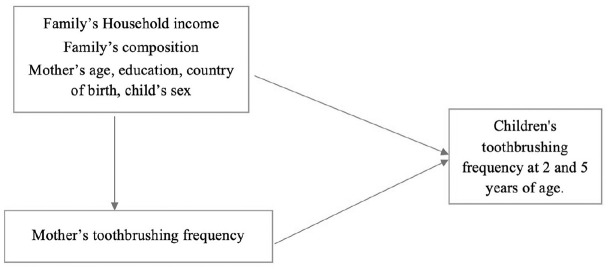
Aim: To examine the effect of a family's sociodemographic status and mothers' oral health behavior on children's toothbrushing frequency at 2 different time points: 2 and 5 y of age.
Design: Secondary analysis (cross-sectional) of longitudinal data collected through a cohort study.
Results: In children aged 2 y, the likelihood of toothbrushing twice or more per day was higher than their comparative counterparts if their mother's toothbrushing frequency was twice or more per day (odds ratio [OR]: 5.63; 95% confidence interval [CI]: 4.01-7.90), if they were girls (OR: 1.36; 95% CI: 1.04-1.79), if the mother had completed tertiary education (OR: 1.48; 95% CI: 1.01-2.19) or vocational training (OR: 1.54; 95% CI: 1.01-2.33), if the household had 2 adults (OR: 2.48; 95% CI: 1.12-5.50) or 3 or more adults (OR: 2.52; 95% CI: 1.06-5.97), if the total household income was >A$120,000/year (OR: 1.62; 95% CI: 1.03-2.56), if the household had both parents (OR: 2.11; 95 % CI: 1.11-4.02). At the age of 5 y, girls whose mothers brushed their teeth twice or more per day were 1.43 (95 % CI: 1.02-2.02) and 10.53 (95% CI: 7.01-15.80) times more likely to brush their teeth more than twice or more per day than boys whose mothers brushed less than twice per day, respectively.
Conclusions: Child sex and mother's toothbrushing were the 2 main factors associated with children's toothbrushing frequency at both ages. In addition, several sociodemographic factors were associated with toothbrushing frequency at 2 y of age.Knowledge Transfer Statement:The results of this study can be used by parents, especially mothers and policy makers, as they can help promote consistent toothbrushing habits in children. This is crucial as it is a preventive measure against oral health issues and cavities. In addition, the research can play a vital role in shaping policies to improve toothbrushing practices among children between the ages of 2 and 5 y.
期刊介绍:
JDR Clinical & Translational Research seeks to publish the highest quality research articles on clinical and translational research including all of the dental specialties and implantology. Examples include behavioral sciences, cariology, oral & pharyngeal cancer, disease diagnostics, evidence based health care delivery, human genetics, health services research, periodontal diseases, oral medicine, radiology, and pathology. The JDR Clinical & Translational Research expands on its research content by including high-impact health care and global oral health policy statements and systematic reviews of clinical concepts affecting clinical practice. Unique to the JDR Clinical & Translational Research are advances in clinical and translational medicine articles created to focus on research with an immediate potential to affect clinical therapy outcomes.





 京公网安备 11010802042870号
京ICP备2023020795号-1
京公网安备 11010802042870号
京ICP备2023020795号-1

 分享
分享
 求助内容:
求助内容: 应助结果提醒方式:
 扫码关注我们
