Şahin Temel MD , Hatice Metin MD , Mehmet Gökhan Gök MD , Recep Civan Yüksel MD , Murat Sungur MD , Emrah Gülmez MD , Gönül Sungur PhD , Kürşat Gündoğan MD
{"title":"Comparative Analysis of Percutaneous Dilatational Tracheotomy and Surgical Tracheotomy in Critically Ill Patients: Outcomes and Complications","authors":"Şahin Temel MD , Hatice Metin MD , Mehmet Gökhan Gök MD , Recep Civan Yüksel MD , Murat Sungur MD , Emrah Gülmez MD , Gönül Sungur PhD , Kürşat Gündoğan MD","doi":"10.1053/j.jvca.2025.02.008","DOIUrl":null,"url":null,"abstract":"<div><h3>Objective</h3><div>To evaluate the outcomes of percutaneous dilatational tracheostomy (PDT) versus surgical tracheostomy (ST) in critically ill patients, focusing on complications, duration of mechanical ventilation (MV), intensive care unit (ICU) length of stay, and mortality.</div></div><div><h3>Design</h3><div>Retrospective trial</div></div><div><h3>Setting</h3><div>Single tertiary center</div></div><div><h3>Participants</h3><div>A total of 119 patients receiving invasive MV in a medical ICU</div></div><div><h3>Interventions</h3><div>PDT (n = 55) or ST (n = 64) methods</div></div><div><h3>Measurements and Main Results</h3><div>The 2 groups showed comparable outcomes in terms of MV duration (36 days for PDT vs 35 days for ST; p = 0.72), ICU stay (43 days for PDT vs 37 days for ST; p = 0.17), and all-cause mortality (71% for PDT vs 64% for ST; p = 0.42). PDT was associated with significantly lower rates of subcutaneous emphysema (0% vs 16%; p = 0.01). Multivariate analysis showed no statistically significant association between tracheostomy technique and ICU mortality or overall complication rates after adjustment for confounders.</div></div><div><h3>Conclusion</h3><div>PDT and ST yield comparable outcomes in critically ill ICU patients, with no significant difference in overall complication rates or mortality. The fewer specific complications for PDT, such as subcutaneous emphysema, highlight its advantages in suitable cases. Individualized patient assessment remains crucial, and further studies are needed to refine tracheostomy practices.</div></div>","PeriodicalId":15176,"journal":{"name":"Journal of cardiothoracic and vascular anesthesia","volume":"39 5","pages":"Pages 1214-1220"},"PeriodicalIF":2.1000,"publicationDate":"2025-02-06","publicationTypes":"Journal Article","fieldsOfStudy":null,"isOpenAccess":false,"openAccessPdf":"","citationCount":"0","resultStr":null,"platform":"Semanticscholar","paperid":null,"PeriodicalName":"Journal of cardiothoracic and vascular anesthesia","FirstCategoryId":"3","ListUrlMain":"https://www.sciencedirect.com/science/article/pii/S1053077025001193","RegionNum":4,"RegionCategory":"医学","ArticlePicture":[],"TitleCN":null,"AbstractTextCN":null,"PMCID":null,"EPubDate":"","PubModel":"","JCR":"Q2","JCRName":"ANESTHESIOLOGY","Score":null,"Total":0}
引用次数: 0
Abstract
Objective
To evaluate the outcomes of percutaneous dilatational tracheostomy (PDT) versus surgical tracheostomy (ST) in critically ill patients, focusing on complications, duration of mechanical ventilation (MV), intensive care unit (ICU) length of stay, and mortality.
Design
Retrospective trial
Setting
Single tertiary center
Participants
A total of 119 patients receiving invasive MV in a medical ICU
Interventions
PDT (n = 55) or ST (n = 64) methods
Measurements and Main Results
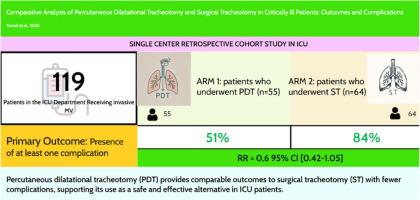
The 2 groups showed comparable outcomes in terms of MV duration (36 days for PDT vs 35 days for ST; p = 0.72), ICU stay (43 days for PDT vs 37 days for ST; p = 0.17), and all-cause mortality (71% for PDT vs 64% for ST; p = 0.42). PDT was associated with significantly lower rates of subcutaneous emphysema (0% vs 16%; p = 0.01). Multivariate analysis showed no statistically significant association between tracheostomy technique and ICU mortality or overall complication rates after adjustment for confounders.
Conclusion
PDT and ST yield comparable outcomes in critically ill ICU patients, with no significant difference in overall complication rates or mortality. The fewer specific complications for PDT, such as subcutaneous emphysema, highlight its advantages in suitable cases. Individualized patient assessment remains crucial, and further studies are needed to refine tracheostomy practices.
期刊介绍:
The Journal of Cardiothoracic and Vascular Anesthesia is primarily aimed at anesthesiologists who deal with patients undergoing cardiac, thoracic or vascular surgical procedures. JCVA features a multidisciplinary approach, with contributions from cardiac, vascular and thoracic surgeons, cardiologists, and other related specialists. Emphasis is placed on rapid publication of clinically relevant material.



 京公网安备 11010802042870号
京ICP备2023020795号-1
京公网安备 11010802042870号
京ICP备2023020795号-1

 分享
分享
 求助内容:
求助内容: 应助结果提醒方式:
 扫码关注我们
