{"title":"Suspected Calvarial Hyperostosis Syndrome Causing Different Ophthalmological Signs in Two Young Labrador Retrievers-Case Report.","authors":"Andrea Steinmetz, Stefan Kohl","doi":"10.1111/vop.70007","DOIUrl":null,"url":null,"abstract":"<p><strong>Objective: </strong>To describe calvarial hyperostosis syndrome (CHS) as a potential and unusual cause of exophthalmos or epiphora in young dogs.</p><p><strong>Animals studied: </strong>A nine-month-old female intact (case 1) and a two-year-old male intact Labrador Retriever (case 2).</p><p><strong>Procedures: </strong>Patient history, including previous treatments, was documented. Both cases underwent physical and ophthalmological examinations, computed Tomography (CT), and histopathological analysis. Additional dacryocystorhinography (DCR) was performed in case 2.</p><p><strong>Results: </strong>Lateral exophthalmos of the left eye was the primary clinical sign in case 1. In case 2, serous lacrimal discharge was observed without other signs of ocular irritation. A slightly thickened and firm area distal to the medial canthus of the right eye was also noted. In this case, Jones 1 test on the right side was negative, whereas Jones test 2 revealed increased resistance when flushing the nasolacrimal system. CT imaging in both cases identified solid, smoothly marginated new bone formation. In case 1, this involved the left frontal bone, occipital bone, parietal bone, and temporal bone. In case 2, the new bone formation affected the right lacrimal bone and frontal process of the maxillary bone, leading to encasement and narrowing of the nasolacrimal duct (NLD). Histopathological analysis revealed active bone remodeling with osteoblasts in case 1, while case 2 demonstrated regularly differentiated trabecular lamellar bone with intertrabecular spaces. No evidence of neoplasia or osteomyelitis was observed in either case. Taken together, these findings strongly support a diagnosis of CHS in both cases.</p><p><strong>Conclusions: </strong>CHS involving flat bones can present as exophthalmos or epiphora and should be considered in the differential diagnoses of these conditions, particularly in young dogs.</p>","PeriodicalId":23836,"journal":{"name":"Veterinary ophthalmology","volume":" ","pages":"e70007"},"PeriodicalIF":1.3000,"publicationDate":"2026-01-01","publicationTypes":"Journal Article","fieldsOfStudy":null,"isOpenAccess":false,"openAccessPdf":"https://www.ncbi.nlm.nih.gov/pmc/articles/PMC12757434/pdf/","citationCount":"0","resultStr":null,"platform":"Semanticscholar","paperid":null,"PeriodicalName":"Veterinary ophthalmology","FirstCategoryId":"97","ListUrlMain":"https://doi.org/10.1111/vop.70007","RegionNum":4,"RegionCategory":"农林科学","ArticlePicture":[],"TitleCN":null,"AbstractTextCN":null,"PMCID":null,"EPubDate":"2025/2/23 0:00:00","PubModel":"Epub","JCR":"Q2","JCRName":"VETERINARY SCIENCES","Score":null,"Total":0}
引用次数: 0
Abstract
Objective: To describe calvarial hyperostosis syndrome (CHS) as a potential and unusual cause of exophthalmos or epiphora in young dogs.
Animals studied: A nine-month-old female intact (case 1) and a two-year-old male intact Labrador Retriever (case 2).
Procedures: Patient history, including previous treatments, was documented. Both cases underwent physical and ophthalmological examinations, computed Tomography (CT), and histopathological analysis. Additional dacryocystorhinography (DCR) was performed in case 2.
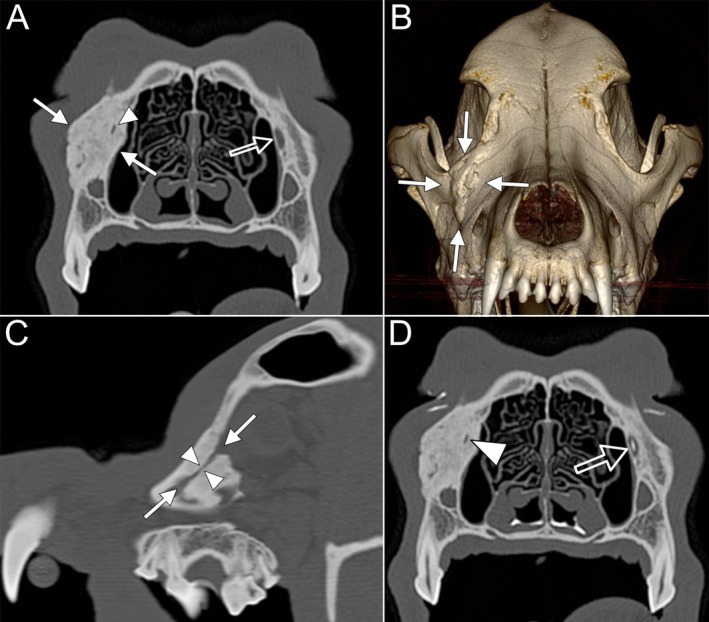
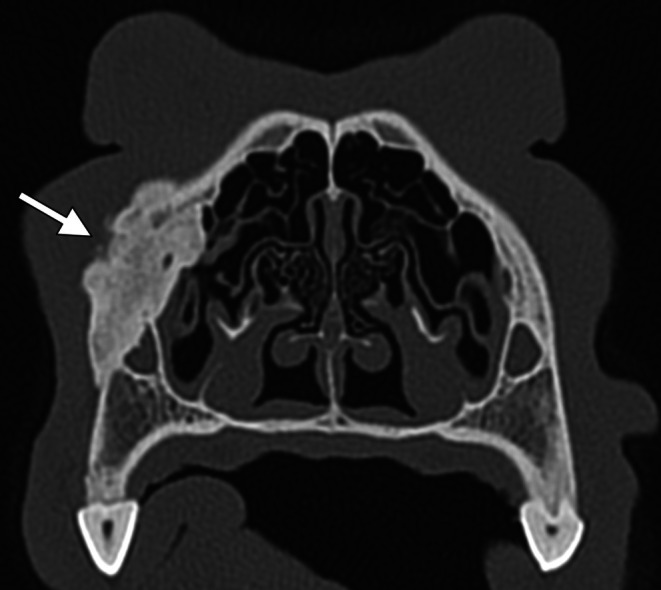
Results: Lateral exophthalmos of the left eye was the primary clinical sign in case 1. In case 2, serous lacrimal discharge was observed without other signs of ocular irritation. A slightly thickened and firm area distal to the medial canthus of the right eye was also noted. In this case, Jones 1 test on the right side was negative, whereas Jones test 2 revealed increased resistance when flushing the nasolacrimal system. CT imaging in both cases identified solid, smoothly marginated new bone formation. In case 1, this involved the left frontal bone, occipital bone, parietal bone, and temporal bone. In case 2, the new bone formation affected the right lacrimal bone and frontal process of the maxillary bone, leading to encasement and narrowing of the nasolacrimal duct (NLD). Histopathological analysis revealed active bone remodeling with osteoblasts in case 1, while case 2 demonstrated regularly differentiated trabecular lamellar bone with intertrabecular spaces. No evidence of neoplasia or osteomyelitis was observed in either case. Taken together, these findings strongly support a diagnosis of CHS in both cases.
Conclusions: CHS involving flat bones can present as exophthalmos or epiphora and should be considered in the differential diagnoses of these conditions, particularly in young dogs.
期刊介绍:
Veterinary Ophthalmology is a peer-reviewed, international journal that welcomes submission of manuscripts directed towards academic researchers of veterinary ophthalmology, specialists and general practitioners with a strong ophthalmology interest. Articles include those relating to all aspects of:
Clinical and investigational veterinary and comparative ophthalmology;
Prospective and retrospective studies or reviews of naturally occurring ocular disease in veterinary species;
Experimental models of both animal and human ocular disease in veterinary species;
Anatomic studies of the animal eye;
Physiological studies of the animal eye;
Pharmacological studies of the animal eye.





 京公网安备 11010802042870号
京ICP备2023020795号-1
京公网安备 11010802042870号
京ICP备2023020795号-1

 分享
分享
 求助内容:
求助内容: 应助结果提醒方式:
 扫码关注我们
