Lorenza Mistura , Cinzia Le Donne , Laura D'Addezio , Marika Ferrari , Francisco Javier Comendador , Raffaela Piccinelli , Deborah Martone , Stefania Sette , Giovina Catasta , Aida Turrini , IV SCAI field work team
{"title":"The Italian IV SCAI dietary survey: Main results on food consumption","authors":"Lorenza Mistura , Cinzia Le Donne , Laura D'Addezio , Marika Ferrari , Francisco Javier Comendador , Raffaela Piccinelli , Deborah Martone , Stefania Sette , Giovina Catasta , Aida Turrini , IV SCAI field work team","doi":"10.1016/j.numecd.2025.103863","DOIUrl":null,"url":null,"abstract":"<div><h3>Background and aims</h3><div>The food consumption surveys, conducted for over 30 years by the CREA Research Centre for Food and Nutrition, are the most reliable source of data to evaluate the food consumption intake and dietary patterns of the Italian population. The fourth and most recent survey (IV SCAI 2017–2020), was carried out as part of the pan-European framework ‘EU Menu’, according to the harmonized methods recommended by European Food Safety Authority (EFSA). The current paper aims to present its main results in terms of food group consumption.</div></div><div><h3>Methods and results</h3><div>The sample of IV SCAI was stratified by geographical areas and included 1969 individuals aged 3 months to 74 years living in Italy. Dietary assessment was based on food diaries for children, and 24h recalls for adolescents, adults, and elderly, for both techniques on two non-consecutive days. The most consumed food groups were: <em>Milk</em> and <em>Cereals</em>, followed by <em>Fruit</em>, <em>Vegetables</em>, and <em>Meat</em>. At the subgroup level, bread was the most consumed cereal product in terms of quantity (70 g/day), followed by pasta (79 % of consumers; 49 g/day). Only 39 % of individuals had an adequate fruit and vegetable consumption according to the latest World Health Organization (WHO) recommendations, although this percentage increased in adults and the elderly (43 %, and 73 % respectively). Consumption of red and processed meat was also not in line with international recommendations, being slightly higher mainly in adults and adolescents with a mean consumption of 83 g/day and 100 g/day respectively, compared to the WHO recommendation not to exceed 70 g/day.</div></div><div><h3>Conclusion</h3><div>The detailed dietary data collected in IV SCAI are a fundamental evidence platform supporting public health programs, a reliable reference to guide nutritional policies and monitoring diet in the coming years.</div></div>","PeriodicalId":49722,"journal":{"name":"Nutrition Metabolism and Cardiovascular Diseases","volume":"35 7","pages":"Article 103863"},"PeriodicalIF":3.7000,"publicationDate":"2025-01-28","publicationTypes":"Journal Article","fieldsOfStudy":null,"isOpenAccess":false,"openAccessPdf":"","citationCount":"0","resultStr":null,"platform":"Semanticscholar","paperid":null,"PeriodicalName":"Nutrition Metabolism and Cardiovascular Diseases","FirstCategoryId":"3","ListUrlMain":"https://www.sciencedirect.com/science/article/pii/S0939475325000171","RegionNum":3,"RegionCategory":"医学","ArticlePicture":[],"TitleCN":null,"AbstractTextCN":null,"PMCID":null,"EPubDate":"","PubModel":"","JCR":"Q2","JCRName":"CARDIAC & CARDIOVASCULAR SYSTEMS","Score":null,"Total":0}
引用次数: 0
Abstract
Background and aims
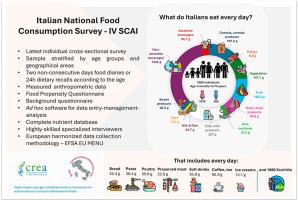
The food consumption surveys, conducted for over 30 years by the CREA Research Centre for Food and Nutrition, are the most reliable source of data to evaluate the food consumption intake and dietary patterns of the Italian population. The fourth and most recent survey (IV SCAI 2017–2020), was carried out as part of the pan-European framework ‘EU Menu’, according to the harmonized methods recommended by European Food Safety Authority (EFSA). The current paper aims to present its main results in terms of food group consumption.
Methods and results
The sample of IV SCAI was stratified by geographical areas and included 1969 individuals aged 3 months to 74 years living in Italy. Dietary assessment was based on food diaries for children, and 24h recalls for adolescents, adults, and elderly, for both techniques on two non-consecutive days. The most consumed food groups were: Milk and Cereals, followed by Fruit, Vegetables, and Meat. At the subgroup level, bread was the most consumed cereal product in terms of quantity (70 g/day), followed by pasta (79 % of consumers; 49 g/day). Only 39 % of individuals had an adequate fruit and vegetable consumption according to the latest World Health Organization (WHO) recommendations, although this percentage increased in adults and the elderly (43 %, and 73 % respectively). Consumption of red and processed meat was also not in line with international recommendations, being slightly higher mainly in adults and adolescents with a mean consumption of 83 g/day and 100 g/day respectively, compared to the WHO recommendation not to exceed 70 g/day.
Conclusion
The detailed dietary data collected in IV SCAI are a fundamental evidence platform supporting public health programs, a reliable reference to guide nutritional policies and monitoring diet in the coming years.
期刊介绍:
Nutrition, Metabolism & Cardiovascular Diseases is a forum designed to focus on the powerful interplay between nutritional and metabolic alterations, and cardiovascular disorders. It aims to be a highly qualified tool to help refine strategies against the nutrition-related epidemics of metabolic and cardiovascular diseases. By presenting original clinical and experimental findings, it introduces readers and authors into a rapidly developing area of clinical and preventive medicine, including also vascular biology. Of particular concern are the origins, the mechanisms and the means to prevent and control diabetes, atherosclerosis, hypertension, and other nutrition-related diseases.



 京公网安备 11010802042870号
京ICP备2023020795号-1
京公网安备 11010802042870号
京ICP备2023020795号-1

 分享
分享
 求助内容:
求助内容: 应助结果提醒方式:
 扫码关注我们
