{"title":"Revisiting light-flavor diquarks in the inverse matrix method of QCD sum rules","authors":"Halil Mutuk","doi":"10.1103/physrevd.111.034035","DOIUrl":null,"url":null,"abstract":"This study reexamines the spectroscopic parameters of light-flavor diquarks within the framework of quantum chromodynamics sum rules (QCDSR) using the inverse matrix method. Conventional QCDSR analyses are based on assumptions such as quark-hadron duality and continuum models, which introduce a degree of systematic uncertainty. The inverse matrix method circumvents these assumptions by reformulating the problem as an inverse integral equation and expanding the unknown spectral density using orthogonal Laguerre polynomials. This method allows for a direct determination of spectral densities, thereby enhancing the precision of predictions regarding resonance masses and decay constants. By employing this methodology with regard to light-flavor diquarks (s</a:mi>q</a:mi></a:mrow></a:math> and <c:math xmlns:c=\"http://www.w3.org/1998/Math/MathML\" display=\"inline\"><c:mi>u</c:mi><c:mi>d</c:mi></c:math>), it is possible to extract the associated masses and decay constants. The results indicate that the masses of diquarks with quantum numbers <e:math xmlns:e=\"http://www.w3.org/1998/Math/MathML\" display=\"inline\"><e:msup><e:mi>J</e:mi><e:mi>P</e:mi></e:msup><e:mo>=</e:mo><e:msup><e:mn>0</e:mn><e:mo>+</e:mo></e:msup></e:math> and <g:math xmlns:g=\"http://www.w3.org/1998/Math/MathML\" display=\"inline\"><g:msup><g:mi>J</g:mi><g:mi>P</g:mi></g:msup><g:mo>=</g:mo><g:msup><g:mn>0</g:mn><g:mo>−</g:mo></g:msup></g:math> are nearly degenerate. We compare our results regarding masses and decay constants with those of other theoretical predictions, which could prove a useful complementary tool in interpretation. Our results are consistent with those in the literature and can be shown as evidence for the consistency of the method. The results achieved in this study highlight the potential of the inverse matrix method as a robust tool for exploring nonperturbative QCD phenomena and elucidating the internal structure of exotic hadronic systems. <jats:supplementary-material> <jats:copyright-statement>Published by the American Physical Society</jats:copyright-statement> <jats:copyright-year>2025</jats:copyright-year> </jats:permissions> </jats:supplementary-material>","PeriodicalId":20167,"journal":{"name":"Physical Review D","volume":"48 1","pages":""},"PeriodicalIF":5.3000,"publicationDate":"2025-02-24","publicationTypes":"Journal Article","fieldsOfStudy":null,"isOpenAccess":false,"openAccessPdf":"","citationCount":"0","resultStr":null,"platform":"Semanticscholar","paperid":null,"PeriodicalName":"Physical Review D","FirstCategoryId":"101","ListUrlMain":"https://doi.org/10.1103/physrevd.111.034035","RegionNum":2,"RegionCategory":"物理与天体物理","ArticlePicture":[],"TitleCN":null,"AbstractTextCN":null,"PMCID":null,"EPubDate":"","PubModel":"","JCR":"Q1","JCRName":"Physics and Astronomy","Score":null,"Total":0}
引用次数: 0
Abstract
This study reexamines the spectroscopic parameters of light-flavor diquarks within the framework of quantum chromodynamics sum rules (QCDSR) using the inverse matrix method. Conventional QCDSR analyses are based on assumptions such as quark-hadron duality and continuum models, which introduce a degree of systematic uncertainty. The inverse matrix method circumvents these assumptions by reformulating the problem as an inverse integral equation and expanding the unknown spectral density using orthogonal Laguerre polynomials. This method allows for a direct determination of spectral densities, thereby enhancing the precision of predictions regarding resonance masses and decay constants. By employing this methodology with regard to light-flavor diquarks (sq and ud), it is possible to extract the associated masses and decay constants. The results indicate that the masses of diquarks with quantum numbers JP=0+ and JP=0− are nearly degenerate. We compare our results regarding masses and decay constants with those of other theoretical predictions, which could prove a useful complementary tool in interpretation. Our results are consistent with those in the literature and can be shown as evidence for the consistency of the method. The results achieved in this study highlight the potential of the inverse matrix method as a robust tool for exploring nonperturbative QCD phenomena and elucidating the internal structure of exotic hadronic systems. Published by the American Physical Society2025
期刊介绍:
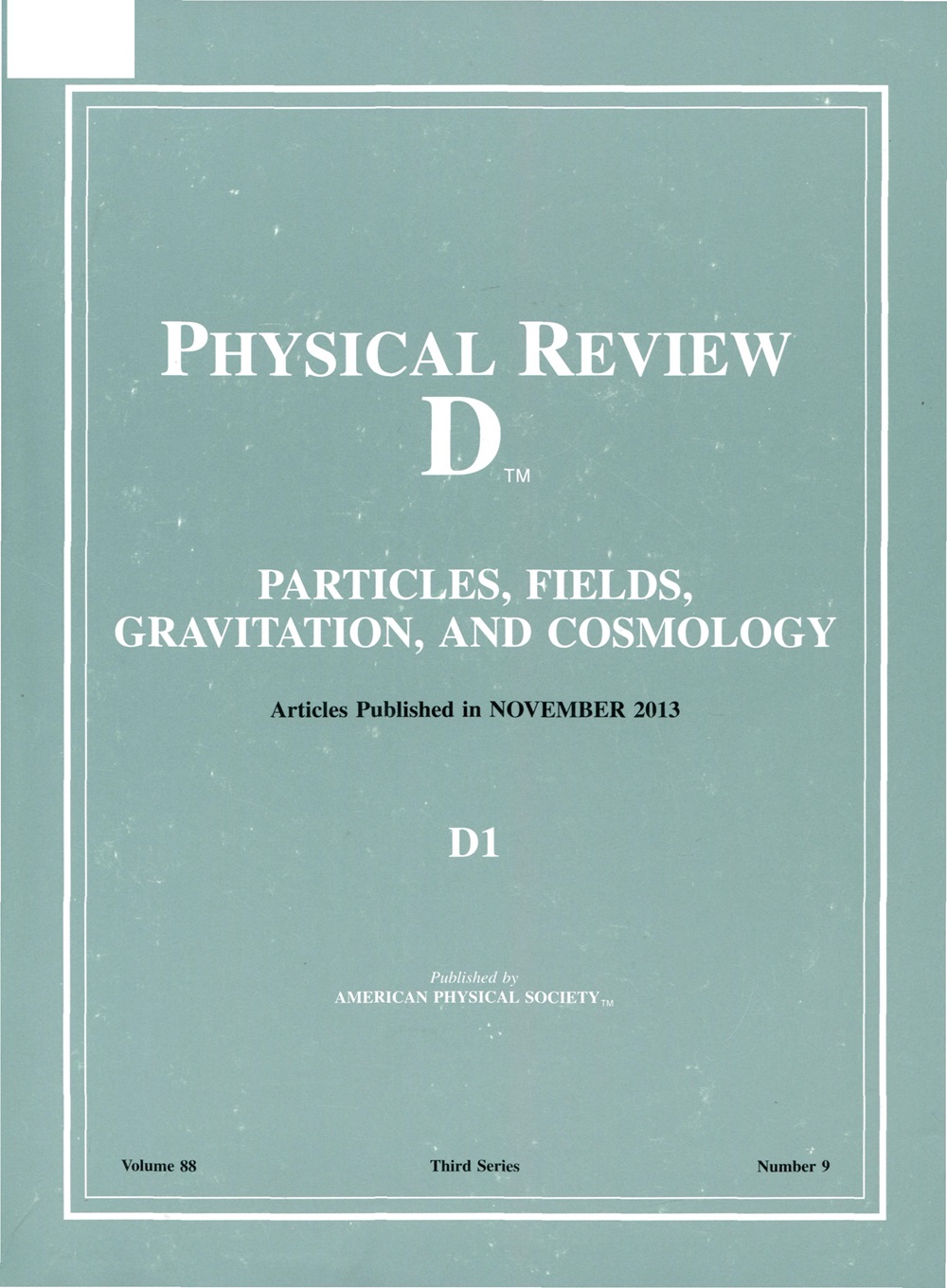
Physical Review D (PRD) is a leading journal in elementary particle physics, field theory, gravitation, and cosmology and is one of the top-cited journals in high-energy physics.
PRD covers experimental and theoretical results in all aspects of particle physics, field theory, gravitation and cosmology, including:
Particle physics experiments,
Electroweak interactions,
Strong interactions,
Lattice field theories, lattice QCD,
Beyond the standard model physics,
Phenomenological aspects of field theory, general methods,
Gravity, cosmology, cosmic rays,
Astrophysics and astroparticle physics,
General relativity,
Formal aspects of field theory, field theory in curved space,
String theory, quantum gravity, gauge/gravity duality.



 京公网安备 11010802042870号
京ICP备2023020795号-1
京公网安备 11010802042870号
京ICP备2023020795号-1

 分享
分享
 求助内容:
求助内容: 应助结果提醒方式:
 扫码关注我们
