Subhasis Das, Chandra Prakash Tiwari, Ganapati D. Yadav
{"title":"Sustainable Ethanol Production via CO2 Hydrogenation with Enhanced Metal–Support Interfaces","authors":"Subhasis Das, Chandra Prakash Tiwari, Ganapati D. Yadav","doi":"10.1021/acs.iecr.4c02794","DOIUrl":null,"url":null,"abstract":"Cobalt-based catalysts were synthesized using the coprecipitation method from hydrotalcite precursors with CoO loadings of 10–50 mol %. Characterization was done using X-ray diffraction (XRD), N<sub>2</sub> physisorption, X-ray photoelectron spectroscopy (XPS), H<sub>2</sub>-temperature-programmed reduction (TPR), and transmission electron microscopy (TEM), and their ethanol synthesis efficiency from CO<sub>2</sub> was tested in a fixed bed microreactor. The Co<sub>30</sub>MgAl catalyst, with 30 mol % CoO, had highly dispersed Co nanoparticles and intermediate metal–support interaction, creating bifunctional Co<sup>δ+</sup> and Co<sup>0</sup> sites for robust activity. It achieved peak ethanol selectivity of 22.4% at 300 °C, 4 MPa, and GHSV of 2 L g<sup>–1</sup> h<sup>–1</sup>, with H<sub>2</sub>/CO<sub>2</sub> = 3. Higher Co concentrations led to weaker metal–support interactions and methane production, while lower concentrations favored CO and methanol formation. The present study highlights the importance of intermediate metal–support interactions and optimal CoO loading (30 mol %) for improved CO<sub>2</sub>-to-ethanol selectivity, supported by density functional theory (DFT) calculations.","PeriodicalId":39,"journal":{"name":"Industrial & Engineering Chemistry Research","volume":"174 1","pages":""},"PeriodicalIF":3.9000,"publicationDate":"2025-02-25","publicationTypes":"Journal Article","fieldsOfStudy":null,"isOpenAccess":false,"openAccessPdf":"","citationCount":"0","resultStr":null,"platform":"Semanticscholar","paperid":null,"PeriodicalName":"Industrial & Engineering Chemistry Research","FirstCategoryId":"5","ListUrlMain":"https://doi.org/10.1021/acs.iecr.4c02794","RegionNum":3,"RegionCategory":"工程技术","ArticlePicture":[],"TitleCN":null,"AbstractTextCN":null,"PMCID":null,"EPubDate":"","PubModel":"","JCR":"Q2","JCRName":"ENGINEERING, CHEMICAL","Score":null,"Total":0}
引用次数: 0
Abstract
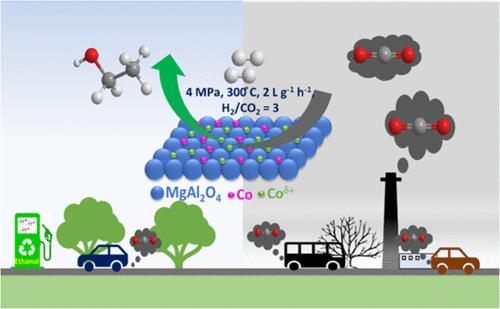
Cobalt-based catalysts were synthesized using the coprecipitation method from hydrotalcite precursors with CoO loadings of 10–50 mol %. Characterization was done using X-ray diffraction (XRD), N2 physisorption, X-ray photoelectron spectroscopy (XPS), H2-temperature-programmed reduction (TPR), and transmission electron microscopy (TEM), and their ethanol synthesis efficiency from CO2 was tested in a fixed bed microreactor. The Co30MgAl catalyst, with 30 mol % CoO, had highly dispersed Co nanoparticles and intermediate metal–support interaction, creating bifunctional Coδ+ and Co0 sites for robust activity. It achieved peak ethanol selectivity of 22.4% at 300 °C, 4 MPa, and GHSV of 2 L g–1 h–1, with H2/CO2 = 3. Higher Co concentrations led to weaker metal–support interactions and methane production, while lower concentrations favored CO and methanol formation. The present study highlights the importance of intermediate metal–support interactions and optimal CoO loading (30 mol %) for improved CO2-to-ethanol selectivity, supported by density functional theory (DFT) calculations.
期刊介绍:
ndustrial & Engineering Chemistry, with variations in title and format, has been published since 1909 by the American Chemical Society. Industrial & Engineering Chemistry Research is a weekly publication that reports industrial and academic research in the broad fields of applied chemistry and chemical engineering with special focus on fundamentals, processes, and products.



 京公网安备 11010802042870号
京ICP备2023020795号-1
京公网安备 11010802042870号
京ICP备2023020795号-1

 分享
分享
 求助内容:
求助内容: 应助结果提醒方式:
 扫码关注我们
