{"title":"Simultaneous removal of NH4+ and NO3– by coupling sulfur-based autotrophic denitrification and ANAMMOX with different electron donors","authors":"Liang Zhu , Zhiqiang Chen , Qinxue Wen , Xia Huang","doi":"10.1016/j.seppur.2025.132283","DOIUrl":null,"url":null,"abstract":"<div><div>Unstable nitrite supply and low ammonia concentration limited the application of mainstream Anammox. In this study, sulfur-based autotrophic denitrification coupled Anammox system (SADA) was established with pyrite and sulfur as electron donors, respectively, to simultaneously remove NH<sub>4</sub><sup>+</sup>-N and NO<sub>3</sub><sup>–</sup>-N. More than 85 % of the total inorganic nitrogen removal efficiency was achieved with S<sup>0</sup> as the electron donor. The synergistic nitrogen removal of autotrophic denitrification and Anammox reduced SO<sub>4</sub><sup>2−</sup> production. The average NH<sub>4</sub><sup>+</sup>-N removal efficiency reached 94.73 % when pyrite was used as the electron donor, but the NO<sub>3</sub><sup>–</sup>-N concentration in the effluent was higher than that in the influent. Microorganisms associated with nitrogen cycle were significantly enriched at the bottom of both reactors, where major biochemical processes occurred. Batch tests showed the coexistence of multiple N metabolic pathways in SADA, including Anammox, autotrophic denitrification, Sulfammox and Feammox. The genus <em>Thiobacillus</em>, <em>Ferritrophicum</em>, <em>Candidatus_Brocadia</em>, <em>Ignavibacterium</em> and <em>Thermoanaerobaculum</em> played major roles in nitrogen removal.</div></div>","PeriodicalId":427,"journal":{"name":"Separation and Purification Technology","volume":"363 ","pages":"Article 132283"},"PeriodicalIF":9.0000,"publicationDate":"2025-08-14","publicationTypes":"Journal Article","fieldsOfStudy":null,"isOpenAccess":false,"openAccessPdf":"","citationCount":"0","resultStr":null,"platform":"Semanticscholar","paperid":null,"PeriodicalName":"Separation and Purification Technology","FirstCategoryId":"5","ListUrlMain":"https://www.sciencedirect.com/science/article/pii/S1383586625008809","RegionNum":1,"RegionCategory":"工程技术","ArticlePicture":[],"TitleCN":null,"AbstractTextCN":null,"PMCID":null,"EPubDate":"2025/2/25 0:00:00","PubModel":"Epub","JCR":"Q1","JCRName":"ENGINEERING, CHEMICAL","Score":null,"Total":0}
引用次数: 0
Abstract
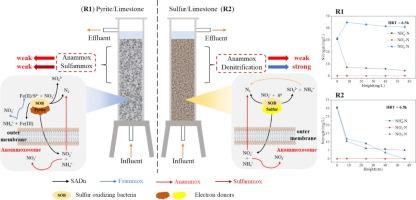
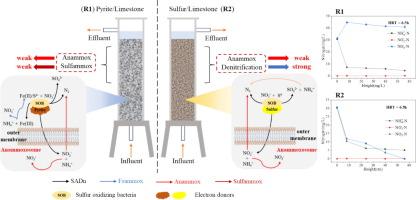
Unstable nitrite supply and low ammonia concentration limited the application of mainstream Anammox. In this study, sulfur-based autotrophic denitrification coupled Anammox system (SADA) was established with pyrite and sulfur as electron donors, respectively, to simultaneously remove NH4+-N and NO3–-N. More than 85 % of the total inorganic nitrogen removal efficiency was achieved with S0 as the electron donor. The synergistic nitrogen removal of autotrophic denitrification and Anammox reduced SO42− production. The average NH4+-N removal efficiency reached 94.73 % when pyrite was used as the electron donor, but the NO3–-N concentration in the effluent was higher than that in the influent. Microorganisms associated with nitrogen cycle were significantly enriched at the bottom of both reactors, where major biochemical processes occurred. Batch tests showed the coexistence of multiple N metabolic pathways in SADA, including Anammox, autotrophic denitrification, Sulfammox and Feammox. The genus Thiobacillus, Ferritrophicum, Candidatus_Brocadia, Ignavibacterium and Thermoanaerobaculum played major roles in nitrogen removal.
期刊介绍:
Separation and Purification Technology is a premier journal committed to sharing innovative methods for separation and purification in chemical and environmental engineering, encompassing both homogeneous solutions and heterogeneous mixtures. Our scope includes the separation and/or purification of liquids, vapors, and gases, as well as carbon capture and separation techniques. However, it's important to note that methods solely intended for analytical purposes are not within the scope of the journal. Additionally, disciplines such as soil science, polymer science, and metallurgy fall outside the purview of Separation and Purification Technology. Join us in advancing the field of separation and purification methods for sustainable solutions in chemical and environmental engineering.



 京公网安备 11010802042870号
京ICP备2023020795号-1
京公网安备 11010802042870号
京ICP备2023020795号-1

 分享
分享
 求助内容:
求助内容: 应助结果提醒方式:
 扫码关注我们
