Seok-Ki Hyeong, Byung Joon Moon, Aram Lee, Min Ji Im, Hee Yun Yang, Ji-Hee Choi, Seung-Il Kim, Ji-Yun Moon, Seoungwoong Park, Sung Kyu Jang, Tae-Wook Kim, Jae-Hyun Lee, Sukang Bae, Seoung-Ki Lee
{"title":"Artificial Modulation of the Hydrogen Evolution Reaction Kinetics via Control of Grain Boundaries Density in Mo2C Through Laser Processing","authors":"Seok-Ki Hyeong, Byung Joon Moon, Aram Lee, Min Ji Im, Hee Yun Yang, Ji-Hee Choi, Seung-Il Kim, Ji-Yun Moon, Seoungwoong Park, Sung Kyu Jang, Tae-Wook Kim, Jae-Hyun Lee, Sukang Bae, Seoung-Ki Lee","doi":"10.1002/adfm.202422918","DOIUrl":null,"url":null,"abstract":"<p>Mo<sub>2</sub>C-based electrocatalysts have emerged as promising alternatives to Pt noble metals for hydrogen production, owing to their high catalytic activity. However, the catalytic efficiency of Mo<sub>2</sub>C is highly sensitive to factors such as surface termination, morphology, and support. Therefore, it is crucial to develop systematic crystal structure engineering methods to precisely modulate the activity, thereby enhancing both catalytic efficiency and stability. In this study, laser-based material processing is employed to modulate the microstructure of Mo<sub>2</sub>C catalysts, with a focus on grain size control and developing a grain boundary (GB)-rich structure to enhance the kinetics of hydrogen evolution reaction (HER). Laser-based thermal control promoted the formation of fine and uniformly distributed Mo<sub>2</sub>C grains (15.6 ± 5 nm) and high-density GBs (130 µm<sup>−1</sup>). High-angle GBs, which occupy most Mo<sub>2</sub>C GBs, enhance electrochemically active sites, facilitate electron transfer, and shift the work function to 5.10 eV, thereby reducing hydrogen adsorption energy. In addition, electrochemical tests reveal a significant decrease in overpotential (148 mV at 10 mA cm<sup>−2</sup>) and improve Tafel slopes (67.6 mV dec<sup>−1</sup>), confirming the enhanced kinetics of the HER. This laser-induced GB engineering strategy opens a new pathway for designing high-performance Mo<sub>2</sub>C-based electrocatalysts, advancing next-generation hydrogen production technologies.</p>","PeriodicalId":112,"journal":{"name":"Advanced Functional Materials","volume":"35 28","pages":""},"PeriodicalIF":19.0000,"publicationDate":"2025-02-25","publicationTypes":"Journal Article","fieldsOfStudy":null,"isOpenAccess":false,"openAccessPdf":"https://onlinelibrary.wiley.com/doi/epdf/10.1002/adfm.202422918","citationCount":"0","resultStr":null,"platform":"Semanticscholar","paperid":null,"PeriodicalName":"Advanced Functional Materials","FirstCategoryId":"88","ListUrlMain":"https://advanced.onlinelibrary.wiley.com/doi/10.1002/adfm.202422918","RegionNum":1,"RegionCategory":"材料科学","ArticlePicture":[],"TitleCN":null,"AbstractTextCN":null,"PMCID":null,"EPubDate":"","PubModel":"","JCR":"Q1","JCRName":"CHEMISTRY, MULTIDISCIPLINARY","Score":null,"Total":0}
引用次数: 0
Abstract
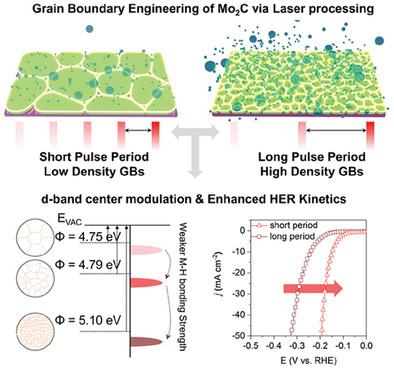
Mo2C-based electrocatalysts have emerged as promising alternatives to Pt noble metals for hydrogen production, owing to their high catalytic activity. However, the catalytic efficiency of Mo2C is highly sensitive to factors such as surface termination, morphology, and support. Therefore, it is crucial to develop systematic crystal structure engineering methods to precisely modulate the activity, thereby enhancing both catalytic efficiency and stability. In this study, laser-based material processing is employed to modulate the microstructure of Mo2C catalysts, with a focus on grain size control and developing a grain boundary (GB)-rich structure to enhance the kinetics of hydrogen evolution reaction (HER). Laser-based thermal control promoted the formation of fine and uniformly distributed Mo2C grains (15.6 ± 5 nm) and high-density GBs (130 µm−1). High-angle GBs, which occupy most Mo2C GBs, enhance electrochemically active sites, facilitate electron transfer, and shift the work function to 5.10 eV, thereby reducing hydrogen adsorption energy. In addition, electrochemical tests reveal a significant decrease in overpotential (148 mV at 10 mA cm−2) and improve Tafel slopes (67.6 mV dec−1), confirming the enhanced kinetics of the HER. This laser-induced GB engineering strategy opens a new pathway for designing high-performance Mo2C-based electrocatalysts, advancing next-generation hydrogen production technologies.
期刊介绍:
Firmly established as a top-tier materials science journal, Advanced Functional Materials reports breakthrough research in all aspects of materials science, including nanotechnology, chemistry, physics, and biology every week.
Advanced Functional Materials is known for its rapid and fair peer review, quality content, and high impact, making it the first choice of the international materials science community.







 京公网安备 11010802042870号
京ICP备2023020795号-1
京公网安备 11010802042870号
京ICP备2023020795号-1

 分享
分享
 求助内容:
求助内容: 应助结果提醒方式:
 扫码关注我们
