{"title":"Biomimetic Design of Breathable 2D Photothermal Fabric with Three-Layered Structure for Efficient Four-Plane Evaporation of Seawater","authors":"Jinjing Hu, Mohammad-Mahdi Pazuki, Ruoxin Li, Mohsen Salimi, Huamei Cai, Ye Peng, Zixiao Liu, Tingfeng Zhao, Majid Amidpour, Yen Wei, Zhigang Chen","doi":"10.1002/adma.202420482","DOIUrl":null,"url":null,"abstract":"<p>2D photothermal membranes have demonstrated numerous advantages in solar desalination due to their flexibility, scalability, and low cost. However, their practical applications are limited by the restricted evaporation area and obstructed vapor channels. A biomimetic design of the breathable 2D photothermal fabric is reported, which is composed of two carbon-nanotube-hydrogel-coated polyester (PET) fabrics separated by fiber pillars, with the upper fabric layer having a hole array as stomatal channels. This fabric shows high solar-absorption efficiency (96.1%) and decreased water-evaporation enthalpy (1664.6 kJ kg<sup>−1</sup>). The hanging fabric as a heliotropic evaporator exhibits four-plane evaporation feature and achieves a high evaporation rate of 2.6 kg m<sup>−2</sup> h<sup>−1</sup> under sunlight (1.0 kW m<sup>−2</sup>) illumination, better than the traditional floated model (single-plane, 1.6 kg m<sup>−2</sup> h<sup>−1</sup>). The evaporation rate can be further enhanced to 4.2 kg m<sup>−2</sup> h<sup>−1</sup> upon introducing adscititious airflow (2 m s<sup>−1</sup>). Simultaneously, the heliotropic-hanging design allows the dropping of concentrated brine, avoiding solid-salt-crystallization.</p>","PeriodicalId":114,"journal":{"name":"Advanced Materials","volume":"37 14","pages":""},"PeriodicalIF":26.8000,"publicationDate":"2025-02-25","publicationTypes":"Journal Article","fieldsOfStudy":null,"isOpenAccess":false,"openAccessPdf":"","citationCount":"0","resultStr":null,"platform":"Semanticscholar","paperid":null,"PeriodicalName":"Advanced Materials","FirstCategoryId":"88","ListUrlMain":"https://advanced.onlinelibrary.wiley.com/doi/10.1002/adma.202420482","RegionNum":1,"RegionCategory":"材料科学","ArticlePicture":[],"TitleCN":null,"AbstractTextCN":null,"PMCID":null,"EPubDate":"","PubModel":"","JCR":"Q1","JCRName":"CHEMISTRY, MULTIDISCIPLINARY","Score":null,"Total":0}
引用次数: 0
Abstract
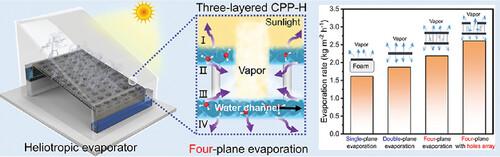
2D photothermal membranes have demonstrated numerous advantages in solar desalination due to their flexibility, scalability, and low cost. However, their practical applications are limited by the restricted evaporation area and obstructed vapor channels. A biomimetic design of the breathable 2D photothermal fabric is reported, which is composed of two carbon-nanotube-hydrogel-coated polyester (PET) fabrics separated by fiber pillars, with the upper fabric layer having a hole array as stomatal channels. This fabric shows high solar-absorption efficiency (96.1%) and decreased water-evaporation enthalpy (1664.6 kJ kg−1). The hanging fabric as a heliotropic evaporator exhibits four-plane evaporation feature and achieves a high evaporation rate of 2.6 kg m−2 h−1 under sunlight (1.0 kW m−2) illumination, better than the traditional floated model (single-plane, 1.6 kg m−2 h−1). The evaporation rate can be further enhanced to 4.2 kg m−2 h−1 upon introducing adscititious airflow (2 m s−1). Simultaneously, the heliotropic-hanging design allows the dropping of concentrated brine, avoiding solid-salt-crystallization.
由于其灵活性、可扩展性和低成本,二维光热膜在太阳能海水淡化中表现出许多优势。然而,它们的实际应用受到蒸发面积受限和蒸汽通道阻塞的限制。本文报道了一种透气性二维光热织物的仿生设计,该织物由两根纤维柱隔开的碳纳米管-水凝胶涂层聚酯(PET)织物组成,织物上层具有孔阵列作为气孔通道。该织物具有较高的太阳能吸收效率(96.1%)和较低的水蒸发焓(1664.6 kJ kg−1)。悬挂织物作为向日向蒸发器具有四平面蒸发特性,在光照(1.0 kW m−2)下的蒸发速率高达2.6 kg m−2 h−1,优于传统的浮动模型(单平面,1.6 kg m−2 h−1)。在引入额外气流(2 m s−1)后,蒸发速率可进一步提高到4.2 kg m−2 h−1。同时,日光悬挂设计允许浓盐水滴下,避免固体盐结晶。
期刊介绍:
Advanced Materials, one of the world's most prestigious journals and the foundation of the Advanced portfolio, is the home of choice for best-in-class materials science for more than 30 years. Following this fast-growing and interdisciplinary field, we are considering and publishing the most important discoveries on any and all materials from materials scientists, chemists, physicists, engineers as well as health and life scientists and bringing you the latest results and trends in modern materials-related research every week.



 京公网安备 11010802042870号
京ICP备2023020795号-1
京公网安备 11010802042870号
京ICP备2023020795号-1

 分享
分享
 求助内容:
求助内容: 应助结果提醒方式:
 扫码关注我们
