Jiaxing Guo, Feng Guo, Huijun Zhao, Hang Yang, Xiaona Du, Fei Fan, Weiwei Liu, Yang Zhang, Dong Tu, Jianhua Hao
{"title":"In-Sensor Computing with Visual-Tactile Perception Enabled by Mechano-Optical Artificial Synapse","authors":"Jiaxing Guo, Feng Guo, Huijun Zhao, Hang Yang, Xiaona Du, Fei Fan, Weiwei Liu, Yang Zhang, Dong Tu, Jianhua Hao","doi":"10.1002/adma.202419405","DOIUrl":null,"url":null,"abstract":"<p>In-sensor computing paradigm holds the promise of realizing rapid and low-power signal processing. Constructing crossmodal in-sensor computing systems to emulate human sensory and recognition capabilities has been a persistent pursuit for developing humanoid robotics. Here, an artificial mechano-optical synapse is reported to implement in-sensor dynamic computing with visual-tactile perception. By employing mechanoluminescence (ML) material, direct conversion of the mechanical signals into light emission is achieved and the light is transported to an adjacent photostimulated luminescence (PSL) layer without pre- and post-irradiation. The PSL layer acts as a photon reservoir as well as a processing unit for achieving in-memory computing. The approach based on ML coupled with PSL material is different from traditional circuit–constrained methods, enabling remote operation and easy accessibility. Individual and synergistic plasticity are elaborately investigated under force and light pulses, including paired-pulse facilitation, learning behavior, and short-term and long-term memory. A multisensory neural network is built for processing the obtained handwritten patterns with a tablet consisting of the device, achieving a recognition accuracy of up to 92.5%. Moreover, material identification has been explored based on visual-tactile sensing, with an accuracy rate of 98.6%. This work provides a promising strategy to construct in-sensor computing systems with crossmodal integration and recognition.</p>","PeriodicalId":114,"journal":{"name":"Advanced Materials","volume":"37 14","pages":""},"PeriodicalIF":26.8000,"publicationDate":"2025-02-25","publicationTypes":"Journal Article","fieldsOfStudy":null,"isOpenAccess":false,"openAccessPdf":"","citationCount":"0","resultStr":null,"platform":"Semanticscholar","paperid":null,"PeriodicalName":"Advanced Materials","FirstCategoryId":"88","ListUrlMain":"https://advanced.onlinelibrary.wiley.com/doi/10.1002/adma.202419405","RegionNum":1,"RegionCategory":"材料科学","ArticlePicture":[],"TitleCN":null,"AbstractTextCN":null,"PMCID":null,"EPubDate":"","PubModel":"","JCR":"Q1","JCRName":"CHEMISTRY, MULTIDISCIPLINARY","Score":null,"Total":0}
引用次数: 0
Abstract
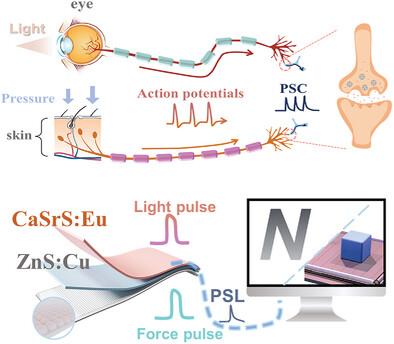
In-sensor computing paradigm holds the promise of realizing rapid and low-power signal processing. Constructing crossmodal in-sensor computing systems to emulate human sensory and recognition capabilities has been a persistent pursuit for developing humanoid robotics. Here, an artificial mechano-optical synapse is reported to implement in-sensor dynamic computing with visual-tactile perception. By employing mechanoluminescence (ML) material, direct conversion of the mechanical signals into light emission is achieved and the light is transported to an adjacent photostimulated luminescence (PSL) layer without pre- and post-irradiation. The PSL layer acts as a photon reservoir as well as a processing unit for achieving in-memory computing. The approach based on ML coupled with PSL material is different from traditional circuit–constrained methods, enabling remote operation and easy accessibility. Individual and synergistic plasticity are elaborately investigated under force and light pulses, including paired-pulse facilitation, learning behavior, and short-term and long-term memory. A multisensory neural network is built for processing the obtained handwritten patterns with a tablet consisting of the device, achieving a recognition accuracy of up to 92.5%. Moreover, material identification has been explored based on visual-tactile sensing, with an accuracy rate of 98.6%. This work provides a promising strategy to construct in-sensor computing systems with crossmodal integration and recognition.
期刊介绍:
Advanced Materials, one of the world's most prestigious journals and the foundation of the Advanced portfolio, is the home of choice for best-in-class materials science for more than 30 years. Following this fast-growing and interdisciplinary field, we are considering and publishing the most important discoveries on any and all materials from materials scientists, chemists, physicists, engineers as well as health and life scientists and bringing you the latest results and trends in modern materials-related research every week.







 京公网安备 11010802042870号
京ICP备2023020795号-1
京公网安备 11010802042870号
京ICP备2023020795号-1

 分享
分享
 求助内容:
求助内容: 应助结果提醒方式:
 扫码关注我们
