Yuye Qiu, Tao Zheng, Rui Liu, Jingjing Liu, Xiangdong Xue, Wengang Liu and Jian Liu
{"title":"Bimetallic Ni/Co single-atom catalysts guided by an energy descriptor for efficient CO2 electroreduction to syngas†","authors":"Yuye Qiu, Tao Zheng, Rui Liu, Jingjing Liu, Xiangdong Xue, Wengang Liu and Jian Liu","doi":"10.1039/D4QI03138E","DOIUrl":null,"url":null,"abstract":"<p >Electrochemical CO<small><sub>2</sub></small> reduction to syngas (CO + H<small><sub>2</sub></small>) offers a promising way to produce valuable chemicals and fuels from renewable electricity and capture CO<small><sub>2</sub></small>, but developing efficient, tunable catalysts to control the syngas ratio remains challenging. Herein, we demonstrated the rational design of bimetallic Ni/Co single-atom catalysts for efficient, tunable CO<small><sub>2</sub></small> electroreduction to syngas. The adsorption energy descriptor was introduced to identify optimal metal–N<small><sub>4</sub></small> sites for CO<small><sub>2</sub></small> electroreduction, highlighting Ni–N<small><sub>4</sub></small> and Co–N<small><sub>4</sub></small> as promising candidates. Isolated Ni and Co atoms were precisely anchored into nitrogen-doped carbon supports, forming Ni/Co–N<small><sub>4</sub></small> active sites. Mechanistic insights revealed that atomic Ni–N<small><sub>4</sub></small> sites selectively adsorbed and activated CO<small><sub>2</sub></small> to form CO, while Co–N<small><sub>4</sub></small> sites bound H<small><sub>2</sub></small>O to facilitate hydrogen evolution. This synergy between Co/Ni single-atom sites enabled high faradaic efficiency and a tunable CO/H<small><sub>2</sub></small> ratio from 1 : 2.3 to 2.8 : 1. This research offers strategies for designing single-atom catalysts to achieve precise product selectivity control over energy-related applications.</p>","PeriodicalId":79,"journal":{"name":"Inorganic Chemistry Frontiers","volume":" 7","pages":" 2944-2953"},"PeriodicalIF":6.4000,"publicationDate":"2025-02-25","publicationTypes":"Journal Article","fieldsOfStudy":null,"isOpenAccess":false,"openAccessPdf":"","citationCount":"0","resultStr":null,"platform":"Semanticscholar","paperid":null,"PeriodicalName":"Inorganic Chemistry Frontiers","FirstCategoryId":"92","ListUrlMain":"https://pubs.rsc.org/en/content/articlelanding/2025/qi/d4qi03138e","RegionNum":1,"RegionCategory":"化学","ArticlePicture":[],"TitleCN":null,"AbstractTextCN":null,"PMCID":null,"EPubDate":"","PubModel":"","JCR":"Q1","JCRName":"CHEMISTRY, INORGANIC & NUCLEAR","Score":null,"Total":0}
引用次数: 0
Abstract
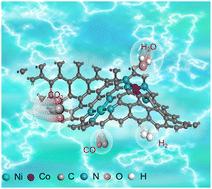
Electrochemical CO2 reduction to syngas (CO + H2) offers a promising way to produce valuable chemicals and fuels from renewable electricity and capture CO2, but developing efficient, tunable catalysts to control the syngas ratio remains challenging. Herein, we demonstrated the rational design of bimetallic Ni/Co single-atom catalysts for efficient, tunable CO2 electroreduction to syngas. The adsorption energy descriptor was introduced to identify optimal metal–N4 sites for CO2 electroreduction, highlighting Ni–N4 and Co–N4 as promising candidates. Isolated Ni and Co atoms were precisely anchored into nitrogen-doped carbon supports, forming Ni/Co–N4 active sites. Mechanistic insights revealed that atomic Ni–N4 sites selectively adsorbed and activated CO2 to form CO, while Co–N4 sites bound H2O to facilitate hydrogen evolution. This synergy between Co/Ni single-atom sites enabled high faradaic efficiency and a tunable CO/H2 ratio from 1 : 2.3 to 2.8 : 1. This research offers strategies for designing single-atom catalysts to achieve precise product selectivity control over energy-related applications.



 京公网安备 11010802042870号
京ICP备2023020795号-1
京公网安备 11010802042870号
京ICP备2023020795号-1

 分享
分享
 求助内容:
求助内容: 应助结果提醒方式:
 扫码关注我们
