Oluseyi Olawuyi, James Stewart, Md. Minhas Hossain Sakib, William Bryant, Mary-Kate Wewers, Noam Lewit, Md. Ackas Ali, Md. Sajjadur Rahman and Mohammad A. Halim
{"title":"Elucidating gas phase microstructures of therapeutic deep eutectic systems†","authors":"Oluseyi Olawuyi, James Stewart, Md. Minhas Hossain Sakib, William Bryant, Mary-Kate Wewers, Noam Lewit, Md. Ackas Ali, Md. Sajjadur Rahman and Mohammad A. Halim","doi":"10.1039/D4AN00645C","DOIUrl":null,"url":null,"abstract":"<p >Therapeutic deep eutectic solvents are a new class of deep eutectic solvents (DESs), which include at least an active pharmaceutical ingredient (API) as one of the components. Therapeutic DESs are emerging alternatives that improve the bioavailability, solubility, delivery, and pharmacokinetics properties of drugs. DESs comprise two components, generally a hydrogen bond acceptor (HBA) and a hydrogen bond donor (HBD), with varying ratios. The interaction chemistry between HBA : HBD components in DESs is complex. Moreover, stoichiometry and cluster formation of DESs at the molecular level have received little attention. Mass spectrometry (MS) is an attractive technique for studying isolated gas phase molecules; however, such investigations have not been implemented for DESs. Compared to other techniques, MS is unique in providing information on the gas phase stoichiometry, cluster formation, and interaction network between the two components of DESs. In addition, computational modeling assists in visualizing the isolated DES clusters and unraveling a deeper understanding of the structure–property relationship. In this study, multi-technique approaches, including thermogravimetric (TGA), calorimetric (DSC), spectroscopic (IR and Raman), emerging mass spectrometry, and computational, were employed to characterize the menthol : ibuprofen-based therapeutic DES. The thermal, calorimetric, and spectroscopic studies showed that hydrogen bonding is the primary factor contributing to DES formation. This study also reported the stable gas phase cluster structure of a menthol : ibuprofen DES using electrospray ionization (ESI) and direct analysis in real time (DART) coupled with mass spectrometry. Subsequently, a temperature-dependent DART-MS investigation shows that different-temperature conditions impact the formation and intensity of clusters, and the presence of ester impurities. The most intense peak in the ESI-MS and DART-MS spectra was detected at <em>m</em>/<em>z</em> 363.1, corresponding to the hetero-molecular cluster of a 1 : 1 menthol : ibuprofen complex. In addition to the hetero-cluster, homo-clusters of a two-menthol molecule and a two-ibuprofen molecule were also detected. Density functional theory (DFT) was employed to investigate the possible gas phase structures of the selected clusters obtained from MS. The DFT results show that hydrogen bonds between the constituents stabilize most of the clusters. An MS-guided computational model visualized detailed microstructures and provided insights into the formation mechanism and intermolecular interaction of therapeutic DES.</p>","PeriodicalId":63,"journal":{"name":"Analyst","volume":" 9","pages":" 1846-1855"},"PeriodicalIF":3.3000,"publicationDate":"2025-02-25","publicationTypes":"Journal Article","fieldsOfStudy":null,"isOpenAccess":false,"openAccessPdf":"","citationCount":"0","resultStr":null,"platform":"Semanticscholar","paperid":null,"PeriodicalName":"Analyst","FirstCategoryId":"92","ListUrlMain":"https://pubs.rsc.org/en/content/articlelanding/2025/an/d4an00645c","RegionNum":3,"RegionCategory":"化学","ArticlePicture":[],"TitleCN":null,"AbstractTextCN":null,"PMCID":null,"EPubDate":"","PubModel":"","JCR":"Q2","JCRName":"CHEMISTRY, ANALYTICAL","Score":null,"Total":0}
引用次数: 0
Abstract
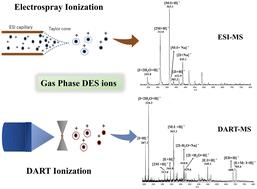
Therapeutic deep eutectic solvents are a new class of deep eutectic solvents (DESs), which include at least an active pharmaceutical ingredient (API) as one of the components. Therapeutic DESs are emerging alternatives that improve the bioavailability, solubility, delivery, and pharmacokinetics properties of drugs. DESs comprise two components, generally a hydrogen bond acceptor (HBA) and a hydrogen bond donor (HBD), with varying ratios. The interaction chemistry between HBA : HBD components in DESs is complex. Moreover, stoichiometry and cluster formation of DESs at the molecular level have received little attention. Mass spectrometry (MS) is an attractive technique for studying isolated gas phase molecules; however, such investigations have not been implemented for DESs. Compared to other techniques, MS is unique in providing information on the gas phase stoichiometry, cluster formation, and interaction network between the two components of DESs. In addition, computational modeling assists in visualizing the isolated DES clusters and unraveling a deeper understanding of the structure–property relationship. In this study, multi-technique approaches, including thermogravimetric (TGA), calorimetric (DSC), spectroscopic (IR and Raman), emerging mass spectrometry, and computational, were employed to characterize the menthol : ibuprofen-based therapeutic DES. The thermal, calorimetric, and spectroscopic studies showed that hydrogen bonding is the primary factor contributing to DES formation. This study also reported the stable gas phase cluster structure of a menthol : ibuprofen DES using electrospray ionization (ESI) and direct analysis in real time (DART) coupled with mass spectrometry. Subsequently, a temperature-dependent DART-MS investigation shows that different-temperature conditions impact the formation and intensity of clusters, and the presence of ester impurities. The most intense peak in the ESI-MS and DART-MS spectra was detected at m/z 363.1, corresponding to the hetero-molecular cluster of a 1 : 1 menthol : ibuprofen complex. In addition to the hetero-cluster, homo-clusters of a two-menthol molecule and a two-ibuprofen molecule were also detected. Density functional theory (DFT) was employed to investigate the possible gas phase structures of the selected clusters obtained from MS. The DFT results show that hydrogen bonds between the constituents stabilize most of the clusters. An MS-guided computational model visualized detailed microstructures and provided insights into the formation mechanism and intermolecular interaction of therapeutic DES.



 京公网安备 11010802042870号
京ICP备2023020795号-1
京公网安备 11010802042870号
京ICP备2023020795号-1

 分享
分享
 求助内容:
求助内容: 应助结果提醒方式:
 扫码关注我们
