{"title":"Perception of window views in VR: Impact of display and type of motion on subjective and physiological responses","authors":"Yunni Cho , Caroline Karmann , Marilyne Andersen","doi":"10.1016/j.buildenv.2025.112757","DOIUrl":null,"url":null,"abstract":"<div><div>This study investigates the effect of dynamic and static representations of window views on visual perception in a virtual reality environment. Across two experimental sessions, participants were exposed to fifteen different views-out scenes of passive natural movement, pedestrian activities, and vehicular traffic, presented both as dynamic videos and still images. Participant impressions were collected through numerical ratings and verbal feedback, in addition to measurements of physiological responses and eye movement patterns. The experiment identified three key findings: (1) enhanced visual engagement, reflected in longer fixation duration and higher fixation count, for videos of human and traffic movements; (2) stronger preference for scenes with pedestrian movement compared to passive or traffic movements, where images of human motion elicited greater physiological arousal; and (3) higher perceptual ratings for images of passive movement, despite videos of passive movement being observed for longer durations. These findings highlight the importance of dynamically representing movement and considering diverse types of movements to improve realism and validity in views-out research. The outcome of this study aims to contribute to advancing future building science research by revealing the importance of capturing more dimensions in the visual experience of building occupants.</div></div>","PeriodicalId":9273,"journal":{"name":"Building and Environment","volume":"274 ","pages":"Article 112757"},"PeriodicalIF":7.6000,"publicationDate":"2025-04-15","publicationTypes":"Journal Article","fieldsOfStudy":null,"isOpenAccess":false,"openAccessPdf":"","citationCount":"0","resultStr":null,"platform":"Semanticscholar","paperid":null,"PeriodicalName":"Building and Environment","FirstCategoryId":"5","ListUrlMain":"https://www.sciencedirect.com/science/article/pii/S0360132325002392","RegionNum":1,"RegionCategory":"工程技术","ArticlePicture":[],"TitleCN":null,"AbstractTextCN":null,"PMCID":null,"EPubDate":"2025/2/20 0:00:00","PubModel":"Epub","JCR":"Q1","JCRName":"CONSTRUCTION & BUILDING TECHNOLOGY","Score":null,"Total":0}
引用次数: 0
Abstract
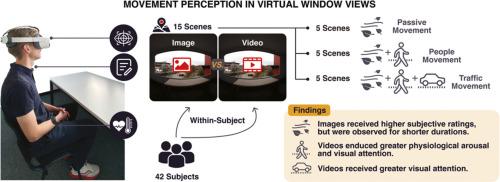
This study investigates the effect of dynamic and static representations of window views on visual perception in a virtual reality environment. Across two experimental sessions, participants were exposed to fifteen different views-out scenes of passive natural movement, pedestrian activities, and vehicular traffic, presented both as dynamic videos and still images. Participant impressions were collected through numerical ratings and verbal feedback, in addition to measurements of physiological responses and eye movement patterns. The experiment identified three key findings: (1) enhanced visual engagement, reflected in longer fixation duration and higher fixation count, for videos of human and traffic movements; (2) stronger preference for scenes with pedestrian movement compared to passive or traffic movements, where images of human motion elicited greater physiological arousal; and (3) higher perceptual ratings for images of passive movement, despite videos of passive movement being observed for longer durations. These findings highlight the importance of dynamically representing movement and considering diverse types of movements to improve realism and validity in views-out research. The outcome of this study aims to contribute to advancing future building science research by revealing the importance of capturing more dimensions in the visual experience of building occupants.
期刊介绍:
Building and Environment, an international journal, is dedicated to publishing original research papers, comprehensive review articles, editorials, and short communications in the fields of building science, urban physics, and human interaction with the indoor and outdoor built environment. The journal emphasizes innovative technologies and knowledge verified through measurement and analysis. It covers environmental performance across various spatial scales, from cities and communities to buildings and systems, fostering collaborative, multi-disciplinary research with broader significance.




 京公网安备 11010802042870号
京ICP备2023020795号-1
京公网安备 11010802042870号
京ICP备2023020795号-1

 分享
分享
 求助内容:
求助内容: 应助结果提醒方式:
 扫码关注我们
