Thermodynamic and Kinetic Study on Eco-friendly Atmospheric Pressure Dyeing of Poly(Ethylene Terephthalate-co-Polyethylene Glycol) Fibers

IF 2.3 4区 工程技术 Q1 MATERIALS SCIENCE, TEXTILES Fibers and Polymers Pub Date : 2025-01-30 DOI:10.1007/s12221-025-00843-1
Shekh Md. Mamun Kabir, Md. Morshedur Rahman, Ingi Hong, Joonseok Koh
{"title":"Thermodynamic and Kinetic Study on Eco-friendly Atmospheric Pressure Dyeing of Poly(Ethylene Terephthalate-co-Polyethylene Glycol) Fibers","authors":"Shekh Md. Mamun Kabir,&nbsp;Md. Morshedur Rahman,&nbsp;Ingi Hong,&nbsp;Joonseok Koh","doi":"10.1007/s12221-025-00843-1","DOIUrl":null,"url":null,"abstract":"<div><p>This study investigated the dyeability of poly(ethylene terephthalate-<i>co</i>-polyethylene glycol) (PCP) fibers engineered for convenient disperse dyeing, using both low and high energy disperse dyes within a temperature range of 90–130 °C. A thermodynamic analysis revealed that the disperse dyeing of PCP fibers followed the Nernst isotherm. It displayed higher partition coefficients and equilibrium exhaustion than those of conventional PET fibers. The affinity parameter indicated a higher affinity of the disperse dyes for the PCP fibers, although the enthalpy and entropy variation indicated weaker dye embedding within the PCP polymer matrix. Kinetic studies revealed that dye exhaustion occurs more rapidly on PCP fibers at a temperature below the conventional disperse dyeing temperature for polyester (i.e., below 130 °C). In addition, the PCP fibers exhibited lower dyeing transition temperatures and higher diffusion coefficients at these reduced temperatures. Among the studied dyes, the low-molecular-weight disperse dye demonstrated more favorable thermodynamic and kinetic parameters than the high-molecular-weight disperse dye. Overall, these observations indicate that dyeing at 100 °C under atmospheric pressure is the optimal process condition for PCP fibers and is effective for both low- and high-molecular-weight dyes.</p></div>","PeriodicalId":557,"journal":{"name":"Fibers and Polymers","volume":"26 2","pages":"723 - 737"},"PeriodicalIF":2.3000,"publicationDate":"2025-01-30","publicationTypes":"Journal Article","fieldsOfStudy":null,"isOpenAccess":false,"openAccessPdf":"","citationCount":"0","resultStr":null,"platform":"Semanticscholar","paperid":null,"PeriodicalName":"Fibers and Polymers","FirstCategoryId":"88","ListUrlMain":"https://link.springer.com/article/10.1007/s12221-025-00843-1","RegionNum":4,"RegionCategory":"工程技术","ArticlePicture":[],"TitleCN":null,"AbstractTextCN":null,"PMCID":null,"EPubDate":"","PubModel":"","JCR":"Q1","JCRName":"MATERIALS SCIENCE, TEXTILES","Score":null,"Total":0}
引用次数: 0

Abstract

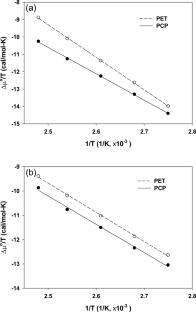
This study investigated the dyeability of poly(ethylene terephthalate-co-polyethylene glycol) (PCP) fibers engineered for convenient disperse dyeing, using both low and high energy disperse dyes within a temperature range of 90–130 °C. A thermodynamic analysis revealed that the disperse dyeing of PCP fibers followed the Nernst isotherm. It displayed higher partition coefficients and equilibrium exhaustion than those of conventional PET fibers. The affinity parameter indicated a higher affinity of the disperse dyes for the PCP fibers, although the enthalpy and entropy variation indicated weaker dye embedding within the PCP polymer matrix. Kinetic studies revealed that dye exhaustion occurs more rapidly on PCP fibers at a temperature below the conventional disperse dyeing temperature for polyester (i.e., below 130 °C). In addition, the PCP fibers exhibited lower dyeing transition temperatures and higher diffusion coefficients at these reduced temperatures. Among the studied dyes, the low-molecular-weight disperse dye demonstrated more favorable thermodynamic and kinetic parameters than the high-molecular-weight disperse dye. Overall, these observations indicate that dyeing at 100 °C under atmospheric pressure is the optimal process condition for PCP fibers and is effective for both low- and high-molecular-weight dyes.
Abstract Image

查看原文
分享 分享
微信好友 朋友圈 QQ好友 复制链接
本刊更多论文
环保常压染色聚对苯二甲酸乙酯-聚乙二醇纤维的热力学和动力学研究
本研究研究了用于分散染色的聚对苯二甲酸乙酯-共聚乙二醇(PCP)纤维的可染性,在90-130℃的温度范围内使用低能和高能分散染料。热力学分析表明,PCP纤维的分散染色遵循能思特等温线。与传统聚酯纤维相比,它具有更高的分配系数和平衡耗竭。亲和参数表明分散染料对PCP纤维具有较高的亲和性,但焓值和熵值变化表明分散染料在PCP聚合物基体中的嵌入性较弱。动力学研究表明,在低于聚酯传统分散染色温度(即低于130°C)的温度下,PCP纤维上的染料耗尽发生得更快。此外,PCP纤维表现出较低的染色转变温度和较高的扩散系数。在所研究的染料中,低分子量分散染料比高分子量分散染料表现出更有利的热力学和动力学参数。总的来说,这些观察结果表明,在100°C大气压下染色是PCP纤维的最佳工艺条件,对低分子量和高分子量染料都有效。
本文章由计算机程序翻译,如有差异,请以英文原文为准。
求助全文
约1分钟内获得全文 去求助
来源期刊
Fibers and Polymers
Fibers and Polymers 工程技术-材料科学:纺织
CiteScore
3.90
自引率
8.00%
发文量
267
审稿时长
3.9 months
期刊介绍: -Chemistry of Fiber Materials, Polymer Reactions and Synthesis- Physical Properties of Fibers, Polymer Blends and Composites- Fiber Spinning and Textile Processing, Polymer Physics, Morphology- Colorants and Dyeing, Polymer Analysis and Characterization- Chemical Aftertreatment of Textiles, Polymer Processing and Rheology- Textile and Apparel Science, Functional Polymers
期刊最新文献
Silane-Treated Glass Fibre-Reinforced Thermoplastic Composites: A Review of Nanofillers and Fibre Configurations Honeycomb Structures with Conical Pits and Tetrahedral Confined Spaces: A Comprehensive Study on Mechanical Attributes Computational Studies on the Strain Energy and Natural Frequency of a Parabolic Deployable Composite Boom for Space Antenna Structures Capturing Curved Lag Plots in Dye Adsorption Kinetics Using a Generalized Three-State Discrete-Time Markov Chain Model Sustainable Dyeing of Polyester with 1,5-Diaminonaphthalene-Modified Marigold Dye: Preparation, Dyeing Performance, and Adsorption Kinetics
×
引用
GB/T 7714-2015
复制
MLA
复制
APA
复制
导出至
BibTeX EndNote RefMan NoteFirst NoteExpress
×
×
提示
您的信息不完整,为了账户安全,请先补充。
现在去补充
×
提示
您因"违规操作"
具体请查看互助需知
我知道了
×
提示
现在去查看 取消
×
提示
确定
0
微信
客服QQ
Book学术公众号 扫码关注我们
反馈
×
意见反馈
请填写您的意见或建议
请填写您的手机或邮箱
已复制链接
已复制链接
快去分享给好友吧!
我知道了
×
扫码分享
扫码分享
Book学术官方微信
Book学术文献互助
Book学术文献互助群
群 号:604180095
Book学术
文献互助 智能选刊 最新文献 互助须知 联系我们:info@booksci.cn
Book学术提供免费学术资源搜索服务,方便国内外学者检索中英文文献。致力于提供最便捷和优质的服务体验。
Copyright © 2023 Book学术 All rights reserved.
ghs 京公网安备 11010802042870号 京ICP备2023020795号-1





