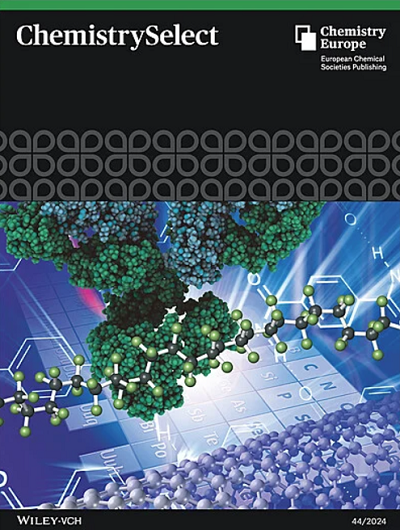
{"title":"Simulation of TiN Nanospheres, Nanoellipsoids, and Nanorings for Enhanced Localized Surface Plasmon Resonance and Field Amplification","authors":"Sumit Faujdar, Ayushi Nayal, Jyoti Katyal, Pankaj Pathania","doi":"10.1002/slct.202404987","DOIUrl":null,"url":null,"abstract":"<p>This study investigates the plasmonic behavior of TiN nanostructures, specifically focusing on three geometries: nanospheres, nanoelliptical particles, and nanorings. The localized surface plasmon resonance (LSPR) of these structures is analyzed and compared with noble plasmonic materials to determine their potential in applications such as sensing, photothermal therapy, and energy harvesting. TiN nanospheres exhibit strong absorption and scattering in the visible to near-infrared region, making them suitable for applications requiring high field enhancement. The optical absorption and scattering efficiencies were found to depend heavily on particle size and the surrounding medium's refractive index. Nanoelliptical particles offer tunability in their plasmonic response by adjusting their aspect ratio, allowing for enhanced field confinement and broader spectral coverage. This tunability makes them ideal for applications requiring precise control over resonance frequencies. Nanorings, with their unique hollow structure, demonstrate distinct plasmonic modes that are sensitive to both inner and outer diameters. These geometries enhance light-matter interactions at their edges and enable further tuning of LSPR properties. The plasmonic field enhancement of TiN nanorings surpasses that of spherical and elliptical counterparts due to their larger surface area that are crucial for applications like biosensing and surface-enhanced Raman spectroscopy (SERS). Overall, the versatility in geometry offers a range of tunable plasmonic properties for TiN nanostructures, paving the way for their use in next-generation nanophotonic and sensing devices.</p>","PeriodicalId":146,"journal":{"name":"ChemistrySelect","volume":"10 9","pages":""},"PeriodicalIF":2.3000,"publicationDate":"2025-02-26","publicationTypes":"Journal Article","fieldsOfStudy":null,"isOpenAccess":false,"openAccessPdf":"","citationCount":"0","resultStr":null,"platform":"Semanticscholar","paperid":null,"PeriodicalName":"ChemistrySelect","FirstCategoryId":"92","ListUrlMain":"https://chemistry-europe.onlinelibrary.wiley.com/doi/10.1002/slct.202404987","RegionNum":4,"RegionCategory":"化学","ArticlePicture":[],"TitleCN":null,"AbstractTextCN":null,"PMCID":null,"EPubDate":"","PubModel":"","JCR":"Q3","JCRName":"CHEMISTRY, MULTIDISCIPLINARY","Score":null,"Total":0}
引用次数: 0
Abstract
This study investigates the plasmonic behavior of TiN nanostructures, specifically focusing on three geometries: nanospheres, nanoelliptical particles, and nanorings. The localized surface plasmon resonance (LSPR) of these structures is analyzed and compared with noble plasmonic materials to determine their potential in applications such as sensing, photothermal therapy, and energy harvesting. TiN nanospheres exhibit strong absorption and scattering in the visible to near-infrared region, making them suitable for applications requiring high field enhancement. The optical absorption and scattering efficiencies were found to depend heavily on particle size and the surrounding medium's refractive index. Nanoelliptical particles offer tunability in their plasmonic response by adjusting their aspect ratio, allowing for enhanced field confinement and broader spectral coverage. This tunability makes them ideal for applications requiring precise control over resonance frequencies. Nanorings, with their unique hollow structure, demonstrate distinct plasmonic modes that are sensitive to both inner and outer diameters. These geometries enhance light-matter interactions at their edges and enable further tuning of LSPR properties. The plasmonic field enhancement of TiN nanorings surpasses that of spherical and elliptical counterparts due to their larger surface area that are crucial for applications like biosensing and surface-enhanced Raman spectroscopy (SERS). Overall, the versatility in geometry offers a range of tunable plasmonic properties for TiN nanostructures, paving the way for their use in next-generation nanophotonic and sensing devices.
期刊介绍:
ChemistrySelect is the latest journal from ChemPubSoc Europe and Wiley-VCH. It offers researchers a quality society-owned journal in which to publish their work in all areas of chemistry. Manuscripts are evaluated by active researchers to ensure they add meaningfully to the scientific literature, and those accepted are processed quickly to ensure rapid online publication.






 京公网安备 11010802042870号
京ICP备2023020795号-1
京公网安备 11010802042870号
京ICP备2023020795号-1

 分享
分享
 求助内容:
求助内容: 应助结果提醒方式:
 扫码关注我们
