Qingyang Jian, Yaru Gong, Chen Chen, Rongxin Sun, Song Zhao, Tao Shen, Qingtang Zhang, Yang Geng, Yanan Li, Wei Dou, Congmin Liang, Yuqi Liu, Deshang Xiang, Pan Ying, Guodong Tang
{"title":"Composite Engineering Facilitates High-Performance Cu<sub>2</sub>Se-GeTe Thermoelectrics.","authors":"Qingyang Jian, Yaru Gong, Chen Chen, Rongxin Sun, Song Zhao, Tao Shen, Qingtang Zhang, Yang Geng, Yanan Li, Wei Dou, Congmin Liang, Yuqi Liu, Deshang Xiang, Pan Ying, Guodong Tang","doi":"10.1021/acsami.5c00052","DOIUrl":null,"url":null,"abstract":"<p><p>Cu<sub>2</sub>Se has emerged as a promising thermoelectric material due to its low lattice thermal conductivity, high Seebeck coefficient, and high peak figure of merit (<i>ZT</i>) at elevated temperatures. However, its performance is limited by a high intrinsic carrier concentration and low carrier mobility. In this work, we investigate Cu<sub>2</sub>Se-based composites to overcome these challenges by introducing GeTe as compound phase to optimize carrier concentration, enhance mobility, and promote phonon scattering. The incorporation of GeTe significantly optimized both carrier concentration and mobility, with the Cu<sub>2</sub>Se/5 wt % GeTe composite exhibiting a carrier mobility of 30.8 cm<sup>2</sup>·V<sup>-1</sup>·s<sup>-1</sup>, more than twice that of pristine Cu<sub>2</sub>Se (11.4 cm<sup>2</sup>·V<sup>-1</sup>·s<sup>-1</sup>). Additionally, the inclusion of GeTe substantially reduced both the electrical and lattice thermal conductivity across the entire temperature range. These improvements culminated in a peak <i>ZT</i> of 2.2 at 923 K for the Cu<sub>2</sub>Se/10 wt % GeTe composite. These findings underscore the effectiveness of utilizing high-performance thermoelectric materials, such as GeTe, as secondary phases to substantially boost the thermoelectric properties of Cu<sub>2</sub>Se. This approach offers a promising pathway for the development of advanced thermoelectric materials for energy conversion applications.</p>","PeriodicalId":5,"journal":{"name":"ACS Applied Materials & Interfaces","volume":" ","pages":"15527-15534"},"PeriodicalIF":8.2000,"publicationDate":"2025-03-12","publicationTypes":"Journal Article","fieldsOfStudy":null,"isOpenAccess":false,"openAccessPdf":"","citationCount":"0","resultStr":null,"platform":"Semanticscholar","paperid":null,"PeriodicalName":"ACS Applied Materials & Interfaces","FirstCategoryId":"88","ListUrlMain":"https://doi.org/10.1021/acsami.5c00052","RegionNum":2,"RegionCategory":"材料科学","ArticlePicture":[],"TitleCN":null,"AbstractTextCN":null,"PMCID":null,"EPubDate":"2025/2/25 0:00:00","PubModel":"Epub","JCR":"Q1","JCRName":"MATERIALS SCIENCE, MULTIDISCIPLINARY","Score":null,"Total":0}
引用次数: 0
Abstract
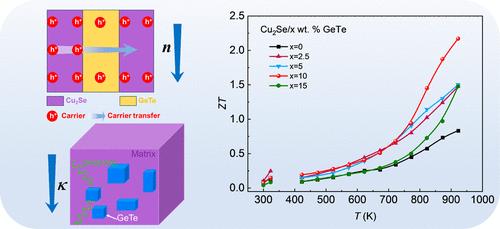
Cu2Se has emerged as a promising thermoelectric material due to its low lattice thermal conductivity, high Seebeck coefficient, and high peak figure of merit (ZT) at elevated temperatures. However, its performance is limited by a high intrinsic carrier concentration and low carrier mobility. In this work, we investigate Cu2Se-based composites to overcome these challenges by introducing GeTe as compound phase to optimize carrier concentration, enhance mobility, and promote phonon scattering. The incorporation of GeTe significantly optimized both carrier concentration and mobility, with the Cu2Se/5 wt % GeTe composite exhibiting a carrier mobility of 30.8 cm2·V-1·s-1, more than twice that of pristine Cu2Se (11.4 cm2·V-1·s-1). Additionally, the inclusion of GeTe substantially reduced both the electrical and lattice thermal conductivity across the entire temperature range. These improvements culminated in a peak ZT of 2.2 at 923 K for the Cu2Se/10 wt % GeTe composite. These findings underscore the effectiveness of utilizing high-performance thermoelectric materials, such as GeTe, as secondary phases to substantially boost the thermoelectric properties of Cu2Se. This approach offers a promising pathway for the development of advanced thermoelectric materials for energy conversion applications.
期刊介绍:
ACS Applied Materials & Interfaces is a leading interdisciplinary journal that brings together chemists, engineers, physicists, and biologists to explore the development and utilization of newly-discovered materials and interfacial processes for specific applications. Our journal has experienced remarkable growth since its establishment in 2009, both in terms of the number of articles published and the impact of the research showcased. We are proud to foster a truly global community, with the majority of published articles originating from outside the United States, reflecting the rapid growth of applied research worldwide.



 京公网安备 11010802042870号
京ICP备2023020795号-1
京公网安备 11010802042870号
京ICP备2023020795号-1

 分享
分享
 求助内容:
求助内容: 应助结果提醒方式:
 扫码关注我们
