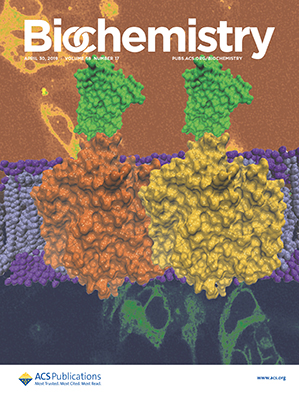
{"title":"Presenilin, γ-Secretase, and the Search for Pathogenic Triggers of Alzheimer's Disease.","authors":"Michael S Wolfe","doi":"10.1021/acs.biochem.4c00830","DOIUrl":null,"url":null,"abstract":"<p><p>Cerebral plaques of the amyloid β-peptide (Aβ) are a defining pathology in Alzheimer's disease (AD). The amyloid hypothesis of AD pathogenesis has dominated the field for over 30 years, ostensibly validated by rare AD-causing mutations in the substrate and enzyme that produce Aβ. The γ-secretase complex carries out intramembrane proteolysis of the substrate derived from the amyloid precursor protein (APP). Mutations in APP and presenilin, the catalytic component of γ-secretase, typically increase the ratio of aggregation-prone 42-residue Aβ (Aβ42) over the more soluble 40-residue form (Aβ40). Nevertheless, the inability to clarify how Aβ aggregation leads to neurodegeneration, along with poor progress in developing effective AD therapeutics that target Aβ, raises concern about whether Aβ is the primary disease driver. γ-Secretase carries out processive proteolysis on the APP substrate, producing long Aβ peptides that are generally trimmed in tripeptide intervals to shorter secreted peptides. Recent studies on effects of AD-causing mutations on the complicated proteolytic processing of the APP substrate by γ-secretase has led to the discovery that these mutations reduce─but do not abolish─processive proteolysis. Reduced proteolysis is apparently due to stabilization of enzyme-substrate complexes, and these stalled substrate-bound γ-secretase complexes can trigger synaptic degeneration even in the absence of Aβ production. Thus, the stalled process rather than the proteolytic products may be a principal initiator of AD pathogenesis. This new amyloid-independent hypothesis suggests that pharmacological agents that rescue stalled γ-secretase enzyme-substrate complexes might be effective therapeutics for AD prevention and/or treatment.</p>","PeriodicalId":28,"journal":{"name":"Biochemistry Biochemistry","volume":" ","pages":"1662-1672"},"PeriodicalIF":3.0000,"publicationDate":"2025-04-15","publicationTypes":"Journal Article","fieldsOfStudy":null,"isOpenAccess":false,"openAccessPdf":"","citationCount":"0","resultStr":null,"platform":"Semanticscholar","paperid":null,"PeriodicalName":"Biochemistry Biochemistry","FirstCategoryId":"1","ListUrlMain":"https://doi.org/10.1021/acs.biochem.4c00830","RegionNum":3,"RegionCategory":"生物学","ArticlePicture":[],"TitleCN":null,"AbstractTextCN":null,"PMCID":null,"EPubDate":"2025/2/25 0:00:00","PubModel":"Epub","JCR":"Q3","JCRName":"BIOCHEMISTRY & MOLECULAR BIOLOGY","Score":null,"Total":0}
引用次数: 0
Abstract
Cerebral plaques of the amyloid β-peptide (Aβ) are a defining pathology in Alzheimer's disease (AD). The amyloid hypothesis of AD pathogenesis has dominated the field for over 30 years, ostensibly validated by rare AD-causing mutations in the substrate and enzyme that produce Aβ. The γ-secretase complex carries out intramembrane proteolysis of the substrate derived from the amyloid precursor protein (APP). Mutations in APP and presenilin, the catalytic component of γ-secretase, typically increase the ratio of aggregation-prone 42-residue Aβ (Aβ42) over the more soluble 40-residue form (Aβ40). Nevertheless, the inability to clarify how Aβ aggregation leads to neurodegeneration, along with poor progress in developing effective AD therapeutics that target Aβ, raises concern about whether Aβ is the primary disease driver. γ-Secretase carries out processive proteolysis on the APP substrate, producing long Aβ peptides that are generally trimmed in tripeptide intervals to shorter secreted peptides. Recent studies on effects of AD-causing mutations on the complicated proteolytic processing of the APP substrate by γ-secretase has led to the discovery that these mutations reduce─but do not abolish─processive proteolysis. Reduced proteolysis is apparently due to stabilization of enzyme-substrate complexes, and these stalled substrate-bound γ-secretase complexes can trigger synaptic degeneration even in the absence of Aβ production. Thus, the stalled process rather than the proteolytic products may be a principal initiator of AD pathogenesis. This new amyloid-independent hypothesis suggests that pharmacological agents that rescue stalled γ-secretase enzyme-substrate complexes might be effective therapeutics for AD prevention and/or treatment.
期刊介绍:
Biochemistry provides an international forum for publishing exceptional, rigorous, high-impact research across all of biological chemistry. This broad scope includes studies on the chemical, physical, mechanistic, and/or structural basis of biological or cell function, and encompasses the fields of chemical biology, synthetic biology, disease biology, cell biology, nucleic acid biology, neuroscience, structural biology, and biophysics. In addition to traditional Research Articles, Biochemistry also publishes Communications, Viewpoints, and Perspectives, as well as From the Bench articles that report new methods of particular interest to the biological chemistry community.



 京公网安备 11010802042870号
京ICP备2023020795号-1
京公网安备 11010802042870号
京ICP备2023020795号-1

 分享
分享
 求助内容:
求助内容: 应助结果提醒方式:
 扫码关注我们
