Vicente Toscano de Araújo-Neto, Andressa Noronha Barbosa-Silva, Lucas Abrantes Batista, Rodrigo de Souza Mendes, Christiane Carlos Araújo de Negreiros, Barbara de Araújo Fidellis, George Harisson Felinto Sampaio, Yannara Barbosa Nogueira Freitas, Carlos Ramon do Nascimento Brito, Paulo Marcos da Matta Guedes, Lúcia Maria da Cunha Galvão, Antonia Claudia Jácome da Câmara
{"title":"Chagas disease in a naturally-infected dog from Northeast Brazil: a case report.","authors":"Vicente Toscano de Araújo-Neto, Andressa Noronha Barbosa-Silva, Lucas Abrantes Batista, Rodrigo de Souza Mendes, Christiane Carlos Araújo de Negreiros, Barbara de Araújo Fidellis, George Harisson Felinto Sampaio, Yannara Barbosa Nogueira Freitas, Carlos Ramon do Nascimento Brito, Paulo Marcos da Matta Guedes, Lúcia Maria da Cunha Galvão, Antonia Claudia Jácome da Câmara","doi":"10.1186/s12917-025-04486-5","DOIUrl":null,"url":null,"abstract":"<p><strong>Background: </strong>Dogs are the main domestic reservoir host of the parasite Trypanosoma cruzi, the causative agent of Chagas disease, and they are considered sentinel animals for the detection of new cases of human infection. Canis familiaris is also a well-established experimental T. cruzi infection model, but little is known about the progression of Chagas disease in naturally-infected dogs, especially during the acute phase in these hosts. Triatomine species infected with discrete typing units (DTUs) I, II and III of T. cruzi have been previously found in many of the municipalities of the state of Rio Grande do Norte. The current study describes the clinical, hematological, biochemical, cardiological and parasitological characteristics of a single dog during the acute phase of its naturally-acquired T. cruzi infection, and characterizes the isolate obtained from this individual host using biological, molecular and phylogenetic methods.</p><p><strong>Results: </strong>A juvenile dog exhibiting discomfort during defecation, itchy skin, and enlarged popliteal lymph nodes showed a prolonged period of patent parasitemia, with normocytic and hypochromic anemia. In addition, cardiac damage was suggested by high concentrations of the biomarkers cardiac troponin I and NT-ProBNP, as well as Doppler echocardiography, which showed qualitative segmental hypokinesia. The parasites isolated from this individual canine were genotyped, using three molecular markers and phylogenetic analysis, as the DTU TcIII. First detected in sylvatic environments, our current observations also demonstrate the presence of this DTU in domestic/ peridomestic locations.</p><p><strong>Conclusions: </strong>The cardiac alterations that we observed in a naturally-T. cruzi-infected dog contribute to expanding our knowledge of both Chagas disease in Canis familiaris, and the epidemiological scenario in locations where Triatoma brasiliensis is the main triatomine vector of T. cruzi.</p>","PeriodicalId":9041,"journal":{"name":"BMC Veterinary Research","volume":"21 1","pages":"97"},"PeriodicalIF":2.6000,"publicationDate":"2025-02-25","publicationTypes":"Journal Article","fieldsOfStudy":null,"isOpenAccess":false,"openAccessPdf":"https://www.ncbi.nlm.nih.gov/pmc/articles/PMC11853798/pdf/","citationCount":"0","resultStr":null,"platform":"Semanticscholar","paperid":null,"PeriodicalName":"BMC Veterinary Research","FirstCategoryId":"97","ListUrlMain":"https://doi.org/10.1186/s12917-025-04486-5","RegionNum":2,"RegionCategory":"农林科学","ArticlePicture":[],"TitleCN":null,"AbstractTextCN":null,"PMCID":null,"EPubDate":"","PubModel":"","JCR":"Q1","JCRName":"VETERINARY SCIENCES","Score":null,"Total":0}
引用次数: 0
Abstract
Background: Dogs are the main domestic reservoir host of the parasite Trypanosoma cruzi, the causative agent of Chagas disease, and they are considered sentinel animals for the detection of new cases of human infection. Canis familiaris is also a well-established experimental T. cruzi infection model, but little is known about the progression of Chagas disease in naturally-infected dogs, especially during the acute phase in these hosts. Triatomine species infected with discrete typing units (DTUs) I, II and III of T. cruzi have been previously found in many of the municipalities of the state of Rio Grande do Norte. The current study describes the clinical, hematological, biochemical, cardiological and parasitological characteristics of a single dog during the acute phase of its naturally-acquired T. cruzi infection, and characterizes the isolate obtained from this individual host using biological, molecular and phylogenetic methods.
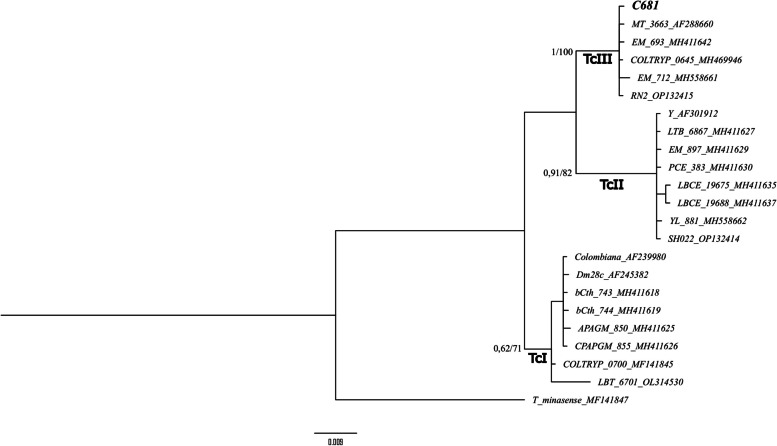
Results: A juvenile dog exhibiting discomfort during defecation, itchy skin, and enlarged popliteal lymph nodes showed a prolonged period of patent parasitemia, with normocytic and hypochromic anemia. In addition, cardiac damage was suggested by high concentrations of the biomarkers cardiac troponin I and NT-ProBNP, as well as Doppler echocardiography, which showed qualitative segmental hypokinesia. The parasites isolated from this individual canine were genotyped, using three molecular markers and phylogenetic analysis, as the DTU TcIII. First detected in sylvatic environments, our current observations also demonstrate the presence of this DTU in domestic/ peridomestic locations.
Conclusions: The cardiac alterations that we observed in a naturally-T. cruzi-infected dog contribute to expanding our knowledge of both Chagas disease in Canis familiaris, and the epidemiological scenario in locations where Triatoma brasiliensis is the main triatomine vector of T. cruzi.
期刊介绍:
BMC Veterinary Research is an open access, peer-reviewed journal that considers articles on all aspects of veterinary science and medicine, including the epidemiology, diagnosis, prevention and treatment of medical conditions of domestic, companion, farm and wild animals, as well as the biomedical processes that underlie their health.






 京公网安备 11010802042870号
京ICP备2023020795号-1
京公网安备 11010802042870号
京ICP备2023020795号-1

 分享
分享
 求助内容:
求助内容: 应助结果提醒方式:
 扫码关注我们
