{"title":"Metagenomic next-generation sequencing for etiological diagnosis of an unexpected rabies case with unclear exposure history.","authors":"Jing Wu, Yingjie Qi, Wenyan Zhang, Lixue Liu, Jiangrong Chen, Yun Yang, Xuanshun Zhang, Xinru Liu, Yuru Shi","doi":"10.1186/s12879-025-10687-y","DOIUrl":null,"url":null,"abstract":"<p><strong>Background: </strong>Rabies is an acute and lethal zoonotic disease caused by the rabies virus (RABV). After onset, there are no effective drugs or treatment methods.</p><p><strong>Case presentation: </strong>A 49-year-old female from Hefei, Anhui Province, China, presented to a local hospital with fever, pruritus, chest distress, and shortness of breath. During the consultation, the patient exhibited agitation and was later admitted to the intensive care unit (ICU) in the local hospital for endotracheal intubation and mechanical ventilation due to worsened agitation and dyspnea. Cerebrospinal fluid (CSF) and blood samples were collected and pathogenic microorganism identification was performed by culture and mNGS. However, all results were negative. In addition, the patient did not display typical rabies-specific symptoms such as aerophobia, hydrophobia or photophobia from onset to admission. Subsequently, saliva samples were collected for mNGS detection following consultation with experts at our hospital. Nucleic acid sequences uniquely aligned to the rabies virus (RABV) were identified in these samples. The result was further confirmed by local Center for Disease Control and Prevention (CDC) through RT-qPCR which detected part of the N gene of RABV in the saliva sample. The patient was then transferred to the ICU for isolation. Unfortunately, the patient died on the 10th day of admission due to multiple organ failure. The detection of human rabies virus IgG antibodies reported positive during the advanced stage of the disease during the hospitalization. We consistently verified with the patient's family member that there was no clear history of animal bites and no history of RABV vaccination. Furthermore, we performed phylogenetic analysis of partial L and G gene sequences of RABV obtained by mNGS (designated HFG23-L and HFG23-G, respectively), the results showed that both HFG23-L and HFG23-G belonged to the China I lineage, and shared 99.7% similarity with the Fengtai strain isolated from dogs in Beijing.</p><p><strong>Conclusions: </strong>The identification of unique RABV sequence through mNGS in the patient's saliva sample suggested that mNGS could serve as a valuable screening tool for the etiological diagnosis of rabies, especially when timely laboratory testing was unavailable or when patients lacked non-specific prodromal symptom and clear exposure history.</p>","PeriodicalId":8981,"journal":{"name":"BMC Infectious Diseases","volume":"25 1","pages":"258"},"PeriodicalIF":3.0000,"publicationDate":"2025-02-24","publicationTypes":"Journal Article","fieldsOfStudy":null,"isOpenAccess":false,"openAccessPdf":"https://www.ncbi.nlm.nih.gov/pmc/articles/PMC11849319/pdf/","citationCount":"0","resultStr":null,"platform":"Semanticscholar","paperid":null,"PeriodicalName":"BMC Infectious Diseases","FirstCategoryId":"3","ListUrlMain":"https://doi.org/10.1186/s12879-025-10687-y","RegionNum":3,"RegionCategory":"医学","ArticlePicture":[],"TitleCN":null,"AbstractTextCN":null,"PMCID":null,"EPubDate":"","PubModel":"","JCR":"Q2","JCRName":"INFECTIOUS DISEASES","Score":null,"Total":0}
引用次数: 0
Abstract
Background: Rabies is an acute and lethal zoonotic disease caused by the rabies virus (RABV). After onset, there are no effective drugs or treatment methods.
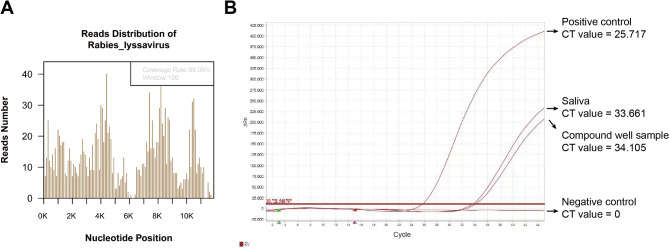
Case presentation: A 49-year-old female from Hefei, Anhui Province, China, presented to a local hospital with fever, pruritus, chest distress, and shortness of breath. During the consultation, the patient exhibited agitation and was later admitted to the intensive care unit (ICU) in the local hospital for endotracheal intubation and mechanical ventilation due to worsened agitation and dyspnea. Cerebrospinal fluid (CSF) and blood samples were collected and pathogenic microorganism identification was performed by culture and mNGS. However, all results were negative. In addition, the patient did not display typical rabies-specific symptoms such as aerophobia, hydrophobia or photophobia from onset to admission. Subsequently, saliva samples were collected for mNGS detection following consultation with experts at our hospital. Nucleic acid sequences uniquely aligned to the rabies virus (RABV) were identified in these samples. The result was further confirmed by local Center for Disease Control and Prevention (CDC) through RT-qPCR which detected part of the N gene of RABV in the saliva sample. The patient was then transferred to the ICU for isolation. Unfortunately, the patient died on the 10th day of admission due to multiple organ failure. The detection of human rabies virus IgG antibodies reported positive during the advanced stage of the disease during the hospitalization. We consistently verified with the patient's family member that there was no clear history of animal bites and no history of RABV vaccination. Furthermore, we performed phylogenetic analysis of partial L and G gene sequences of RABV obtained by mNGS (designated HFG23-L and HFG23-G, respectively), the results showed that both HFG23-L and HFG23-G belonged to the China I lineage, and shared 99.7% similarity with the Fengtai strain isolated from dogs in Beijing.
Conclusions: The identification of unique RABV sequence through mNGS in the patient's saliva sample suggested that mNGS could serve as a valuable screening tool for the etiological diagnosis of rabies, especially when timely laboratory testing was unavailable or when patients lacked non-specific prodromal symptom and clear exposure history.
期刊介绍:
BMC Infectious Diseases is an open access, peer-reviewed journal that considers articles on all aspects of the prevention, diagnosis and management of infectious and sexually transmitted diseases in humans, as well as related molecular genetics, pathophysiology, and epidemiology.





 京公网安备 11010802042870号
京ICP备2023020795号-1
京公网安备 11010802042870号
京ICP备2023020795号-1

 分享
分享
 求助内容:
求助内容: 应助结果提醒方式:
 扫码关注我们
