Characteristics and outcomes for hip fracture patients in an integrated orthogeriatric care model: a descriptive study of four discharge pathways with one-year follow-up.
Eirik Solheim Salvesen, Kristin Taraldsen, Greger Lønne, Stian Lydersen, Sarah Elizabeth Lamb, Kjersti Opdal, Ingvild Saltvedt, Lars Gunnar Johnsen
{"title":"Characteristics and outcomes for hip fracture patients in an integrated orthogeriatric care model: a descriptive study of four discharge pathways with one-year follow-up.","authors":"Eirik Solheim Salvesen, Kristin Taraldsen, Greger Lønne, Stian Lydersen, Sarah Elizabeth Lamb, Kjersti Opdal, Ingvild Saltvedt, Lars Gunnar Johnsen","doi":"10.1186/s12891-025-08427-z","DOIUrl":null,"url":null,"abstract":"<p><strong>Background: </strong>Orthogeriatric hospital care is recommended for hip fra cture patients, but differentiated hospital care has not been evaluated. The aim of this study was to describe physical performance and health-related quality of life for hip fracture patients 1-year after surgery in four treatment pathways. We also report changes in functional outcomes from baseline to 1-year follow-up together with readmission and mortality rates for each pathway.</p><p><strong>Methods: </strong>We included 177 hip fracture patients aged 65 years or older from a single center in Norway. Participants were discharged home, to specialised rehabilitation, regular rehabilitation or nursing home based on orthogeriatric assessment of pre- and postfracture function, mobility level and Ac tivities of Daily Living. Outcome variables included Short Physical Performance Battery, EuroQol-5-dimension-5-level, Barthel-index, Lawton & Brody Instrumental Activities of Daily Living, Lawton & Brody Self-Maintenance Scale, readmission and mortality rates during follow-up.</p><p><strong>Results: </strong>Participants discharged home and to specialised rehabilitation were younger and healthier than participants discharged to regular rehabilitation and nursing home. All groups had a clinically important improvement in Short Physical Performance Battery score (mean 4.8 points, 95% confidence interval (CI) 4.2, 5.5) from post-surgery to 1-year follow-up and a clinically important decline in EuroQol-5-dimension-5-level (mean -0.12 points, CI -0.16, -0.07) from baseline to 1-year follow-up. The decline in Barthel-index from baseline to 1-year follow-up was greater in the regular rehabilitation group (mean -2.3 points, CI -4.2, -0.2) than in the home group (mean -0.6 points, CI -1.4, 0.2) and specialised rehabilitation group (mean -0.4 points, CI -2.4, 1.6). Participants in the regular rehabilitation group were more frequently readmitted (standardised Pearson residual 4.1) and mortality rates were higher in the nursing home group (standardised Pearson residual 7.8) during the first year.</p><p><strong>Conclusions: </strong>Orthogeriatric treatment pathways for hip fracture patients entailed differentiation based on factors such as age, mobility, comorbidity and physical function. Participants in all pathways improved in physical performance-scores, yet experienced decline in quality of life-scores during follow-up. Overall readmission and mortality rates were not influenced, but varied between pathways. Further research is needed to investigate the need for differentiated hospital treatment and its potential effects on rehabilitation after discharge.</p>","PeriodicalId":9189,"journal":{"name":"BMC Musculoskeletal Disorders","volume":"26 1","pages":"184"},"PeriodicalIF":2.4000,"publicationDate":"2025-02-24","publicationTypes":"Journal Article","fieldsOfStudy":null,"isOpenAccess":false,"openAccessPdf":"https://www.ncbi.nlm.nih.gov/pmc/articles/PMC11849285/pdf/","citationCount":"0","resultStr":null,"platform":"Semanticscholar","paperid":null,"PeriodicalName":"BMC Musculoskeletal Disorders","FirstCategoryId":"3","ListUrlMain":"https://doi.org/10.1186/s12891-025-08427-z","RegionNum":3,"RegionCategory":"医学","ArticlePicture":[],"TitleCN":null,"AbstractTextCN":null,"PMCID":null,"EPubDate":"","PubModel":"","JCR":"Q2","JCRName":"ORTHOPEDICS","Score":null,"Total":0}
引用次数: 0
Abstract
Background: Orthogeriatric hospital care is recommended for hip fra cture patients, but differentiated hospital care has not been evaluated. The aim of this study was to describe physical performance and health-related quality of life for hip fracture patients 1-year after surgery in four treatment pathways. We also report changes in functional outcomes from baseline to 1-year follow-up together with readmission and mortality rates for each pathway.
Methods: We included 177 hip fracture patients aged 65 years or older from a single center in Norway. Participants were discharged home, to specialised rehabilitation, regular rehabilitation or nursing home based on orthogeriatric assessment of pre- and postfracture function, mobility level and Ac tivities of Daily Living. Outcome variables included Short Physical Performance Battery, EuroQol-5-dimension-5-level, Barthel-index, Lawton & Brody Instrumental Activities of Daily Living, Lawton & Brody Self-Maintenance Scale, readmission and mortality rates during follow-up.
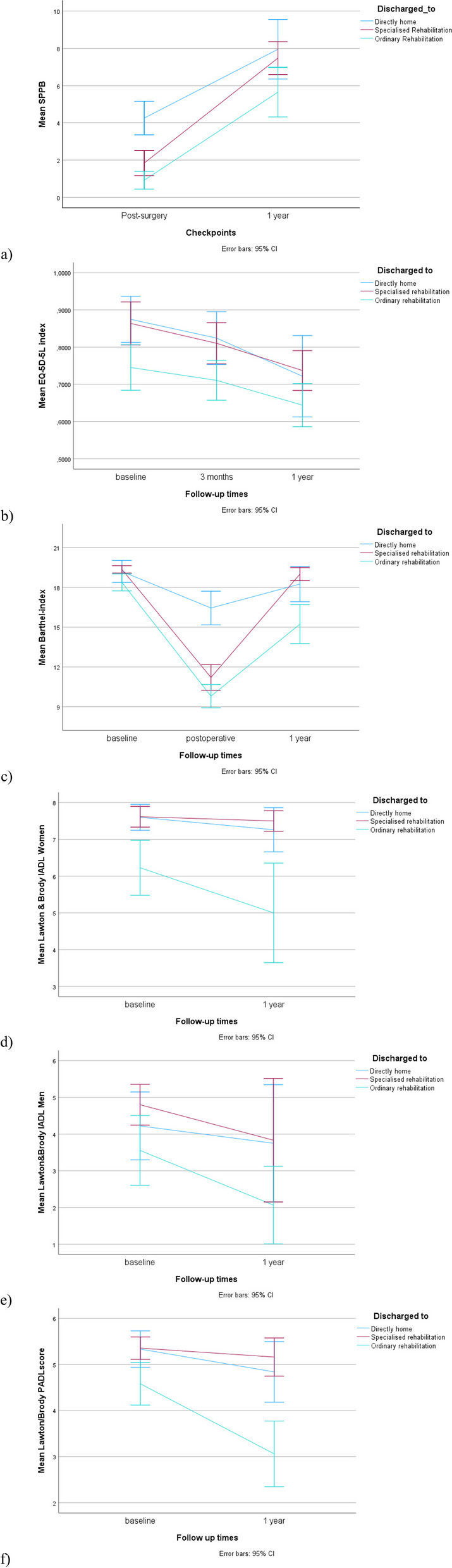
Results: Participants discharged home and to specialised rehabilitation were younger and healthier than participants discharged to regular rehabilitation and nursing home. All groups had a clinically important improvement in Short Physical Performance Battery score (mean 4.8 points, 95% confidence interval (CI) 4.2, 5.5) from post-surgery to 1-year follow-up and a clinically important decline in EuroQol-5-dimension-5-level (mean -0.12 points, CI -0.16, -0.07) from baseline to 1-year follow-up. The decline in Barthel-index from baseline to 1-year follow-up was greater in the regular rehabilitation group (mean -2.3 points, CI -4.2, -0.2) than in the home group (mean -0.6 points, CI -1.4, 0.2) and specialised rehabilitation group (mean -0.4 points, CI -2.4, 1.6). Participants in the regular rehabilitation group were more frequently readmitted (standardised Pearson residual 4.1) and mortality rates were higher in the nursing home group (standardised Pearson residual 7.8) during the first year.
Conclusions: Orthogeriatric treatment pathways for hip fracture patients entailed differentiation based on factors such as age, mobility, comorbidity and physical function. Participants in all pathways improved in physical performance-scores, yet experienced decline in quality of life-scores during follow-up. Overall readmission and mortality rates were not influenced, but varied between pathways. Further research is needed to investigate the need for differentiated hospital treatment and its potential effects on rehabilitation after discharge.
期刊介绍:
BMC Musculoskeletal Disorders is an open access, peer-reviewed journal that considers articles on all aspects of the prevention, diagnosis and management of musculoskeletal disorders, as well as related molecular genetics, pathophysiology, and epidemiology.
The scope of the Journal covers research into rheumatic diseases where the primary focus relates specifically to a component(s) of the musculoskeletal system.




 京公网安备 11010802042870号
京ICP备2023020795号-1
京公网安备 11010802042870号
京ICP备2023020795号-1

 分享
分享
 求助内容:
求助内容: 应助结果提醒方式:
 扫码关注我们
