{"title":"Numerical study of interstitial fluid flow behavior in osteons under dynamic loading.","authors":"Tianyu Liu, Baochuan Xiong, Xin Cui, Chunqiu Zhang","doi":"10.1186/s12891-025-08425-1","DOIUrl":null,"url":null,"abstract":"<p><strong>Background: </strong>The porous structure in bone tissue is essential for maintaining the physiological functions and overall health of intraosseous cells. The lacunar-canalicular net (LCN), a microscopic porous structure within osteons, facilitates the transport of nutrients and signaling molecules through interstitial fluid flow. However, the transient behavior of fluid flow within these micro-pores under dynamic loading conditions remains insufficiently studied.</p><p><strong>Methods: </strong>The study constructs a fluid-solid coupling model including the Haversian canal, canaliculi, lacunae, and interstitial fluid, to examine interstitial fluid flow behavior within the LCN under dynamic loading with varying frequencies and amplitudes. The relationship between changes of LCN pore volume and fluid velocity, and pressure is researched.</p><p><strong>Results: </strong>The results demonstrate that increasing strain amplitude leads to significant changes of LCN pore volume within osteons. In a complete loading cycle, with the increase of compressive strain, the pore volume in the osteon gradually shrinks, and the pressure gradient in the LCN increases, which promotes the increase of interstitial fluid velocity. When the compressive strain reaches the peak value, the flow velocity also reaches the maximum. In the subsequent unloading process, the pore volume began to recover, the pressure gradient gradually decreased, the flow rate decreased accordingly, and finally returned to the steady state level. At a loading amplitude of 1000 µε, the pore volume within LCN decreases by 1.1‰. At load amplitudes of 1500 µε, 2000 µε, and 2500 µε, the pore volume decreases by 1.6‰, 2.2‰ and 2.7‰ respectively, and the average flow velocity at the center of the superficial lacuna is 1.36 times, 1.77 times, and 2.14 times that at 1000 µε, respectively. Additionally, at a loading amplitude of 1000 µε under three different loading frequencies, the average flow velocities at the center of the superficial bone lacuna are 0.60 μm/s, 1.04 μm/s, and 1.54 μm/s, respectively. This indicates that high-frequency and high-amplitude dynamic loading can promote more vigorous fluid flow and pressure fluctuations with changes in LCN pore volume.</p><p><strong>Conclusions: </strong>Dynamic mechanical loading can significantly enhance the interstitial fluid flow in LCN by the changes of LCN pore volume. and dynamic loading promoted fluid flow in shallow lacunae significantly higher than that in deep lacunae. The relationship between changes of LCN pore volume and interstitial fluid flow behavior has implications for drug delivery and bone tissue engineering research.</p>","PeriodicalId":9189,"journal":{"name":"BMC Musculoskeletal Disorders","volume":"26 1","pages":"187"},"PeriodicalIF":2.4000,"publicationDate":"2025-02-24","publicationTypes":"Journal Article","fieldsOfStudy":null,"isOpenAccess":false,"openAccessPdf":"https://www.ncbi.nlm.nih.gov/pmc/articles/PMC11854024/pdf/","citationCount":"0","resultStr":null,"platform":"Semanticscholar","paperid":null,"PeriodicalName":"BMC Musculoskeletal Disorders","FirstCategoryId":"3","ListUrlMain":"https://doi.org/10.1186/s12891-025-08425-1","RegionNum":3,"RegionCategory":"医学","ArticlePicture":[],"TitleCN":null,"AbstractTextCN":null,"PMCID":null,"EPubDate":"","PubModel":"","JCR":"Q2","JCRName":"ORTHOPEDICS","Score":null,"Total":0}
引用次数: 0
Abstract
Background: The porous structure in bone tissue is essential for maintaining the physiological functions and overall health of intraosseous cells. The lacunar-canalicular net (LCN), a microscopic porous structure within osteons, facilitates the transport of nutrients and signaling molecules through interstitial fluid flow. However, the transient behavior of fluid flow within these micro-pores under dynamic loading conditions remains insufficiently studied.
Methods: The study constructs a fluid-solid coupling model including the Haversian canal, canaliculi, lacunae, and interstitial fluid, to examine interstitial fluid flow behavior within the LCN under dynamic loading with varying frequencies and amplitudes. The relationship between changes of LCN pore volume and fluid velocity, and pressure is researched.
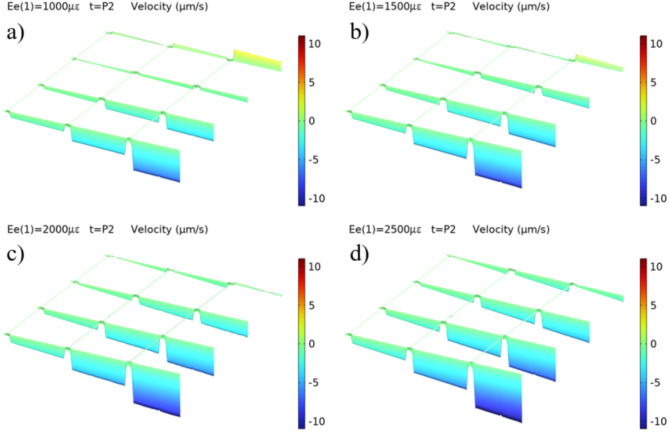
Results: The results demonstrate that increasing strain amplitude leads to significant changes of LCN pore volume within osteons. In a complete loading cycle, with the increase of compressive strain, the pore volume in the osteon gradually shrinks, and the pressure gradient in the LCN increases, which promotes the increase of interstitial fluid velocity. When the compressive strain reaches the peak value, the flow velocity also reaches the maximum. In the subsequent unloading process, the pore volume began to recover, the pressure gradient gradually decreased, the flow rate decreased accordingly, and finally returned to the steady state level. At a loading amplitude of 1000 µε, the pore volume within LCN decreases by 1.1‰. At load amplitudes of 1500 µε, 2000 µε, and 2500 µε, the pore volume decreases by 1.6‰, 2.2‰ and 2.7‰ respectively, and the average flow velocity at the center of the superficial lacuna is 1.36 times, 1.77 times, and 2.14 times that at 1000 µε, respectively. Additionally, at a loading amplitude of 1000 µε under three different loading frequencies, the average flow velocities at the center of the superficial bone lacuna are 0.60 μm/s, 1.04 μm/s, and 1.54 μm/s, respectively. This indicates that high-frequency and high-amplitude dynamic loading can promote more vigorous fluid flow and pressure fluctuations with changes in LCN pore volume.
Conclusions: Dynamic mechanical loading can significantly enhance the interstitial fluid flow in LCN by the changes of LCN pore volume. and dynamic loading promoted fluid flow in shallow lacunae significantly higher than that in deep lacunae. The relationship between changes of LCN pore volume and interstitial fluid flow behavior has implications for drug delivery and bone tissue engineering research.
期刊介绍:
BMC Musculoskeletal Disorders is an open access, peer-reviewed journal that considers articles on all aspects of the prevention, diagnosis and management of musculoskeletal disorders, as well as related molecular genetics, pathophysiology, and epidemiology.
The scope of the Journal covers research into rheumatic diseases where the primary focus relates specifically to a component(s) of the musculoskeletal system.






 京公网安备 11010802042870号
京ICP备2023020795号-1
京公网安备 11010802042870号
京ICP备2023020795号-1

 分享
分享
 求助内容:
求助内容: 应助结果提醒方式:
 扫码关注我们
