{"title":"A Chinese patient with cardiogenic stroke and warfarin resistance: a case report.","authors":"Xiaoyan Du, Peng Zhang, Linhai Hu, Qiu Chen, Shuang Cheng, Xinyu Qiu, Libo Zhao","doi":"10.1186/s12883-025-04088-6","DOIUrl":null,"url":null,"abstract":"<p><strong>Background: </strong>Warfarin is the most commonly used oral anticoagulant drug in clinical practice due to its effective anticoagulant effect and low cost. Warfarin plays a crucial role in the anticoagulant treatment of patients with thrombotic diseases such as atrial fibrillation, heart valve replacement, and deep vein thrombosis. In general, low-dose warfarin can effectively achieve the optimal international normalized ratio (INR) for patients requiring anticoagulation therapy. In some cases, patients may require significantly higher doses of warfarin to achieve an INR in the desired range; failure to achieve this is commonly referred to as warfarin resistance. We report a rare case of cerebral infarction caused by atrial fibrillation and warfarin resistance in China.</p><p><strong>Case presentation: </strong>A Chinese patient with atrial fibrillation complicated by cerebral infarction had been taking warfarin for 2 years, and the dose was gradually increased to 12.5 mg per day; however, the INR remained below the standard. The patient was considered to be resistant to warfarin. The cause of warfarin resistance in this patient is unknown, but we speculate that pharmacodynamic and genetic factors may be involved. Finally, we chose to replace warfarin with rivaroxaban to avoid the risk of bleeding at high doses. To date, there has been no bleeding or infarcts since the patient was discharged. In cases where the cause of warfarin resistance cannot be determined, alternative drugs may be more appropriate.</p><p><strong>Conclusions: </strong>When considering warfarin resistance, it is important to actively search for the cause of resistance early on. If the cause is determined, appropriate measures should be taken. If the cause is not determined or cannot be resolved, the dose can be gradually increased under close monitoring, alternatives can be actively adopted, and patients can be informed and educated.</p>","PeriodicalId":9170,"journal":{"name":"BMC Neurology","volume":"25 1","pages":"77"},"PeriodicalIF":2.2000,"publicationDate":"2025-02-24","publicationTypes":"Journal Article","fieldsOfStudy":null,"isOpenAccess":false,"openAccessPdf":"https://www.ncbi.nlm.nih.gov/pmc/articles/PMC11849382/pdf/","citationCount":"0","resultStr":null,"platform":"Semanticscholar","paperid":null,"PeriodicalName":"BMC Neurology","FirstCategoryId":"3","ListUrlMain":"https://doi.org/10.1186/s12883-025-04088-6","RegionNum":3,"RegionCategory":"医学","ArticlePicture":[],"TitleCN":null,"AbstractTextCN":null,"PMCID":null,"EPubDate":"","PubModel":"","JCR":"Q3","JCRName":"CLINICAL NEUROLOGY","Score":null,"Total":0}
引用次数: 0
Abstract
Background: Warfarin is the most commonly used oral anticoagulant drug in clinical practice due to its effective anticoagulant effect and low cost. Warfarin plays a crucial role in the anticoagulant treatment of patients with thrombotic diseases such as atrial fibrillation, heart valve replacement, and deep vein thrombosis. In general, low-dose warfarin can effectively achieve the optimal international normalized ratio (INR) for patients requiring anticoagulation therapy. In some cases, patients may require significantly higher doses of warfarin to achieve an INR in the desired range; failure to achieve this is commonly referred to as warfarin resistance. We report a rare case of cerebral infarction caused by atrial fibrillation and warfarin resistance in China.
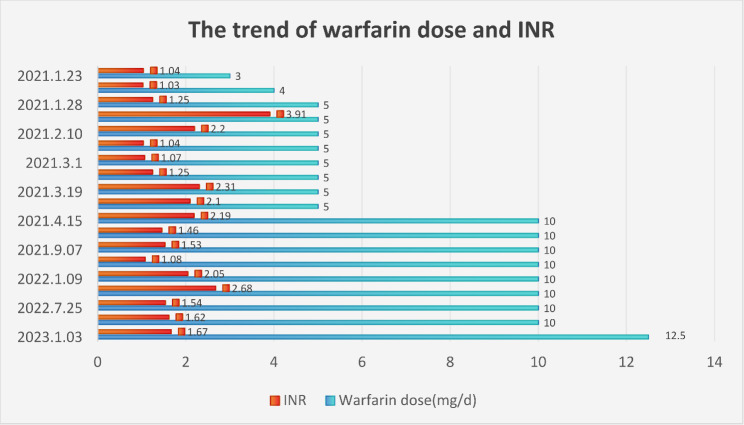
Case presentation: A Chinese patient with atrial fibrillation complicated by cerebral infarction had been taking warfarin for 2 years, and the dose was gradually increased to 12.5 mg per day; however, the INR remained below the standard. The patient was considered to be resistant to warfarin. The cause of warfarin resistance in this patient is unknown, but we speculate that pharmacodynamic and genetic factors may be involved. Finally, we chose to replace warfarin with rivaroxaban to avoid the risk of bleeding at high doses. To date, there has been no bleeding or infarcts since the patient was discharged. In cases where the cause of warfarin resistance cannot be determined, alternative drugs may be more appropriate.
Conclusions: When considering warfarin resistance, it is important to actively search for the cause of resistance early on. If the cause is determined, appropriate measures should be taken. If the cause is not determined or cannot be resolved, the dose can be gradually increased under close monitoring, alternatives can be actively adopted, and patients can be informed and educated.
期刊介绍:
BMC Neurology is an open access, peer-reviewed journal that considers articles on all aspects of the prevention, diagnosis and management of neurological disorders, as well as related molecular genetics, pathophysiology, and epidemiology.



 京公网安备 11010802042870号
京ICP备2023020795号-1
京公网安备 11010802042870号
京ICP备2023020795号-1

 分享
分享
 求助内容:
求助内容: 应助结果提醒方式:
 扫码关注我们
