Dylan Tassé, Victor Quezada-Novoa, Christopher Copeman, Prof. Ashlee J. Howarth, Prof. Alain Rochefort
{"title":"Identification of Adsorption Sites for CO2 in a Series of Rare-Earth and Zr-Based Metal-Organic Frameworks","authors":"Dylan Tassé, Victor Quezada-Novoa, Christopher Copeman, Prof. Ashlee J. Howarth, Prof. Alain Rochefort","doi":"10.1002/cphc.202401050","DOIUrl":null,"url":null,"abstract":"<p>The adsorption of <span></span><math></math>\n in MOF-808, NU-1000 and a series of rare-earth CU-10 analogues has been studied with first principles DFT and classical Monte-Carlo methods. DFT calculations describe the interaction of <span></span><math></math>\n with the different metal-organic frameworks (MOFs) as physisorption, but where we can distinguish several adsorption sites in the vicinity of the metal nodes. Beyond the identification of adsorption sites, the MOFs were synthesized, activated, and characterized to evaluate their experimental <span></span><math></math>\n and <span></span><math></math>\n adsorption capacity. Classical Grand Canonical Monte-Carlo (GCMC) simulations for the adsorption of <span></span><math></math>\n are in very good agreement with DFT results for identifying the most favored adsorption sites in the MOFs. In contrast, a rather mixed agreement between GCMC simulations and experimental results is found for the estimation of adsorption capacity of several MOFs studied toward <span></span><math></math>\n and <span></span><math></math>\n.</p>","PeriodicalId":9819,"journal":{"name":"Chemphyschem","volume":"26 10","pages":""},"PeriodicalIF":2.2000,"publicationDate":"2025-02-25","publicationTypes":"Journal Article","fieldsOfStudy":null,"isOpenAccess":false,"openAccessPdf":"https://onlinelibrary.wiley.com/doi/epdf/10.1002/cphc.202401050","citationCount":"0","resultStr":null,"platform":"Semanticscholar","paperid":null,"PeriodicalName":"Chemphyschem","FirstCategoryId":"92","ListUrlMain":"https://chemistry-europe.onlinelibrary.wiley.com/doi/10.1002/cphc.202401050","RegionNum":3,"RegionCategory":"化学","ArticlePicture":[],"TitleCN":null,"AbstractTextCN":null,"PMCID":null,"EPubDate":"","PubModel":"","JCR":"Q3","JCRName":"CHEMISTRY, PHYSICAL","Score":null,"Total":0}
引用次数: 0
Abstract
The adsorption of
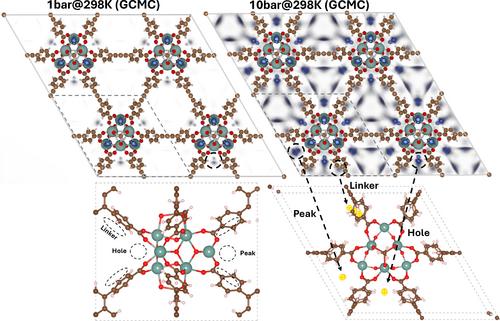
in MOF-808, NU-1000 and a series of rare-earth CU-10 analogues has been studied with first principles DFT and classical Monte-Carlo methods. DFT calculations describe the interaction of
with the different metal-organic frameworks (MOFs) as physisorption, but where we can distinguish several adsorption sites in the vicinity of the metal nodes. Beyond the identification of adsorption sites, the MOFs were synthesized, activated, and characterized to evaluate their experimental
and
adsorption capacity. Classical Grand Canonical Monte-Carlo (GCMC) simulations for the adsorption of
are in very good agreement with DFT results for identifying the most favored adsorption sites in the MOFs. In contrast, a rather mixed agreement between GCMC simulations and experimental results is found for the estimation of adsorption capacity of several MOFs studied toward
and
.
期刊介绍:
ChemPhysChem is one of the leading chemistry/physics interdisciplinary journals (ISI Impact Factor 2018: 3.077) for physical chemistry and chemical physics. It is published on behalf of Chemistry Europe, an association of 16 European chemical societies.
ChemPhysChem is an international source for important primary and critical secondary information across the whole field of physical chemistry and chemical physics. It integrates this wide and flourishing field ranging from Solid State and Soft-Matter Research, Electro- and Photochemistry, Femtochemistry and Nanotechnology, Complex Systems, Single-Molecule Research, Clusters and Colloids, Catalysis and Surface Science, Biophysics and Physical Biochemistry, Atmospheric and Environmental Chemistry, and many more topics. ChemPhysChem is peer-reviewed.





 京公网安备 11010802042870号
京ICP备2023020795号-1
京公网安备 11010802042870号
京ICP备2023020795号-1

 分享
分享
 求助内容:
求助内容: 应助结果提醒方式:
 扫码关注我们
