Kristen S. Ellis, Clint R. V. Otto, Larissa L. Bailey, Tamara A. Smith, Steven Choy, Lauren Hatch
{"title":"Integrating data to assess occupancy patterns of an endangered bumble bee","authors":"Kristen S. Ellis, Clint R. V. Otto, Larissa L. Bailey, Tamara A. Smith, Steven Choy, Lauren Hatch","doi":"10.1111/cobi.14458","DOIUrl":null,"url":null,"abstract":"<p>There is growing interest in integrating community science data with structured monitoring data to estimate changes in distribution patterns of imperiled species, including pollinators. However, significant challenges remain in determining how unstructured community science data should be incorporated into formal analyses of species distributions. We developed a dynamic framework for combining community science and structured monitoring data of bumble bees to estimate changes in occupancy of rusty-patched bumble bees (<i>Bombus affinis</i>), a federally endangered species in the United States. We applied traditional metapopulation theory and accounted for imperfect detection to estimate site-specific extirpation risk and colonization rates across the known distribution of <i>B. affinis</i> in the Upper Midwest (USA). Despite a 144% increase in presence-only detections from 2017 to 2022, occupancy probabilities and the estimated number of occupied sites remained static or declined slightly across a 4-state region during this period. Our results provide preliminary evidence that the probability of local extirpation risk of <i>B. affinis</i> increased in response to drought, but that effect was tempered with a high number of neighboring patches occupied by <i>B. affinis</i> (i.e., rescue effect). Our framework can be used by managers to track population recovery goals for <i>B. affinis</i> and other bumble bees of conservation concern. In addition, our study highlights the importance of accounting for imperfect detection and addressing spatial sampling biases in bumble bee monitoring efforts, particularly those for which a portion of the monitoring data are generated from community science projects.</p>","PeriodicalId":10689,"journal":{"name":"Conservation Biology","volume":"39 4","pages":""},"PeriodicalIF":5.5000,"publicationDate":"2025-02-25","publicationTypes":"Journal Article","fieldsOfStudy":null,"isOpenAccess":false,"openAccessPdf":"https://onlinelibrary.wiley.com/doi/epdf/10.1111/cobi.14458","citationCount":"0","resultStr":null,"platform":"Semanticscholar","paperid":null,"PeriodicalName":"Conservation Biology","FirstCategoryId":"93","ListUrlMain":"https://conbio.onlinelibrary.wiley.com/doi/10.1111/cobi.14458","RegionNum":1,"RegionCategory":"环境科学与生态学","ArticlePicture":[],"TitleCN":null,"AbstractTextCN":null,"PMCID":null,"EPubDate":"","PubModel":"","JCR":"Q1","JCRName":"BIODIVERSITY CONSERVATION","Score":null,"Total":0}
引用次数: 0
Abstract
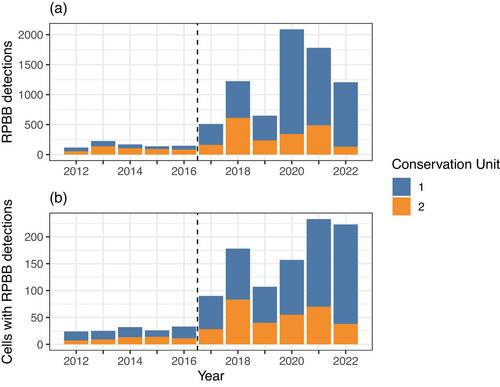
There is growing interest in integrating community science data with structured monitoring data to estimate changes in distribution patterns of imperiled species, including pollinators. However, significant challenges remain in determining how unstructured community science data should be incorporated into formal analyses of species distributions. We developed a dynamic framework for combining community science and structured monitoring data of bumble bees to estimate changes in occupancy of rusty-patched bumble bees (Bombus affinis), a federally endangered species in the United States. We applied traditional metapopulation theory and accounted for imperfect detection to estimate site-specific extirpation risk and colonization rates across the known distribution of B. affinis in the Upper Midwest (USA). Despite a 144% increase in presence-only detections from 2017 to 2022, occupancy probabilities and the estimated number of occupied sites remained static or declined slightly across a 4-state region during this period. Our results provide preliminary evidence that the probability of local extirpation risk of B. affinis increased in response to drought, but that effect was tempered with a high number of neighboring patches occupied by B. affinis (i.e., rescue effect). Our framework can be used by managers to track population recovery goals for B. affinis and other bumble bees of conservation concern. In addition, our study highlights the importance of accounting for imperfect detection and addressing spatial sampling biases in bumble bee monitoring efforts, particularly those for which a portion of the monitoring data are generated from community science projects.
期刊介绍:
Conservation Biology welcomes submissions that address the science and practice of conserving Earth's biological diversity. We encourage submissions that emphasize issues germane to any of Earth''s ecosystems or geographic regions and that apply diverse approaches to analyses and problem solving. Nevertheless, manuscripts with relevance to conservation that transcend the particular ecosystem, species, or situation described will be prioritized for publication.





 京公网安备 11010802042870号
京ICP备2023020795号-1
京公网安备 11010802042870号
京ICP备2023020795号-1

 分享
分享
 求助内容:
求助内容: 应助结果提醒方式:
 扫码关注我们
