Evaluating the effects of seed oils on lipid profile, inflammatory and oxidative markers, and glycemic control of diabetic and dyslipidemic patients: a systematic review of clinical studies.
Lucas Fornari Laurindo, Lívia Fornari Laurindo, Victória Dogani Rodrigues, Jéssica da Silva Camarinha Oliveira, Beatriz Leme Boaro, Adriano Cressoni Araújo, Elen Landgraf Guiguer, Claudia Rucco Penteado Detregiachi, Virgínia Maria Cavallari Strozze Catharin, Eduardo Federighi Baisi Chagas, Vitor Cavallari Strozze Catharin, Rosa Direito, Sandra Maria Barbalho
{"title":"Evaluating the effects of seed oils on lipid profile, inflammatory and oxidative markers, and glycemic control of diabetic and dyslipidemic patients: a systematic review of clinical studies.","authors":"Lucas Fornari Laurindo, Lívia Fornari Laurindo, Victória Dogani Rodrigues, Jéssica da Silva Camarinha Oliveira, Beatriz Leme Boaro, Adriano Cressoni Araújo, Elen Landgraf Guiguer, Claudia Rucco Penteado Detregiachi, Virgínia Maria Cavallari Strozze Catharin, Eduardo Federighi Baisi Chagas, Vitor Cavallari Strozze Catharin, Rosa Direito, Sandra Maria Barbalho","doi":"10.3389/fnut.2025.1502815","DOIUrl":null,"url":null,"abstract":"<p><p>Diabetes mellitus and dyslipidemia are significant health concerns that elevate the risk of cardiovascular disease and other metabolic disorders, necessitating effective management strategies. Recent research has highlighted the potential role of dietary fats, particularly seed oils, in influencing health outcomes in these conditions. This systematic review evaluates the impact of seed oils on lipid profiles, inflammatory and oxidative markers, and glycemic control in patients with diabetes and dyslipidemia. A comprehensive search across databases, including PubMed, Scopus, Web of Science, Cochrane Library, and Google Scholar, identified studies focusing on the effects of seed oils. The studies include randomized controlled, parallel-design, double-blind, placebo-controlled, and open-label studies published in English. The quality of the studies was assessed through a detailed review process, and data were extracted to evaluate the effects of seed oils on key metabolic markers. The review included 11 studies demonstrating that seed oils derived from canola, flaxseed, and sesame seeds can positively influence lipid profiles and glycemic control while potentially modulating oxidative stress markers. The findings suggest that seed oils may benefit in managing diabetes and dyslipidemia, although the results are sometimes inconsistent. This review provides valuable insights for dietary recommendations and therapeutic strategies, highlighting the need for further research to clarify the role of seed oils in metabolic health.</p>","PeriodicalId":12473,"journal":{"name":"Frontiers in Nutrition","volume":"12 ","pages":"1502815"},"PeriodicalIF":4.0000,"publicationDate":"2025-02-07","publicationTypes":"Journal Article","fieldsOfStudy":null,"isOpenAccess":false,"openAccessPdf":"https://www.ncbi.nlm.nih.gov/pmc/articles/PMC11849496/pdf/","citationCount":"0","resultStr":null,"platform":"Semanticscholar","paperid":null,"PeriodicalName":"Frontiers in Nutrition","FirstCategoryId":"97","ListUrlMain":"https://doi.org/10.3389/fnut.2025.1502815","RegionNum":2,"RegionCategory":"农林科学","ArticlePicture":[],"TitleCN":null,"AbstractTextCN":null,"PMCID":null,"EPubDate":"2025/1/1 0:00:00","PubModel":"eCollection","JCR":"Q2","JCRName":"NUTRITION & DIETETICS","Score":null,"Total":0}
引用次数: 0
Abstract
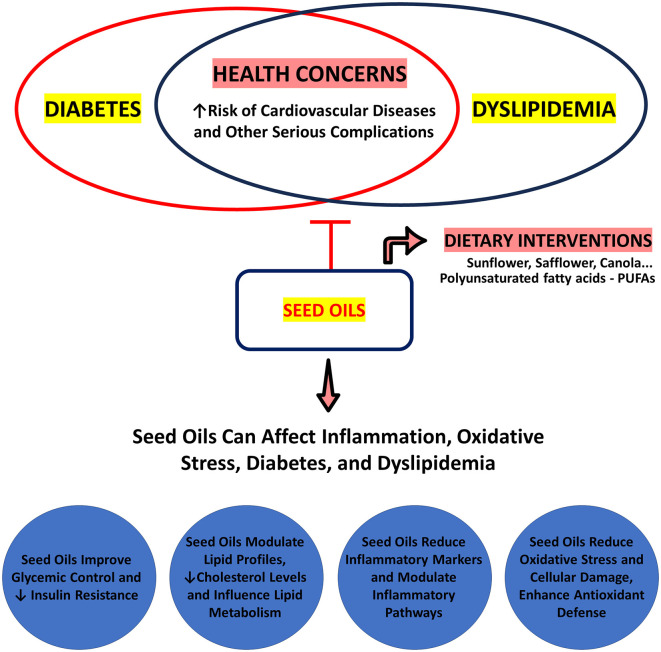
Diabetes mellitus and dyslipidemia are significant health concerns that elevate the risk of cardiovascular disease and other metabolic disorders, necessitating effective management strategies. Recent research has highlighted the potential role of dietary fats, particularly seed oils, in influencing health outcomes in these conditions. This systematic review evaluates the impact of seed oils on lipid profiles, inflammatory and oxidative markers, and glycemic control in patients with diabetes and dyslipidemia. A comprehensive search across databases, including PubMed, Scopus, Web of Science, Cochrane Library, and Google Scholar, identified studies focusing on the effects of seed oils. The studies include randomized controlled, parallel-design, double-blind, placebo-controlled, and open-label studies published in English. The quality of the studies was assessed through a detailed review process, and data were extracted to evaluate the effects of seed oils on key metabolic markers. The review included 11 studies demonstrating that seed oils derived from canola, flaxseed, and sesame seeds can positively influence lipid profiles and glycemic control while potentially modulating oxidative stress markers. The findings suggest that seed oils may benefit in managing diabetes and dyslipidemia, although the results are sometimes inconsistent. This review provides valuable insights for dietary recommendations and therapeutic strategies, highlighting the need for further research to clarify the role of seed oils in metabolic health.
糖尿病和血脂异常是显著的健康问题,可提高心血管疾病和其他代谢紊乱的风险,需要有效的管理策略。最近的研究强调了膳食脂肪,特别是种子油在影响这些疾病的健康结果方面的潜在作用。本系统综述评估了种子油对糖尿病和血脂异常患者的脂质谱、炎症和氧化标志物以及血糖控制的影响。在PubMed、Scopus、Web of Science、Cochrane Library和b谷歌Scholar等数据库中进行了全面的搜索,确定了关注种子油效果的研究。这些研究包括随机对照、平行设计、双盲、安慰剂对照和以英文发表的开放标签研究。通过详细的审查过程来评估研究的质量,并提取数据以评估种子油对关键代谢标志物的影响。这篇综述包括11项研究,表明从菜籽油、亚麻籽和芝麻籽中提取的种子油可以积极影响血脂和血糖控制,同时可能调节氧化应激标志物。研究结果表明,种子油可能有利于控制糖尿病和血脂异常,尽管结果有时不一致。这一综述为膳食建议和治疗策略提供了有价值的见解,强调了进一步研究阐明种子油在代谢健康中的作用的必要性。
期刊介绍:
No subject pertains more to human life than nutrition. The aim of Frontiers in Nutrition is to integrate major scientific disciplines in this vast field in order to address the most relevant and pertinent questions and developments. Our ambition is to create an integrated podium based on original research, clinical trials, and contemporary reviews to build a reputable knowledge forum in the domains of human health, dietary behaviors, agronomy & 21st century food science. Through the recognized open-access Frontiers platform we welcome manuscripts to our dedicated sections relating to different areas in the field of nutrition with a focus on human health.
Specialty sections in Frontiers in Nutrition include, for example, Clinical Nutrition, Nutrition & Sustainable Diets, Nutrition and Food Science Technology, Nutrition Methodology, Sport & Exercise Nutrition, Food Chemistry, and Nutritional Immunology. Based on the publication of rigorous scientific research, we thrive to achieve a visible impact on the global nutrition agenda addressing the grand challenges of our time, including obesity, malnutrition, hunger, food waste, sustainability and consumer health.





 京公网安备 11010802042870号
京ICP备2023020795号-1
京公网安备 11010802042870号
京ICP备2023020795号-1

 分享
分享
 求助内容:
求助内容: 应助结果提醒方式:
 扫码关注我们
