Ana M Yélamos, Jose F Marcos, Paloma Manzanares, Sandra Garrigues
{"title":"Harnessing Filamentous Fungi for Enzyme Cocktail Production Through Rice Bran Bioprocessing.","authors":"Ana M Yélamos, Jose F Marcos, Paloma Manzanares, Sandra Garrigues","doi":"10.3390/jof11020106","DOIUrl":null,"url":null,"abstract":"<p><p>Valorization of agri-food residues has garnered significant interest for obtaining value-added compounds such as enzymes or bioactive molecules. Rice milling by-products, such as rice bran, have limited commercial value and may pose environmental challenges. Filamentous fungi are recognized for their ability to grow on residues and for their capacity to produce large amounts of metabolites and enzymes of industrial interest. Here, we used filamentous fungi to produce enzyme cocktails from rice bran, which, due to its polysaccharide composition, serves as an ideal substrate for the growth of fungi producing cellulases and xylanases. To this end, sixteen fungal strains were isolated from rice bran and identified at the species level. The species belonged to the genera <i>Aspergillus</i>, <i>Penicillium</i>, and <i>Mucor</i>. The <i>Aspergillus</i> species displayed the highest efficiency in cellulase and xylanase activities, especially <i>A. niger</i> var. <i>phoenicis</i> and <i>A. amstelodami</i>. <i>A. terreus</i>, <i>A. tritici</i>, and <i>A. montevidensis</i> stood out as xylanolytic isolates, while <i>P. parvofructum</i> exhibited good cellulase activity. <i>A. niger</i> var. <i>phoenicis</i> followed by <i>A. terreus</i> showed the highest specific enzymatic activities of α- and β-D-galactosidase, α-L-arabinofuranosidase, α- and β-D-glucosidase, and β-D-xylosidase. Additionally, proteomic analysis of <i>A. terreus</i>, <i>A. niger</i> var. <i>phoenicis</i>, and <i>P. parvofructum</i> exoproteomes revealed differences in enzyme production for rice bran degradation. <i>A. niger</i> var. <i>phoenicis</i> had the highest levels of xylanases and cellulases, while <i>P. parvofructum</i> excelled in proteases, starch-degrading enzymes, and antifungal proteins. Finally, two <i>Penicillium</i> isolates were notable as producers of up to three different antifungal proteins. Our results demonstrate that filamentous fungi can effectively valorize rice bran by producing enzyme cocktails of industrial interest, along with bioactive peptides, in a cost-efficient manner, aligning with the circular bio-economy framework.</p>","PeriodicalId":15878,"journal":{"name":"Journal of Fungi","volume":"11 2","pages":""},"PeriodicalIF":4.3000,"publicationDate":"2025-01-31","publicationTypes":"Journal Article","fieldsOfStudy":null,"isOpenAccess":false,"openAccessPdf":"https://www.ncbi.nlm.nih.gov/pmc/articles/PMC11856480/pdf/","citationCount":"0","resultStr":null,"platform":"Semanticscholar","paperid":null,"PeriodicalName":"Journal of Fungi","FirstCategoryId":"99","ListUrlMain":"https://doi.org/10.3390/jof11020106","RegionNum":2,"RegionCategory":"生物学","ArticlePicture":[],"TitleCN":null,"AbstractTextCN":null,"PMCID":null,"EPubDate":"","PubModel":"","JCR":"Q2","JCRName":"MICROBIOLOGY","Score":null,"Total":0}
引用次数: 0
Abstract
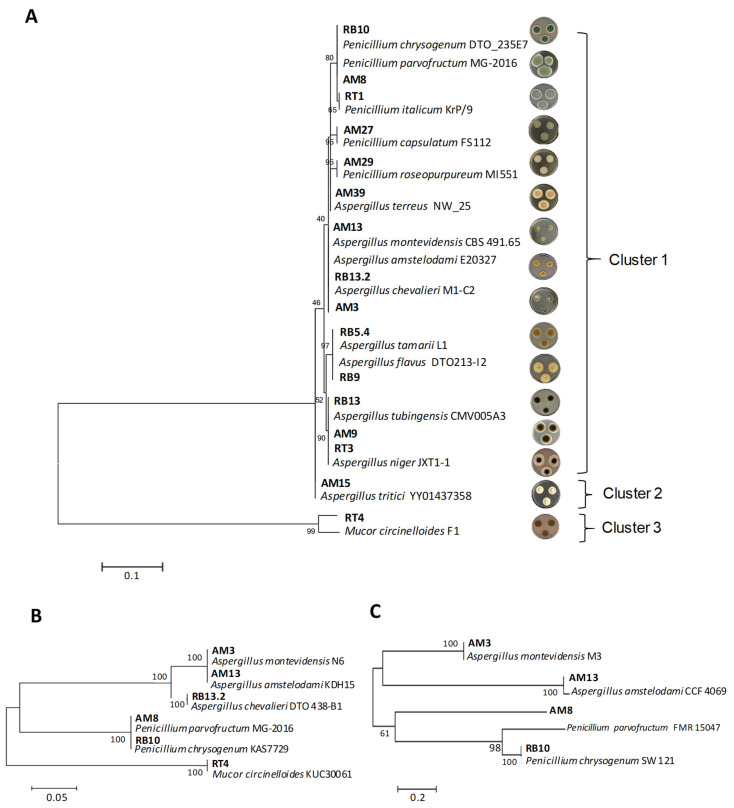
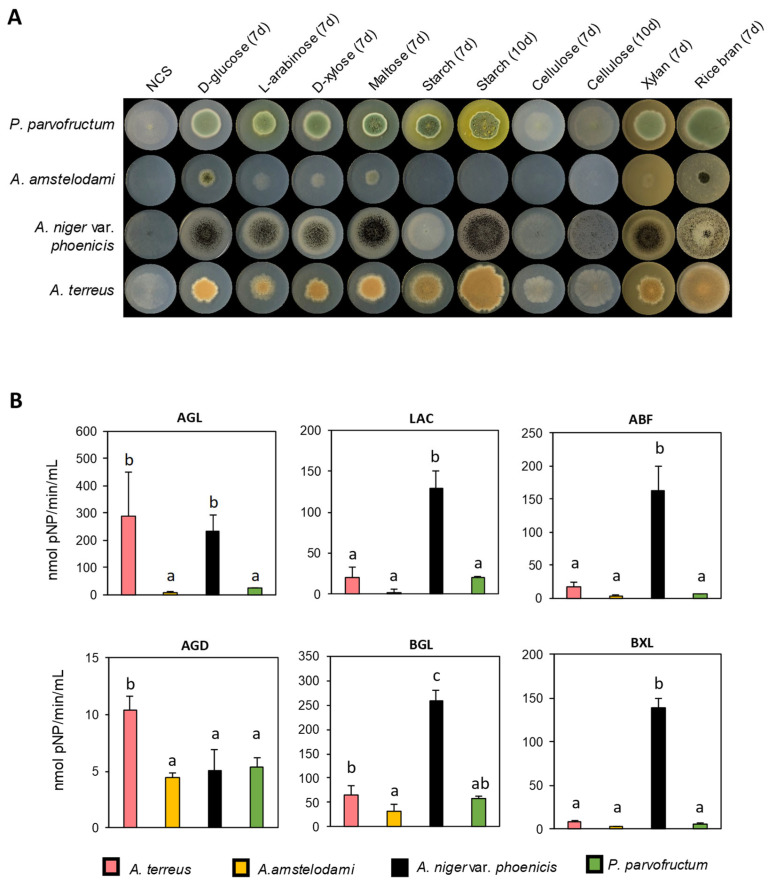
Valorization of agri-food residues has garnered significant interest for obtaining value-added compounds such as enzymes or bioactive molecules. Rice milling by-products, such as rice bran, have limited commercial value and may pose environmental challenges. Filamentous fungi are recognized for their ability to grow on residues and for their capacity to produce large amounts of metabolites and enzymes of industrial interest. Here, we used filamentous fungi to produce enzyme cocktails from rice bran, which, due to its polysaccharide composition, serves as an ideal substrate for the growth of fungi producing cellulases and xylanases. To this end, sixteen fungal strains were isolated from rice bran and identified at the species level. The species belonged to the genera Aspergillus, Penicillium, and Mucor. The Aspergillus species displayed the highest efficiency in cellulase and xylanase activities, especially A. niger var. phoenicis and A. amstelodami. A. terreus, A. tritici, and A. montevidensis stood out as xylanolytic isolates, while P. parvofructum exhibited good cellulase activity. A. niger var. phoenicis followed by A. terreus showed the highest specific enzymatic activities of α- and β-D-galactosidase, α-L-arabinofuranosidase, α- and β-D-glucosidase, and β-D-xylosidase. Additionally, proteomic analysis of A. terreus, A. niger var. phoenicis, and P. parvofructum exoproteomes revealed differences in enzyme production for rice bran degradation. A. niger var. phoenicis had the highest levels of xylanases and cellulases, while P. parvofructum excelled in proteases, starch-degrading enzymes, and antifungal proteins. Finally, two Penicillium isolates were notable as producers of up to three different antifungal proteins. Our results demonstrate that filamentous fungi can effectively valorize rice bran by producing enzyme cocktails of industrial interest, along with bioactive peptides, in a cost-efficient manner, aligning with the circular bio-economy framework.
农业食品残留物的增值已经获得了重要的兴趣,以获得增值化合物,如酶或生物活性分子。米糠等碾米副产品的商业价值有限,并可能带来环境挑战。丝状真菌因其在残留物上生长的能力和产生大量工业用途代谢物和酶的能力而得到认可。在这里,我们使用丝状真菌从米糠中生产鸡尾酒酶,由于其多糖成分,它可以作为真菌生产纤维素酶和木聚糖酶的理想底物。为此,从米糠中分离到16株真菌,并在种水平上进行了鉴定。属曲霉属、青霉属和毛霉属。各曲霉菌的纤维素酶和木聚糖酶活性最高,尤其是黑曲霉和黑曲霉。A. terreus、A. tritici和A. montevidensis具有显著的木聚糖分解活性,而P. parvofructum具有良好的纤维素酶活性。α-和β- d -半乳糖苷酶、α- l -阿拉伯糖核苷酶、α-和β- d -葡萄糖苷酶、β- d -木糖苷酶比活性最高的是黑檀香,其次是土檀香。此外,对土霉、黑霉和小圆霉的蛋白质组学分析也揭示了米糠降解酶产生的差异。黑曲霉的木聚糖酶和纤维素酶含量最高,而小角曲霉的蛋白酶、淀粉降解酶和抗真菌蛋白含量最高。最后,两株青霉菌菌株作为多达三种不同的抗真菌蛋白的生产者而引人注目。我们的研究结果表明,丝状真菌可以通过生产具有工业价值的酶鸡尾酒,以及生物活性肽,以经济高效的方式有效地使米糠增值,符合循环生物经济框架。
期刊介绍:
Journal of Fungi (ISSN 2309-608X) is an international, peer-reviewed scientific open access journal that provides an advanced forum for studies related to pathogenic fungi, fungal biology, and all other aspects of fungal research. The journal publishes reviews, regular research papers, and communications in quarterly issues. Our aim is to encourage scientists to publish their experimental and theoretical results in as much detail as possible. Therefore, there is no restriction on paper length. Full experimental details must be provided so that the results can be reproduced.





 京公网安备 11010802042870号
京ICP备2023020795号-1
京公网安备 11010802042870号
京ICP备2023020795号-1

 分享
分享
 求助内容:
求助内容: 应助结果提醒方式:
 扫码关注我们
