{"title":"Association of Statin Therapy with Functional Outcomes and Survival in Intracerebral and Subarachnoid Hemorrhage.","authors":"Bahadar S Srichawla, Daksha Gopal, Majaz Moonis","doi":"10.3390/neurolint17020027","DOIUrl":null,"url":null,"abstract":"<p><p><b>Background/Objectives</b>: Intracerebral hemorrhage (ICH) and subarachnoid hemorrhage (SAH) are severe forms of stroke with high morbidity and mortality rates. HMG-CoA reductase inhibitors, commonly referred to as statins, known for their lipid-lowering abilities, also possess pleiotropic properties, including anti-inflammatory and neuroprotective effects. We aimed to evaluate the impact of statin therapy on the functional outcomes and survival in patients with ICH and SAH. <b>Methods</b>: This retrospective cohort study analyzed data from the Get With The Guidelines (GWTG) stroke registry at a tertiary care center, including patients diagnosed with ICH or SAH between January 2008 and June 2022. Patients were categorized based on prior initiation of statin therapy: no statin, low-intensity statin, or high-intensity statin. The primary outcome was the Modified Rankin Scale (mRS) score at discharge, dichotomized to good (0-2) and poor (3-6) outcomes. A multivariate logistic regression model controlled for age, gender, and National Institutes of Health Stroke Scale (NIHSS) score at admission. <b>Results</b>: A total of 663 patients with ICH and 159 patients with SAH were included in the analysis. In the ICH patients, low-intensity statin therapy was associated with significantly higher odds of a good functional outcome (aOR 2.56, 95% CI 1.247-5.246, <i>p</i> = 0.0104), as was high-intensity statin therapy (aOR 2.445, 95% CI 1.313-4.552, <i>p</i> = 0.0048). Among the SAH patients, all 39 deaths occurred in the no statin therapy group. <b>Conclusions</b>: Both low- and high-intensity statin therapy are associated with improved functional outcomes in ICH and may offer a survival benefit in SAH. These findings highlight the potential neuroprotective role of statins in hemorrhagic stroke. Further prospective studies and randomized controlled trials are needed to confirm these observations and to clarify the optimal use of statins in this patient population.</p>","PeriodicalId":19130,"journal":{"name":"Neurology International","volume":"17 2","pages":""},"PeriodicalIF":3.0000,"publicationDate":"2025-02-10","publicationTypes":"Journal Article","fieldsOfStudy":null,"isOpenAccess":false,"openAccessPdf":"https://www.ncbi.nlm.nih.gov/pmc/articles/PMC11858637/pdf/","citationCount":"0","resultStr":null,"platform":"Semanticscholar","paperid":null,"PeriodicalName":"Neurology International","FirstCategoryId":"1085","ListUrlMain":"https://doi.org/10.3390/neurolint17020027","RegionNum":0,"RegionCategory":null,"ArticlePicture":[],"TitleCN":null,"AbstractTextCN":null,"PMCID":null,"EPubDate":"","PubModel":"","JCR":"Q2","JCRName":"CLINICAL NEUROLOGY","Score":null,"Total":0}
引用次数: 0
Abstract
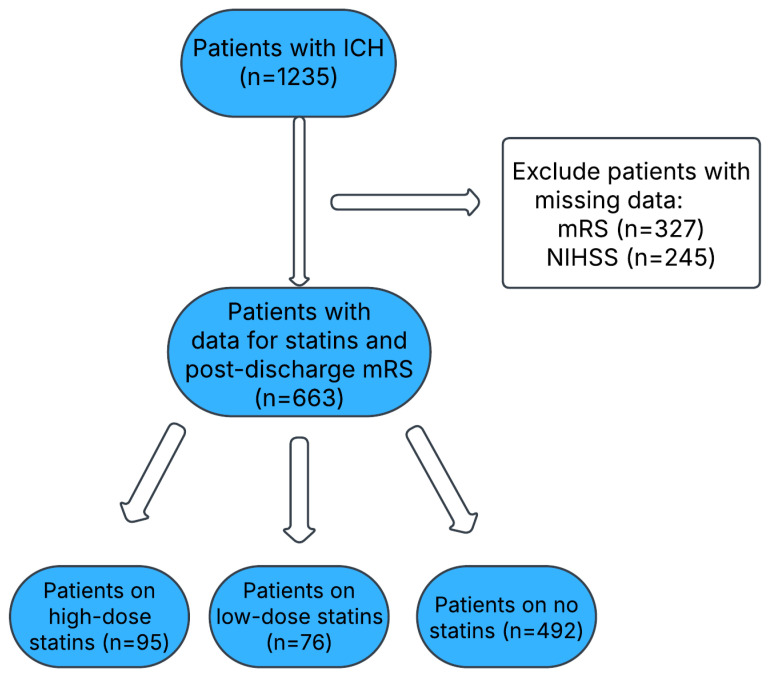
Background/Objectives: Intracerebral hemorrhage (ICH) and subarachnoid hemorrhage (SAH) are severe forms of stroke with high morbidity and mortality rates. HMG-CoA reductase inhibitors, commonly referred to as statins, known for their lipid-lowering abilities, also possess pleiotropic properties, including anti-inflammatory and neuroprotective effects. We aimed to evaluate the impact of statin therapy on the functional outcomes and survival in patients with ICH and SAH. Methods: This retrospective cohort study analyzed data from the Get With The Guidelines (GWTG) stroke registry at a tertiary care center, including patients diagnosed with ICH or SAH between January 2008 and June 2022. Patients were categorized based on prior initiation of statin therapy: no statin, low-intensity statin, or high-intensity statin. The primary outcome was the Modified Rankin Scale (mRS) score at discharge, dichotomized to good (0-2) and poor (3-6) outcomes. A multivariate logistic regression model controlled for age, gender, and National Institutes of Health Stroke Scale (NIHSS) score at admission. Results: A total of 663 patients with ICH and 159 patients with SAH were included in the analysis. In the ICH patients, low-intensity statin therapy was associated with significantly higher odds of a good functional outcome (aOR 2.56, 95% CI 1.247-5.246, p = 0.0104), as was high-intensity statin therapy (aOR 2.445, 95% CI 1.313-4.552, p = 0.0048). Among the SAH patients, all 39 deaths occurred in the no statin therapy group. Conclusions: Both low- and high-intensity statin therapy are associated with improved functional outcomes in ICH and may offer a survival benefit in SAH. These findings highlight the potential neuroprotective role of statins in hemorrhagic stroke. Further prospective studies and randomized controlled trials are needed to confirm these observations and to clarify the optimal use of statins in this patient population.
背景/目的:脑出血(ICH)和蛛网膜下腔出血(SAH)是卒中的严重形式,具有高发病率和高死亡率。HMG-CoA还原酶抑制剂,通常被称为他汀类药物,以其降脂能力而闻名,也具有多效性,包括抗炎和神经保护作用。我们的目的是评估他汀类药物治疗对脑出血和SAH患者的功能结局和生存的影响。方法:这项回顾性队列研究分析了三级保健中心的GWTG卒中登记数据,包括2008年1月至2022年6月诊断为脑出血或SAH的患者。患者根据先前开始的他汀类药物治疗进行分类:无他汀类药物、低强度他汀类药物或高强度他汀类药物。主要转归为出院时的改良兰金量表(mRS)评分,分为好(0-2)和差(3-6)两种结果。采用多变量logistic回归模型控制年龄、性别和入院时美国国立卫生研究院卒中量表(NIHSS)评分。结果:共有663例脑出血患者和159例SAH患者纳入分析。在脑出血患者中,低强度他汀类药物治疗与良好功能结局的几率显著升高相关(aOR 2.56, 95% CI 1.247-5.246, p = 0.0104),高强度他汀类药物治疗也是如此(aOR 2.445, 95% CI 1.313-4.552, p = 0.0048)。在SAH患者中,39例死亡全部发生在未接受他汀类药物治疗的组。结论:低强度和高强度他汀类药物治疗与脑出血患者功能预后的改善相关,并可能提高SAH患者的生存率。这些发现强调了他汀类药物在出血性中风中的潜在神经保护作用。需要进一步的前瞻性研究和随机对照试验来证实这些观察结果,并澄清他汀类药物在该患者群体中的最佳使用。





 京公网安备 11010802042870号
京ICP备2023020795号-1
京公网安备 11010802042870号
京ICP备2023020795号-1

 分享
分享
 求助内容:
求助内容: 应助结果提醒方式:
 扫码关注我们
