Setyo Budi Kurniawan, Azmi Ahmad, Muhammad Fauzul Imron, Siti Rozaimah Sheikh Abdullah, Ahmad Razi Othman, Hassimi Abu Hasan
{"title":"Achieving a Biocircular Economy in the Aquaculture Sector Through Waste Valorization.","authors":"Setyo Budi Kurniawan, Azmi Ahmad, Muhammad Fauzul Imron, Siti Rozaimah Sheikh Abdullah, Ahmad Razi Othman, Hassimi Abu Hasan","doi":"10.3390/toxics13020131","DOIUrl":null,"url":null,"abstract":"<p><p>Aquaculture wastewater treatment not only assists in alleviating the scarcity of clean water for daily usage and environmental pollution, but also generates valuable byproducts. This paper aims to review the generation of wastewater from the aquaculture sector, its characteristics, and available treatment technologies, while comprehensively discussing the adoption of a biocircular economy approach through waste valorization. With rich nutrients, such as nitrogenous compounds, and the presence of phosphorus in the aquaculture effluent, these aspects could be explored and valorized into biofertilizers, broadening their application in aquaponics and hydroponics, as well as in algae and daphnid cultivation. Biofertilizer can also be used in agriculture because it contains essential elements needed by plants. Thus, methods of converting nutrients into biofertilizers in terms of sludge recovery can be accomplished via anaerobic and aerobic digestion, drying, composting, and vermicomposting. Moving forward, aquaculture effluent recovery is addressed under the biocircular economy by re-engaging aquaculture wastewater effluents into the production cycle. The enhancement of aquaculture effluents and biomass for uses such as aquaponics, hydroponics, algae cultivation, daphnid co-cultivation, and biofertilizers presents valuable opportunities for nutrient recovery while ensuring that non-toxic wastewater can be safely discharged into external water bodies. This approach has the potential to revolutionize wastewater treatment in aquaculture, shifting the economic model of wastewater management from a linear system to a circular, more sustainable one.</p>","PeriodicalId":23195,"journal":{"name":"Toxics","volume":"13 2","pages":""},"PeriodicalIF":4.1000,"publicationDate":"2025-02-11","publicationTypes":"Journal Article","fieldsOfStudy":null,"isOpenAccess":false,"openAccessPdf":"https://www.ncbi.nlm.nih.gov/pmc/articles/PMC11860438/pdf/","citationCount":"0","resultStr":null,"platform":"Semanticscholar","paperid":null,"PeriodicalName":"Toxics","FirstCategoryId":"93","ListUrlMain":"https://doi.org/10.3390/toxics13020131","RegionNum":3,"RegionCategory":"环境科学与生态学","ArticlePicture":[],"TitleCN":null,"AbstractTextCN":null,"PMCID":null,"EPubDate":"","PubModel":"","JCR":"Q2","JCRName":"ENVIRONMENTAL SCIENCES","Score":null,"Total":0}
引用次数: 0
Abstract
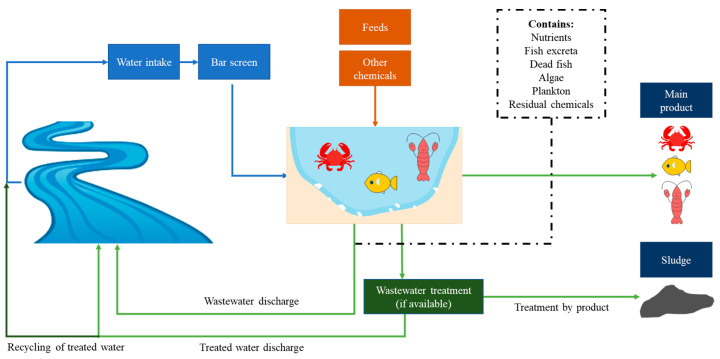
Aquaculture wastewater treatment not only assists in alleviating the scarcity of clean water for daily usage and environmental pollution, but also generates valuable byproducts. This paper aims to review the generation of wastewater from the aquaculture sector, its characteristics, and available treatment technologies, while comprehensively discussing the adoption of a biocircular economy approach through waste valorization. With rich nutrients, such as nitrogenous compounds, and the presence of phosphorus in the aquaculture effluent, these aspects could be explored and valorized into biofertilizers, broadening their application in aquaponics and hydroponics, as well as in algae and daphnid cultivation. Biofertilizer can also be used in agriculture because it contains essential elements needed by plants. Thus, methods of converting nutrients into biofertilizers in terms of sludge recovery can be accomplished via anaerobic and aerobic digestion, drying, composting, and vermicomposting. Moving forward, aquaculture effluent recovery is addressed under the biocircular economy by re-engaging aquaculture wastewater effluents into the production cycle. The enhancement of aquaculture effluents and biomass for uses such as aquaponics, hydroponics, algae cultivation, daphnid co-cultivation, and biofertilizers presents valuable opportunities for nutrient recovery while ensuring that non-toxic wastewater can be safely discharged into external water bodies. This approach has the potential to revolutionize wastewater treatment in aquaculture, shifting the economic model of wastewater management from a linear system to a circular, more sustainable one.
ToxicsChemical Engineering-Chemical Health and Safety
CiteScore
4.50
自引率
10.90%
发文量
681
审稿时长
6 weeks
期刊介绍:
Toxics (ISSN 2305-6304) is an international, peer-reviewed, open access journal which provides an advanced forum for studies related to all aspects of toxic chemicals and materials. It publishes reviews, regular research papers, and short communications. Our aim is to encourage scientists to publish their experimental and theoretical results in detail. There is, therefore, no restriction on the maximum length of the papers, although authors should write their papers in a clear and concise way. The full experimental details must be provided so that the results can be reproduced. Electronic files or software regarding the full details of calculations and experimental procedure can be deposited as supplementary material, if it is not possible to publish them along with the text.




 京公网安备 11010802042870号
京ICP备2023020795号-1
京公网安备 11010802042870号
京ICP备2023020795号-1

 分享
分享
 求助内容:
求助内容: 应助结果提醒方式:
 扫码关注我们
