Debora Cristina Damasceno de Souza, Lucilene Finoto Viana, Fábio Kummrow, Claudia Andrea Lima Cardoso, Nathalya Alice de Lima, Izabelle Alexandra Rodrigues Lacerda, Bruno do Amaral Crispim, Alexeia Barufatti, Lúcio André Viana Dias, Alexandro Cezar Florentino
{"title":"Bioaccumulation of Metals in Fish Collected from Macapá Urban Aquatic Environments (Brazilian Amazon) and the Risks to Human Health.","authors":"Debora Cristina Damasceno de Souza, Lucilene Finoto Viana, Fábio Kummrow, Claudia Andrea Lima Cardoso, Nathalya Alice de Lima, Izabelle Alexandra Rodrigues Lacerda, Bruno do Amaral Crispim, Alexeia Barufatti, Lúcio André Viana Dias, Alexandro Cezar Florentino","doi":"10.3390/toxics13020067","DOIUrl":null,"url":null,"abstract":"<p><p>Macapá City, located in the Brazilian Amazon, faces critical aquatic pollution challenges due to inadequate sanitation infrastructure, leading to metal contamination in fish within its urban water bodies. Our study evaluated the concentrations of metals (Cu, Cd, Cr, Fe, Mn, Ni, Pb, Zn, and Hg) in muscle tissues of fish from igarapés, ressaca areas, and canals. Samples were collected from six sampling sites to investigate the bioaccumulation of these metals and their potential human health risks. All metals were quantified by atomic absorption spectrometry, except Hg, which was quantified by inductively coupled plasma optical emission spectrometry. Metal concentrations were determined in three carnivorous and seven omnivorous fish species. Cd concentrations exceeded the Brazilian maximum limit established for human consumption in all fish species evaluated. The estimated daily intake (EDI) of Pb and Hg exceeded their reference doses. Our risk assessment, which combined the risk quotient (RQ) for individual metals and the risk index (RI) for metal mixtures, indicated health risks associated with the consumption of fish collected from the study areas. These results demonstrated a worrying exposure to metals (mainly Cd, Pb, and Hg), highlighting the need for environmental management measures and continuous monitoring to protect public health in vulnerable urban areas.</p>","PeriodicalId":23195,"journal":{"name":"Toxics","volume":"13 2","pages":""},"PeriodicalIF":4.1000,"publicationDate":"2025-01-21","publicationTypes":"Journal Article","fieldsOfStudy":null,"isOpenAccess":false,"openAccessPdf":"https://www.ncbi.nlm.nih.gov/pmc/articles/PMC11860544/pdf/","citationCount":"0","resultStr":null,"platform":"Semanticscholar","paperid":null,"PeriodicalName":"Toxics","FirstCategoryId":"93","ListUrlMain":"https://doi.org/10.3390/toxics13020067","RegionNum":3,"RegionCategory":"环境科学与生态学","ArticlePicture":[],"TitleCN":null,"AbstractTextCN":null,"PMCID":null,"EPubDate":"","PubModel":"","JCR":"Q2","JCRName":"ENVIRONMENTAL SCIENCES","Score":null,"Total":0}
引用次数: 0
Abstract
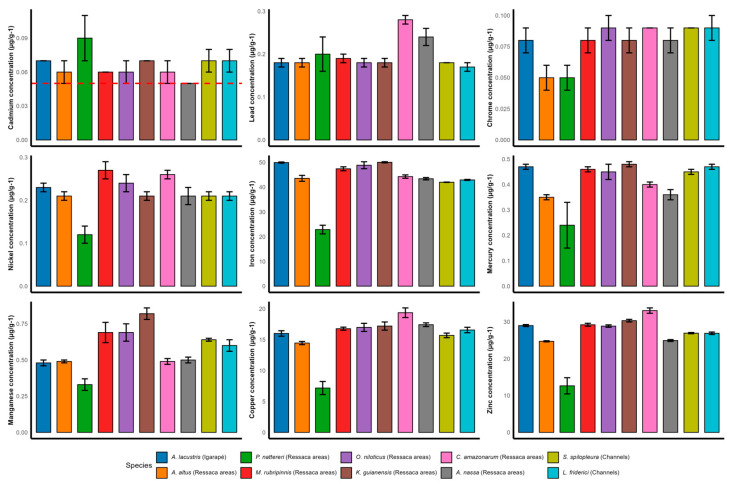
Macapá City, located in the Brazilian Amazon, faces critical aquatic pollution challenges due to inadequate sanitation infrastructure, leading to metal contamination in fish within its urban water bodies. Our study evaluated the concentrations of metals (Cu, Cd, Cr, Fe, Mn, Ni, Pb, Zn, and Hg) in muscle tissues of fish from igarapés, ressaca areas, and canals. Samples were collected from six sampling sites to investigate the bioaccumulation of these metals and their potential human health risks. All metals were quantified by atomic absorption spectrometry, except Hg, which was quantified by inductively coupled plasma optical emission spectrometry. Metal concentrations were determined in three carnivorous and seven omnivorous fish species. Cd concentrations exceeded the Brazilian maximum limit established for human consumption in all fish species evaluated. The estimated daily intake (EDI) of Pb and Hg exceeded their reference doses. Our risk assessment, which combined the risk quotient (RQ) for individual metals and the risk index (RI) for metal mixtures, indicated health risks associated with the consumption of fish collected from the study areas. These results demonstrated a worrying exposure to metals (mainly Cd, Pb, and Hg), highlighting the need for environmental management measures and continuous monitoring to protect public health in vulnerable urban areas.
ToxicsChemical Engineering-Chemical Health and Safety
CiteScore
4.50
自引率
10.90%
发文量
681
审稿时长
6 weeks
期刊介绍:
Toxics (ISSN 2305-6304) is an international, peer-reviewed, open access journal which provides an advanced forum for studies related to all aspects of toxic chemicals and materials. It publishes reviews, regular research papers, and short communications. Our aim is to encourage scientists to publish their experimental and theoretical results in detail. There is, therefore, no restriction on the maximum length of the papers, although authors should write their papers in a clear and concise way. The full experimental details must be provided so that the results can be reproduced. Electronic files or software regarding the full details of calculations and experimental procedure can be deposited as supplementary material, if it is not possible to publish them along with the text.





 京公网安备 11010802042870号
京ICP备2023020795号-1
京公网安备 11010802042870号
京ICP备2023020795号-1

 分享
分享
 求助内容:
求助内容: 应助结果提醒方式:
 扫码关注我们
