{"title":"Medication Non-Adherence in Inflammatory Bowel Disease: A Systematic Review Identifying Risk Factors and Opportunities for Intervention.","authors":"Kathryn King, Wladyslawa Czuber-Dochan, Trudie Chalder, Christine Norton","doi":"10.3390/pharmacy13010021","DOIUrl":null,"url":null,"abstract":"<p><p>Inflammatory bowel disease (IBD) is treated with medications to induce and maintain remission. However, many people with IBD do not take their prescribed treatment. Identifying factors associated with IBD medication adherence is crucial for supporting effective disease management and maintaining remission. Quantitative and qualitative studies researching IBD medication adherence between 2011 and 2023 were reviewed. In total, 36,589 participants were included in 79 studies. The associated non-adherence factors were contradictory across studies, with rates notably higher (72-79%) when measured via medication refill. Non-adherence was lower in high-quality studies using self-report measures (10.7-28.7%). The frequent modifiable non-adherence risks were a poor understanding of treatment or disease, medication accessibility and an individual's organisation and planning. Clinical variables relating to non-adherence were the treatment type, drug regime and disease activity. Depression, negative treatment beliefs/mood and anxiety increased the non-adherence likelihood. The non-modifiable factors of limited finance, younger age and female sex were also risks. Side effects were the main reason cited for IBD non-adherence in interviews. A large, contradictory set of literature exists regarding the factors underpinning IBD non-adherence, influenced by the adherence measures used. Simpler medication regimes and improved accessibility would help to improve adherence. IBD education could enhance patient knowledge and beliefs. Reminders and cues might minimise forgetting medication. Modifying risks through an adherence support intervention could improve outcomes.</p>","PeriodicalId":30544,"journal":{"name":"Pharmacy","volume":"13 1","pages":""},"PeriodicalIF":1.8000,"publicationDate":"2025-02-07","publicationTypes":"Journal Article","fieldsOfStudy":null,"isOpenAccess":false,"openAccessPdf":"https://www.ncbi.nlm.nih.gov/pmc/articles/PMC11859822/pdf/","citationCount":"0","resultStr":null,"platform":"Semanticscholar","paperid":null,"PeriodicalName":"Pharmacy","FirstCategoryId":"1085","ListUrlMain":"https://doi.org/10.3390/pharmacy13010021","RegionNum":0,"RegionCategory":null,"ArticlePicture":[],"TitleCN":null,"AbstractTextCN":null,"PMCID":null,"EPubDate":"","PubModel":"","JCR":"Q3","JCRName":"PHARMACOLOGY & PHARMACY","Score":null,"Total":0}
引用次数: 0
Abstract
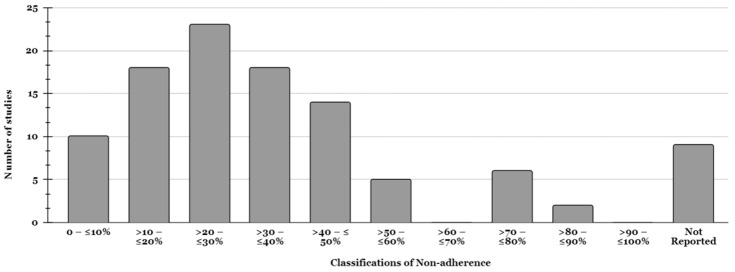
Inflammatory bowel disease (IBD) is treated with medications to induce and maintain remission. However, many people with IBD do not take their prescribed treatment. Identifying factors associated with IBD medication adherence is crucial for supporting effective disease management and maintaining remission. Quantitative and qualitative studies researching IBD medication adherence between 2011 and 2023 were reviewed. In total, 36,589 participants were included in 79 studies. The associated non-adherence factors were contradictory across studies, with rates notably higher (72-79%) when measured via medication refill. Non-adherence was lower in high-quality studies using self-report measures (10.7-28.7%). The frequent modifiable non-adherence risks were a poor understanding of treatment or disease, medication accessibility and an individual's organisation and planning. Clinical variables relating to non-adherence were the treatment type, drug regime and disease activity. Depression, negative treatment beliefs/mood and anxiety increased the non-adherence likelihood. The non-modifiable factors of limited finance, younger age and female sex were also risks. Side effects were the main reason cited for IBD non-adherence in interviews. A large, contradictory set of literature exists regarding the factors underpinning IBD non-adherence, influenced by the adherence measures used. Simpler medication regimes and improved accessibility would help to improve adherence. IBD education could enhance patient knowledge and beliefs. Reminders and cues might minimise forgetting medication. Modifying risks through an adherence support intervention could improve outcomes.




 京公网安备 11010802042870号
京ICP备2023020795号-1
京公网安备 11010802042870号
京ICP备2023020795号-1

 分享
分享
 求助内容:
求助内容: 应助结果提醒方式:
 扫码关注我们
