Labels, Language, and Other Strategies to Improve Communication About Lower Grade Forms of Ductal Carcinoma In Situ of the Breast: A National Delphi Survey.
Mavis S Lyons, Genevieve Chaput, Antonio Finelli, Rachel Kupets, Nicole Look Hong, Frances C Wright, Anna R Gagliardi
{"title":"Labels, Language, and Other Strategies to Improve Communication About Lower Grade Forms of Ductal Carcinoma In Situ of the Breast: A National Delphi Survey.","authors":"Mavis S Lyons, Genevieve Chaput, Antonio Finelli, Rachel Kupets, Nicole Look Hong, Frances C Wright, Anna R Gagliardi","doi":"10.1155/ijbc/8642832","DOIUrl":null,"url":null,"abstract":"<p><p><b>Purpose:</b> This study is aimed at generating consensus among women who had ductal carcinoma in situ (DCIS) and healthcare professionals on how to improve communication about low-risk forms of DCIS and reduce affected women's diagnosis-related confusion and anxiety. <b>Methods:</b> We conducted a two-round online Delphi survey with affected women and professionals from across Canada. They rated items sourced from prior research and key informant interviews on a 7-point Likert scale. We retained items rated 6 or 7 by ≥ 80% of panelists. <b>Results:</b> Thirty-seven panelists (17 women, 20 professionals) completed Round 1 and 94.6% of those completed Round 2. Of 42 items rated, 18 were retained, 13 discarded, and 11 did not achieve consensus to retain or discard. Women and professionals agreed on 3 language approaches (use plain language, distinguish DCIS from invasive breast cancer, specify the risk of recurrence and spread) and 9 other strategies to help discuss DCIS (e.g., use visual aids, provide or refer women to culturally tailored DCIS-specific information, ensure physicians can access interpreters). Based on rating and comments, women were more enthusiastic than professionals about referring to abnormal cells rather than DCIS and scheduling longer or follow-up visits to address concerns. To disseminate these findings, panelists recommended public awareness campaigns for women and continuing education and professional society endorsement for physicians. <b>Conclusion:</b> These findings address gaps in prior research that recommended changing the DCIS label, but had not fully explored label preferences, or identified other ways to improve and support communication about DCIS.</p>","PeriodicalId":46159,"journal":{"name":"International Journal of Breast Cancer","volume":"2025 ","pages":"8642832"},"PeriodicalIF":3.0000,"publicationDate":"2025-02-17","publicationTypes":"Journal Article","fieldsOfStudy":null,"isOpenAccess":false,"openAccessPdf":"https://www.ncbi.nlm.nih.gov/pmc/articles/PMC11850068/pdf/","citationCount":"0","resultStr":null,"platform":"Semanticscholar","paperid":null,"PeriodicalName":"International Journal of Breast Cancer","FirstCategoryId":"1085","ListUrlMain":"https://doi.org/10.1155/ijbc/8642832","RegionNum":0,"RegionCategory":null,"ArticlePicture":[],"TitleCN":null,"AbstractTextCN":null,"PMCID":null,"EPubDate":"2025/1/1 0:00:00","PubModel":"eCollection","JCR":"Q4","JCRName":"ONCOLOGY","Score":null,"Total":0}
引用次数: 0
Abstract
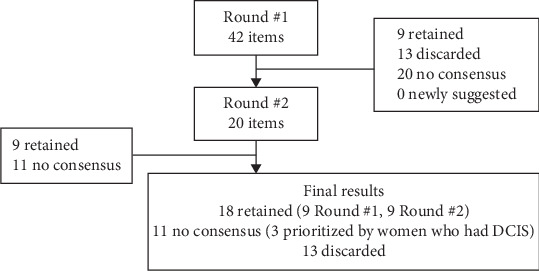
Purpose: This study is aimed at generating consensus among women who had ductal carcinoma in situ (DCIS) and healthcare professionals on how to improve communication about low-risk forms of DCIS and reduce affected women's diagnosis-related confusion and anxiety. Methods: We conducted a two-round online Delphi survey with affected women and professionals from across Canada. They rated items sourced from prior research and key informant interviews on a 7-point Likert scale. We retained items rated 6 or 7 by ≥ 80% of panelists. Results: Thirty-seven panelists (17 women, 20 professionals) completed Round 1 and 94.6% of those completed Round 2. Of 42 items rated, 18 were retained, 13 discarded, and 11 did not achieve consensus to retain or discard. Women and professionals agreed on 3 language approaches (use plain language, distinguish DCIS from invasive breast cancer, specify the risk of recurrence and spread) and 9 other strategies to help discuss DCIS (e.g., use visual aids, provide or refer women to culturally tailored DCIS-specific information, ensure physicians can access interpreters). Based on rating and comments, women were more enthusiastic than professionals about referring to abnormal cells rather than DCIS and scheduling longer or follow-up visits to address concerns. To disseminate these findings, panelists recommended public awareness campaigns for women and continuing education and professional society endorsement for physicians. Conclusion: These findings address gaps in prior research that recommended changing the DCIS label, but had not fully explored label preferences, or identified other ways to improve and support communication about DCIS.
期刊介绍:
International Journal of Breast Cancer is a peer-reviewed, Open Access journal that provides a forum for scientists, clinicians, and health care professionals working in breast cancer research and management. The journal publishes original research articles, review articles, and clinical studies related to molecular pathology, genomics, genetic predisposition, screening and diagnosis, disease markers, drug sensitivity and resistance, as well as novel therapies, with a specific focus on molecular targeted agents and immune therapies.




 京公网安备 11010802042870号
京ICP备2023020795号-1
京公网安备 11010802042870号
京ICP备2023020795号-1

 分享
分享
 求助内容:
求助内容: 应助结果提醒方式:
 扫码关注我们
