Yun Liu, Licheng Miao, Hongyuan Shen, Zhehao Wang, Kaiwen Yao, Yuanyuan Hu, Jianchao Sun, Shifeng Hou, Junwei Zhao, Kai Yang
{"title":"Maximizing Functional Diversity of Electrolyte Additives through Modular Molecular Engineering to Stabilize Zinc Metal Anodes","authors":"Yun Liu, Licheng Miao, Hongyuan Shen, Zhehao Wang, Kaiwen Yao, Yuanyuan Hu, Jianchao Sun, Shifeng Hou, Junwei Zhao, Kai Yang","doi":"10.1002/adfm.202501968","DOIUrl":null,"url":null,"abstract":"<p>Molecule design is significant for achieving the functional diversity of electrolyte additives in aqueous zinc-ion batteries, yet the strategy is underutilized. Here modular molecular engineering is proposed to segregate and recombine hydrophilic (hydrophobic) and zincophobic (zincophilic) modules within electrolyte additives to maximize the efficacy of electrolytes in promoting Zn stability and reversibility. By using an electrolyte with a polyoxometalate (POM) additive, (NH<sub>4</sub>)<sub>3</sub>[PMo<sub>12</sub>O<sub>40</sub>], which contains the zincophilic-hydrophobic polyoxoanion [PMo<sub>12</sub>O<sub>40</sub>]<sup>3−</sup> and the zincophobic-hydrophilic cation NH<sub>4</sub><sup>+</sup>, a promising electrolyte system is developed. Experimental and theoretical analyses unravel that [PMo<sub>12</sub>O<sub>40</sub>]<sup>3−</sup>, consisting of a weak hydrophilic [Mo<sub>12</sub>O<sub>36</sub>] shell encapsulating a zincophilic intensifier PO<sub>4</sub><sup>3−</sup> core, can alter the Zn<sup>2+</sup>-solvation sheath and Zn-electrolyte interface. Meanwhile, NH<sub>4</sub><sup>+</sup> disrupts hydrogen bond networks of water, synergistically realizing high electrochemical stability of the electrolyte and Zn anode at both room and low temperatures. As a result, Zn//NaV<sub>3</sub>O<sub>8</sub>∙1.5H<sub>2</sub>O batteries with (NH<sub>4</sub>)<sub>3</sub>[PMo<sub>12</sub>O<sub>40</sub>] additive exhibit outstanding cycling stability, achieving over 10 000 cycles at 5 A g<sup>−1</sup> at 25 °C and 800 cycles at 0.2 A g<sup>−1</sup> at −30 °C. This work highlights the significance and promising of molecule design for electrolyte additives and expands the research scope of POM chemistry.</p>","PeriodicalId":112,"journal":{"name":"Advanced Functional Materials","volume":"35 30","pages":""},"PeriodicalIF":19.0000,"publicationDate":"2025-02-25","publicationTypes":"Journal Article","fieldsOfStudy":null,"isOpenAccess":false,"openAccessPdf":"","citationCount":"0","resultStr":null,"platform":"Semanticscholar","paperid":null,"PeriodicalName":"Advanced Functional Materials","FirstCategoryId":"88","ListUrlMain":"https://advanced.onlinelibrary.wiley.com/doi/10.1002/adfm.202501968","RegionNum":1,"RegionCategory":"材料科学","ArticlePicture":[],"TitleCN":null,"AbstractTextCN":null,"PMCID":null,"EPubDate":"","PubModel":"","JCR":"Q1","JCRName":"CHEMISTRY, MULTIDISCIPLINARY","Score":null,"Total":0}
引用次数: 0
Abstract
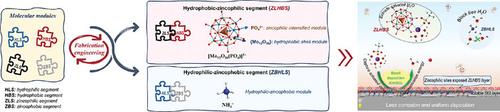
Molecule design is significant for achieving the functional diversity of electrolyte additives in aqueous zinc-ion batteries, yet the strategy is underutilized. Here modular molecular engineering is proposed to segregate and recombine hydrophilic (hydrophobic) and zincophobic (zincophilic) modules within electrolyte additives to maximize the efficacy of electrolytes in promoting Zn stability and reversibility. By using an electrolyte with a polyoxometalate (POM) additive, (NH4)3[PMo12O40], which contains the zincophilic-hydrophobic polyoxoanion [PMo12O40]3− and the zincophobic-hydrophilic cation NH4+, a promising electrolyte system is developed. Experimental and theoretical analyses unravel that [PMo12O40]3−, consisting of a weak hydrophilic [Mo12O36] shell encapsulating a zincophilic intensifier PO43− core, can alter the Zn2+-solvation sheath and Zn-electrolyte interface. Meanwhile, NH4+ disrupts hydrogen bond networks of water, synergistically realizing high electrochemical stability of the electrolyte and Zn anode at both room and low temperatures. As a result, Zn//NaV3O8∙1.5H2O batteries with (NH4)3[PMo12O40] additive exhibit outstanding cycling stability, achieving over 10 000 cycles at 5 A g−1 at 25 °C and 800 cycles at 0.2 A g−1 at −30 °C. This work highlights the significance and promising of molecule design for electrolyte additives and expands the research scope of POM chemistry.
分子设计对于实现锌离子电池电解质添加剂的功能多样性具有重要意义,但该策略尚未得到充分利用。本文提出了模块化分子工程,将电解质添加剂中的亲水(疏水)和亲锌(亲锌)模块分离和重组,以最大限度地提高电解质促进锌稳定性和可逆性的功效。采用含有亲锌-疏水多氧阴离子[PMo12O40]3−和亲锌-亲水阳离子NH4+的聚金属氧酸盐(POM)添加剂(NH4)3[PMo12O40]电解质,开发了一种极具发展前景的电解质体系。实验和理论分析表明,[PMo12O40]3−由包裹亲锌增强剂PO43−核心的弱亲水性[Mo12O36]壳层组成,可以改变Zn2+的溶剂化鞘层和zn -电解质界面。同时,NH4+破坏了水的氢键网络,协同实现了电解质和Zn阳极在室温和低温下的高电化学稳定性。结果表明,添加(NH4)3[PMo12O40]添加剂的Zn//NaV3O8∙1.5H2O电池表现出出色的循环稳定性,在25°C下,在5 a g−1下,循环次数超过10,000次,在- 30°C下,在0.2 a g−1下,循环次数超过800次。这项工作突出了电解质添加剂分子设计的意义和前景,拓展了POM化学的研究范围。
期刊介绍:
Firmly established as a top-tier materials science journal, Advanced Functional Materials reports breakthrough research in all aspects of materials science, including nanotechnology, chemistry, physics, and biology every week.
Advanced Functional Materials is known for its rapid and fair peer review, quality content, and high impact, making it the first choice of the international materials science community.




 京公网安备 11010802042870号
京ICP备2023020795号-1
京公网安备 11010802042870号
京ICP备2023020795号-1

 分享
分享
 求助内容:
求助内容: 应助结果提醒方式:
 扫码关注我们
