Yichao Wang, Cheng Yang, Lingbo Yao, Ning Jiang, Jiahe Liu, Shouyu Sun, Xinyu Wang, Jianhua Yang, Yu Liu
{"title":"Dissolution Inhibition Strategy Stabilizes Manganese Prussian Blue Analogs for High-Energy Sodium-Ion Batteries","authors":"Yichao Wang, Cheng Yang, Lingbo Yao, Ning Jiang, Jiahe Liu, Shouyu Sun, Xinyu Wang, Jianhua Yang, Yu Liu","doi":"10.1002/adfm.202423867","DOIUrl":null,"url":null,"abstract":"<p>The manganese Prussian blue analogs (Mn-PBAs) are regarded as scalable, low-cost, and high-energy cathodes for sodium-ions batteries (SIBs). Unfortunately, Mn-PBAs suffer from severe dissolution, particularly of manganese (Mn), which has been shown will exacerbate the structural collapse of cathode materials and electrolyte decomposition, significantly reducing the cycling stability of Mn-PBAs-based batteries. Herein, an innovative dissolution inhibition strategy is proposed by utilizing solvents that inherently exhibit lower solubility for Mn-PBAs as the electrolyte. This approach successfully establishes a Mn-PBAs dissolution-diffusion inhibition interface, thereby kinetically preventing the dissolution of Mn-PBAs and addressing the associated issues. The interaction energy between Mn-PBAs and the electrolyte, along with analyses of mean square displacement and van Hove function curves, theoretically validates the successful construction of this inhibition interface. In the new electrolyte, the Mn-PBAs can provide a specific capacity of ≈154 mAh g<sup>−1</sup> (≈510 Wh kg<sup>−1</sup>) and can be cycled at a current density of 2 C for >1000 cycles, demonstrating excellent electrochemical performance in the new electrolyte. This pioneering work can forge new avenues for stabilizing high-energy Mn-PBAs and holds substantial promise for practical applications.</p>","PeriodicalId":112,"journal":{"name":"Advanced Functional Materials","volume":"35 28","pages":""},"PeriodicalIF":19.0000,"publicationDate":"2025-02-25","publicationTypes":"Journal Article","fieldsOfStudy":null,"isOpenAccess":false,"openAccessPdf":"","citationCount":"0","resultStr":null,"platform":"Semanticscholar","paperid":null,"PeriodicalName":"Advanced Functional Materials","FirstCategoryId":"88","ListUrlMain":"https://advanced.onlinelibrary.wiley.com/doi/10.1002/adfm.202423867","RegionNum":1,"RegionCategory":"材料科学","ArticlePicture":[],"TitleCN":null,"AbstractTextCN":null,"PMCID":null,"EPubDate":"","PubModel":"","JCR":"Q1","JCRName":"CHEMISTRY, MULTIDISCIPLINARY","Score":null,"Total":0}
引用次数: 0
Abstract
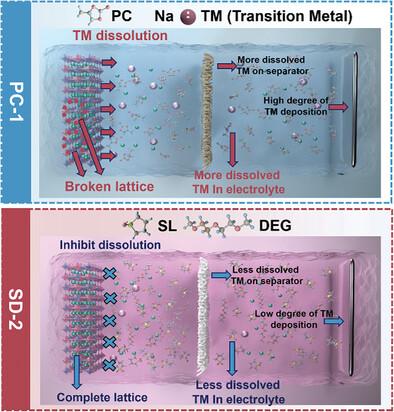
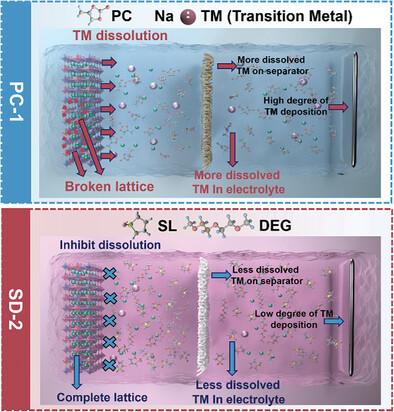
The manganese Prussian blue analogs (Mn-PBAs) are regarded as scalable, low-cost, and high-energy cathodes for sodium-ions batteries (SIBs). Unfortunately, Mn-PBAs suffer from severe dissolution, particularly of manganese (Mn), which has been shown will exacerbate the structural collapse of cathode materials and electrolyte decomposition, significantly reducing the cycling stability of Mn-PBAs-based batteries. Herein, an innovative dissolution inhibition strategy is proposed by utilizing solvents that inherently exhibit lower solubility for Mn-PBAs as the electrolyte. This approach successfully establishes a Mn-PBAs dissolution-diffusion inhibition interface, thereby kinetically preventing the dissolution of Mn-PBAs and addressing the associated issues. The interaction energy between Mn-PBAs and the electrolyte, along with analyses of mean square displacement and van Hove function curves, theoretically validates the successful construction of this inhibition interface. In the new electrolyte, the Mn-PBAs can provide a specific capacity of ≈154 mAh g−1 (≈510 Wh kg−1) and can be cycled at a current density of 2 C for >1000 cycles, demonstrating excellent electrochemical performance in the new electrolyte. This pioneering work can forge new avenues for stabilizing high-energy Mn-PBAs and holds substantial promise for practical applications.
锰普鲁士蓝类似物(Mn-PBAs)被认为是钠离子电池(sib)的可扩展、低成本和高能量阴极。不幸的是,Mn- pbas遭受严重的溶解,特别是锰(Mn)的溶解,这将加剧阴极材料的结构崩溃和电解质分解,显着降低Mn- pbas基电池的循环稳定性。本文提出了一种创新的溶解抑制策略,即利用固有地对Mn-PBAs具有较低溶解度的溶剂作为电解质。该方法成功建立了Mn-PBAs的溶解-扩散抑制界面,从而从动力学上阻止了Mn-PBAs的溶解,并解决了相关问题。Mn-PBAs与电解质的相互作用能以及均方位移和van Hove函数曲线的分析从理论上验证了该抑制界面的成功构建。在新电解质中,Mn-PBAs的比容量可达≈154 mAh g - 1(≈510 Wh kg - 1),并可在2℃的电流密度下循环约1000次,在新电解质中表现出优异的电化学性能。这项开创性的工作可以为稳定高能Mn-PBAs开辟新的途径,并为实际应用提供了巨大的希望。
期刊介绍:
Firmly established as a top-tier materials science journal, Advanced Functional Materials reports breakthrough research in all aspects of materials science, including nanotechnology, chemistry, physics, and biology every week.
Advanced Functional Materials is known for its rapid and fair peer review, quality content, and high impact, making it the first choice of the international materials science community.






 京公网安备 11010802042870号
京ICP备2023020795号-1
京公网安备 11010802042870号
京ICP备2023020795号-1

 分享
分享
 求助内容:
求助内容: 应助结果提醒方式:
 扫码关注我们
