Xiaoying Chen, Licheng Yuan, Han Wen, Qingxia Ma, Zhenfeng Deng, Yongan Xu, Zhihao Yao, Yunfei Wang, Shilong Yang, Nannan Su, Fan Yang
{"title":"Structure and function of a broad-range thermal receptor in myriapods","authors":"Xiaoying Chen, Licheng Yuan, Han Wen, Qingxia Ma, Zhenfeng Deng, Yongan Xu, Zhihao Yao, Yunfei Wang, Shilong Yang, Nannan Su, Fan Yang","doi":"10.1038/s41594-025-01495-8","DOIUrl":null,"url":null,"abstract":"Broad-range thermal receptor 1 (BRTNaC1), activated by heat at low extracellular pH, was recently identified in myriapods. Although the overexpression of BRTNaC1 leads to robust heat-activated current with a cation selectivity profile, the structure of this receptor and how it is gated by proton and heat remain to be investigated. Here we determine cryogenic electron microscopy structures of BRTNaC1 in the apo, proton-induced and heated states. Based on these structures, patch-clamp recordings and molecular dynamic simulations, we found that a ‘twist the wrist’ mechanism is used for proton activation of BRTNaC1, while heat induces broad conformational changes in BRTNaC1, including rotation and shift in the transmembrane helices to open this channel. Moreover, as testosterone inhibited BRTNaC1 activation, we identified four clustered residues important for such inhibition. Therefore, our study has established the structural basis for ligand and temperature gating in the BRTNaC1 ion channel. The authors reveal the structure and gating mechanisms of BRTNaC1, a myriapod ion channel sensitive to heat and acidity. They show that a proton triggers a ‘twist the wrist’ motion, heat induces broad structural changes and testosterone inhibits channel activation.","PeriodicalId":49141,"journal":{"name":"Nature Structural & Molecular Biology","volume":"32 6","pages":"1081-1090"},"PeriodicalIF":10.1000,"publicationDate":"2025-02-26","publicationTypes":"Journal Article","fieldsOfStudy":null,"isOpenAccess":false,"openAccessPdf":"","citationCount":"0","resultStr":null,"platform":"Semanticscholar","paperid":null,"PeriodicalName":"Nature Structural & Molecular Biology","FirstCategoryId":"99","ListUrlMain":"https://www.nature.com/articles/s41594-025-01495-8","RegionNum":1,"RegionCategory":"生物学","ArticlePicture":[],"TitleCN":null,"AbstractTextCN":null,"PMCID":null,"EPubDate":"","PubModel":"","JCR":"Q1","JCRName":"BIOCHEMISTRY & MOLECULAR BIOLOGY","Score":null,"Total":0}
引用次数: 0
Abstract
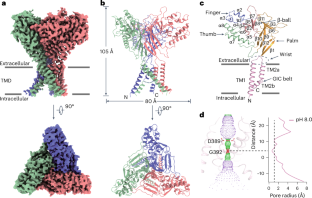
Broad-range thermal receptor 1 (BRTNaC1), activated by heat at low extracellular pH, was recently identified in myriapods. Although the overexpression of BRTNaC1 leads to robust heat-activated current with a cation selectivity profile, the structure of this receptor and how it is gated by proton and heat remain to be investigated. Here we determine cryogenic electron microscopy structures of BRTNaC1 in the apo, proton-induced and heated states. Based on these structures, patch-clamp recordings and molecular dynamic simulations, we found that a ‘twist the wrist’ mechanism is used for proton activation of BRTNaC1, while heat induces broad conformational changes in BRTNaC1, including rotation and shift in the transmembrane helices to open this channel. Moreover, as testosterone inhibited BRTNaC1 activation, we identified four clustered residues important for such inhibition. Therefore, our study has established the structural basis for ligand and temperature gating in the BRTNaC1 ion channel. The authors reveal the structure and gating mechanisms of BRTNaC1, a myriapod ion channel sensitive to heat and acidity. They show that a proton triggers a ‘twist the wrist’ motion, heat induces broad structural changes and testosterone inhibits channel activation.
期刊介绍:
Nature Structural & Molecular Biology is a comprehensive platform that combines structural and molecular research. Our journal focuses on exploring the functional and mechanistic aspects of biological processes, emphasizing how molecular components collaborate to achieve a particular function. While structural data can shed light on these insights, our publication does not require them as a prerequisite.




 京公网安备 11010802042870号
京ICP备2023020795号-1
京公网安备 11010802042870号
京ICP备2023020795号-1

 分享
分享
 求助内容:
求助内容: 应助结果提醒方式:
 扫码关注我们
