{"title":"A manufacturable platform for photonic quantum computing","authors":"PsiQuantum team","doi":"10.1038/s41586-025-08820-7","DOIUrl":null,"url":null,"abstract":"Although holding great promise for low noise, ease of operation and networking1, useful photonic quantum computing has been precluded by the need for beyond-state-of-the-art components, manufactured by the millions2–6. Here we introduce a manufacturable platform7 for quantum computing with photons. We benchmark a set of monolithically integrated silicon-photonics-based modules to generate, manipulate, network and detect heralded photonic qubits, demonstrating dual-rail photonic qubits with 99.98% ± 0.01% state preparation and measurement fidelity, Hong–Ou–Mandel (HOM) quantum interference between independent photon sources with 99.50% ± 0.25% visibility, two-qubit fusion with 99.22% ± 0.12% fidelity and a chip-to-chip qubit interconnect with 99.72% ± 0.04% fidelity, conditional on photon detection and not accounting for loss. We preview a selection of next-generation technologies: low-loss silicon nitride (SiN) waveguides and components to address loss, as well as fabrication-tolerant photon sources, high-efficiency photon-number-resolving detectors (PNRDs), low-loss chip-to-fibre coupling and barium titanate (BTO) electro-optic phase shifters for high-performance fast switching. A manufacturable platform for quantum computing with photons is introduced and a set of monolithically integrated silicon-photonics-based modules is benchmarked, demonstrating dual-rail photonic qubits with performance close to thresholds required for operation.","PeriodicalId":18787,"journal":{"name":"Nature","volume":"641 8064","pages":"876-883"},"PeriodicalIF":48.5000,"publicationDate":"2025-02-26","publicationTypes":"Journal Article","fieldsOfStudy":null,"isOpenAccess":false,"openAccessPdf":"https://www.nature.com/articles/s41586-025-08820-7.pdf","citationCount":"0","resultStr":null,"platform":"Semanticscholar","paperid":null,"PeriodicalName":"Nature","FirstCategoryId":"103","ListUrlMain":"https://www.nature.com/articles/s41586-025-08820-7","RegionNum":1,"RegionCategory":"综合性期刊","ArticlePicture":[],"TitleCN":null,"AbstractTextCN":null,"PMCID":null,"EPubDate":"","PubModel":"","JCR":"Q1","JCRName":"MULTIDISCIPLINARY SCIENCES","Score":null,"Total":0}
引用次数: 0
Abstract
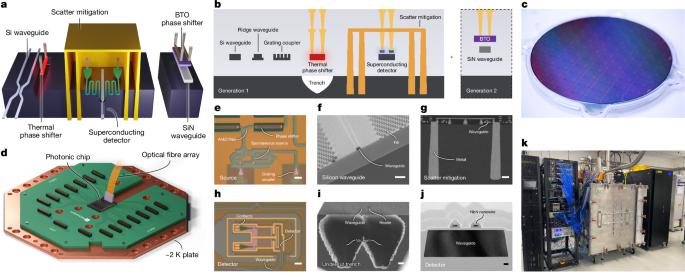
Although holding great promise for low noise, ease of operation and networking1, useful photonic quantum computing has been precluded by the need for beyond-state-of-the-art components, manufactured by the millions2–6. Here we introduce a manufacturable platform7 for quantum computing with photons. We benchmark a set of monolithically integrated silicon-photonics-based modules to generate, manipulate, network and detect heralded photonic qubits, demonstrating dual-rail photonic qubits with 99.98% ± 0.01% state preparation and measurement fidelity, Hong–Ou–Mandel (HOM) quantum interference between independent photon sources with 99.50% ± 0.25% visibility, two-qubit fusion with 99.22% ± 0.12% fidelity and a chip-to-chip qubit interconnect with 99.72% ± 0.04% fidelity, conditional on photon detection and not accounting for loss. We preview a selection of next-generation technologies: low-loss silicon nitride (SiN) waveguides and components to address loss, as well as fabrication-tolerant photon sources, high-efficiency photon-number-resolving detectors (PNRDs), low-loss chip-to-fibre coupling and barium titanate (BTO) electro-optic phase shifters for high-performance fast switching. A manufacturable platform for quantum computing with photons is introduced and a set of monolithically integrated silicon-photonics-based modules is benchmarked, demonstrating dual-rail photonic qubits with performance close to thresholds required for operation.
期刊介绍:
Nature is a prestigious international journal that publishes peer-reviewed research in various scientific and technological fields. The selection of articles is based on criteria such as originality, importance, interdisciplinary relevance, timeliness, accessibility, elegance, and surprising conclusions. In addition to showcasing significant scientific advances, Nature delivers rapid, authoritative, insightful news, and interpretation of current and upcoming trends impacting science, scientists, and the broader public. The journal serves a dual purpose: firstly, to promptly share noteworthy scientific advances and foster discussions among scientists, and secondly, to ensure the swift dissemination of scientific results globally, emphasizing their significance for knowledge, culture, and daily life.



 京公网安备 11010802042870号
京ICP备2023020795号-1
京公网安备 11010802042870号
京ICP备2023020795号-1

 分享
分享
 求助内容:
求助内容: 应助结果提醒方式:
 扫码关注我们
