Multiple defects renovation and phase reconstruction of reduced-dimensional perovskites via in situ chlorination for efficient deep-blue (454 nm) light-emitting diodes
Mubing Yu, Tingxiao Qin, Gang Gao, Kelei Zu, Dongming Zhang, Nan Chen, Dengke Wang, Yong Hua, Hong Zhang, Yong-Biao Zhao, Jiaqi Zhu
{"title":"Multiple defects renovation and phase reconstruction of reduced-dimensional perovskites via in situ chlorination for efficient deep-blue (454 nm) light-emitting diodes","authors":"Mubing Yu, Tingxiao Qin, Gang Gao, Kelei Zu, Dongming Zhang, Nan Chen, Dengke Wang, Yong Hua, Hong Zhang, Yong-Biao Zhao, Jiaqi Zhu","doi":"10.1038/s41377-025-01768-3","DOIUrl":null,"url":null,"abstract":"<p>Deep-blue perovskite light-emitting diodes (PeLEDs) based on reduced-dimensional perovskites (RDPs) still face a few challenges including severe trap-assisted nonradiative recombination, sluggish exciton transfer, and undesirable bathochromic shift of the electroluminescence spectra, impeding the realization of high-performance PeLEDs. Herein, an in situ chlorination (isCl) post-treatment strategy was employed to regulate phase reconstruction and renovate multiple defects of RDPs, leading to superior carrier cooling of 0.88 ps, extraordinary exciton binding energy of 122.53 meV, and higher photoluminescence quantum yield of 60.9% for RDP films with deep-blue emission at 450 nm. The phase regulation is accomplished via fluorine-derived hydrogen bonds that suppress the formation of small-<i>n</i> phases. Multiple defects, including halide vacancies (shallow-state defects) and lead-chloride antisite defects (deep-state defects), are renovated via C=O coordination and hydroxy-group-derived hydrogen bonds. Consequently, deep-blue PeLEDs with a record maximum external quantum efficiency of 6.17% and stable electroluminescence at 454 nm were demonstrated, representing the best-performing deep-blue PeLEDs.</p>","PeriodicalId":18069,"journal":{"name":"Light-Science & Applications","volume":"16 1","pages":""},"PeriodicalIF":23.4000,"publicationDate":"2025-02-26","publicationTypes":"Journal Article","fieldsOfStudy":null,"isOpenAccess":false,"openAccessPdf":"","citationCount":"0","resultStr":null,"platform":"Semanticscholar","paperid":null,"PeriodicalName":"Light-Science & Applications","FirstCategoryId":"1089","ListUrlMain":"https://doi.org/10.1038/s41377-025-01768-3","RegionNum":0,"RegionCategory":null,"ArticlePicture":[],"TitleCN":null,"AbstractTextCN":null,"PMCID":null,"EPubDate":"","PubModel":"","JCR":"Q1","JCRName":"OPTICS","Score":null,"Total":0}
引用次数: 0
Abstract
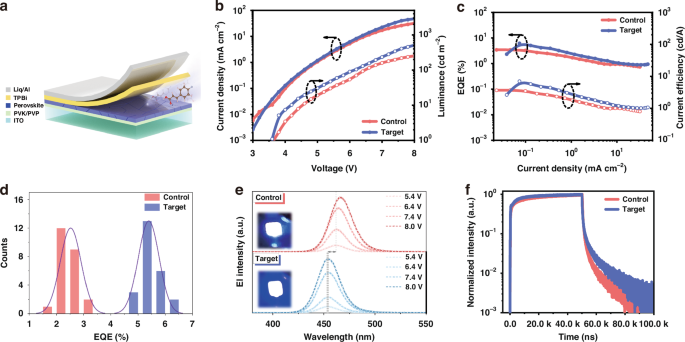
Deep-blue perovskite light-emitting diodes (PeLEDs) based on reduced-dimensional perovskites (RDPs) still face a few challenges including severe trap-assisted nonradiative recombination, sluggish exciton transfer, and undesirable bathochromic shift of the electroluminescence spectra, impeding the realization of high-performance PeLEDs. Herein, an in situ chlorination (isCl) post-treatment strategy was employed to regulate phase reconstruction and renovate multiple defects of RDPs, leading to superior carrier cooling of 0.88 ps, extraordinary exciton binding energy of 122.53 meV, and higher photoluminescence quantum yield of 60.9% for RDP films with deep-blue emission at 450 nm. The phase regulation is accomplished via fluorine-derived hydrogen bonds that suppress the formation of small-n phases. Multiple defects, including halide vacancies (shallow-state defects) and lead-chloride antisite defects (deep-state defects), are renovated via C=O coordination and hydroxy-group-derived hydrogen bonds. Consequently, deep-blue PeLEDs with a record maximum external quantum efficiency of 6.17% and stable electroluminescence at 454 nm were demonstrated, representing the best-performing deep-blue PeLEDs.



 京公网安备 11010802042870号
京ICP备2023020795号-1
京公网安备 11010802042870号
京ICP备2023020795号-1

 分享
分享
 求助内容:
求助内容: 应助结果提醒方式:
 扫码关注我们
