{"title":"Analysing the Effect of MHD Nanoparticles Flow in Blood Plasma over a Stretching Sheet by Taylor Wavelt Operational Matrix Method","authors":"Prithvi S, Patil Mallikarjun B, Basma Souayeh","doi":"10.1002/adts.202401548","DOIUrl":null,"url":null,"abstract":"<p>Studying the flow of nanoparticles (<span></span><math>\n <semantics>\n <mrow>\n <mi>F</mi>\n <msub>\n <mi>e</mi>\n <mn>3</mn>\n </msub>\n <msub>\n <mi>O</mi>\n <mn>4</mn>\n </msub>\n </mrow>\n <annotation>$F{{e}_3}{{O}_4}$</annotation>\n </semantics></math> or <span></span><math>\n <semantics>\n <mrow>\n <mi>M</mi>\n <mi>W</mi>\n <mi>C</mi>\n <mi>N</mi>\n <mi>T</mi>\n </mrow>\n <annotation>$MWCNT$</annotation>\n </semantics></math>) in the base fluid (blood plasma) over a permeable stretched sheet in the presence of an induced magnetic field, which is the primary aim of the research. The flow is studied by applying the temperature and velocity slip conditions. The relevant partial differential equations are transformed into ordinary differential equations using suitable similarity transformations. The Taylor wavelet operational matrix collocation method is then employed to solve the resulting ordinary differential equations (ODE), the comparison of the Nusselt number and local skin friction coefficient with those from previous research reveals a good degree of accuracy. The findings of the study show that <span></span><math>\n <semantics>\n <mrow>\n <mi>M</mi>\n <mi>W</mi>\n <mi>C</mi>\n <mi>N</mi>\n <mi>T</mi>\n </mrow>\n <annotation>$MWCNT$</annotation>\n </semantics></math> improves the fluid's axial velocity and temperature profile more than <span></span><math>\n <semantics>\n <mrow>\n <mi>F</mi>\n <msub>\n <mi>e</mi>\n <mn>3</mn>\n </msub>\n <msub>\n <mi>O</mi>\n <mn>4</mn>\n </msub>\n </mrow>\n <annotation>$F{{e}_3}{{O}_4}$</annotation>\n </semantics></math> does when mixed with blood plasma. Compared to velocity slip boundary constraints, the no-slip boundary condition increases the axial velocity of the fluid.</p>","PeriodicalId":7219,"journal":{"name":"Advanced Theory and Simulations","volume":"8 6","pages":""},"PeriodicalIF":2.9000,"publicationDate":"2025-02-25","publicationTypes":"Journal Article","fieldsOfStudy":null,"isOpenAccess":false,"openAccessPdf":"","citationCount":"0","resultStr":null,"platform":"Semanticscholar","paperid":null,"PeriodicalName":"Advanced Theory and Simulations","FirstCategoryId":"5","ListUrlMain":"https://advanced.onlinelibrary.wiley.com/doi/10.1002/adts.202401548","RegionNum":4,"RegionCategory":"工程技术","ArticlePicture":[],"TitleCN":null,"AbstractTextCN":null,"PMCID":null,"EPubDate":"","PubModel":"","JCR":"Q1","JCRName":"MULTIDISCIPLINARY SCIENCES","Score":null,"Total":0}
引用次数: 0
Abstract
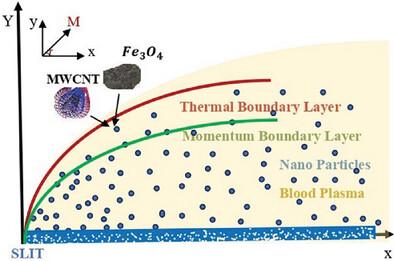
Studying the flow of nanoparticles ( or ) in the base fluid (blood plasma) over a permeable stretched sheet in the presence of an induced magnetic field, which is the primary aim of the research. The flow is studied by applying the temperature and velocity slip conditions. The relevant partial differential equations are transformed into ordinary differential equations using suitable similarity transformations. The Taylor wavelet operational matrix collocation method is then employed to solve the resulting ordinary differential equations (ODE), the comparison of the Nusselt number and local skin friction coefficient with those from previous research reveals a good degree of accuracy. The findings of the study show that improves the fluid's axial velocity and temperature profile more than does when mixed with blood plasma. Compared to velocity slip boundary constraints, the no-slip boundary condition increases the axial velocity of the fluid.
在感应磁场作用下,研究纳米粒子(F ^ e3 ^ O4$F{{e}_3}{{O}_4}$或M ^ W ^ C ^ N ^ T$MWCNT$)在基液(血浆)中的流动,这是本研究的主要目的。采用温度滑移和速度滑移条件对其流动进行了研究。利用适当的相似变换将相关的偏微分方程转化为常微分方程。然后采用Taylor小波变换矩阵配置法求解得到的常微分方程(ODE),将Nusselt数和局部皮肤摩擦系数与前人的研究结果进行比较,得到了较好的精度。研究结果表明,当与血浆混合时,M _ W _ C _ N _ T$MWCNT$比F _ e3 _ O4$F{{e}_3}{{O}_4}$更能改善流体的轴向速度和温度分布。与速度滑移边界约束相比,无滑移边界条件增加了流体的轴向速度。
期刊介绍:
Advanced Theory and Simulations is an interdisciplinary, international, English-language journal that publishes high-quality scientific results focusing on the development and application of theoretical methods, modeling and simulation approaches in all natural science and medicine areas, including:
materials, chemistry, condensed matter physics
engineering, energy
life science, biology, medicine
atmospheric/environmental science, climate science
planetary science, astronomy, cosmology
method development, numerical methods, statistics







 京公网安备 11010802042870号
京ICP备2023020795号-1
京公网安备 11010802042870号
京ICP备2023020795号-1

 分享
分享
 求助内容:
求助内容: 应助结果提醒方式:
 扫码关注我们
