Jie Jiang, Yuqing Gao, Jiang Wang, Yan Huang, Rong Yang, Yongxin Zhang, Yuandi Ma, Yingquan Wen, Gongkai Luo, Shurui Zhang, Yutang Cao, Minjun Yu, Qinxue Wang, Shulei Hu, Kanglong Wang, Xiaozhen Guo, Frank J. Gonzalez, Yameng Liu, Hong Liu, Qing Xie, Cen Xie
{"title":"Hepatic sphingomyelin phosphodiesterase 3 promotes steatohepatitis by disrupting membrane sphingolipid metabolism","authors":"Jie Jiang, Yuqing Gao, Jiang Wang, Yan Huang, Rong Yang, Yongxin Zhang, Yuandi Ma, Yingquan Wen, Gongkai Luo, Shurui Zhang, Yutang Cao, Minjun Yu, Qinxue Wang, Shulei Hu, Kanglong Wang, Xiaozhen Guo, Frank J. Gonzalez, Yameng Liu, Hong Liu, Qing Xie, Cen Xie","doi":"10.1016/j.cmet.2025.01.016","DOIUrl":null,"url":null,"abstract":"Metabolic-dysfunction-associated steatohepatitis (MASH) remains a major health challenge. Herein, we identify sphingomyelin phosphodiesterase 3 (SMPD3) as a key driver of hepatic ceramide accumulation through increasing sphingomyelin hydrolysis at the cell membrane. Hepatocyte-specific <em>Smpd3</em> gene disruption or pharmacological inhibition of SMPD3 alleviates MASH, whereas reintroducing SMPD3 reverses the resolution of MASH. Although healthy livers express low-level SMPD3, lipotoxicity-induced DNA damage suppresses sirtuin 1 (SIRT1), triggering an upregulation of SMPD3 during MASH. This disrupts membrane sphingomyelin-ceramide balance and promotes disease progression by enhancing caveolae-dependent lipid uptake and extracellular vesicle secretion from steatotic hepatocytes to exacerbate inflammation and fibrosis. Consequently, SMPD3 acts as a central hub integrating key MASH hallmarks. Notably, we discovered a bifunctional agent that simultaneously activates SIRT1 and inhibits SMPD3, which shows significant therapeutic potential in MASH treatment. These findings suggest that inhibition of hepatic SMPD3 restores membrane sphingolipid metabolism and holds great promise for developing novel MASH therapies.","PeriodicalId":9840,"journal":{"name":"Cell metabolism","volume":"24 1","pages":""},"PeriodicalIF":30.9000,"publicationDate":"2025-02-26","publicationTypes":"Journal Article","fieldsOfStudy":null,"isOpenAccess":false,"openAccessPdf":"","citationCount":"0","resultStr":null,"platform":"Semanticscholar","paperid":null,"PeriodicalName":"Cell metabolism","FirstCategoryId":"99","ListUrlMain":"https://doi.org/10.1016/j.cmet.2025.01.016","RegionNum":1,"RegionCategory":"生物学","ArticlePicture":[],"TitleCN":null,"AbstractTextCN":null,"PMCID":null,"EPubDate":"","PubModel":"","JCR":"Q1","JCRName":"CELL BIOLOGY","Score":null,"Total":0}
引用次数: 0
Abstract
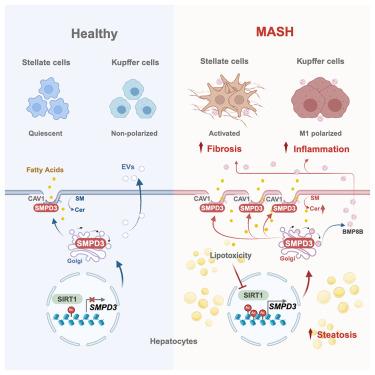
Metabolic-dysfunction-associated steatohepatitis (MASH) remains a major health challenge. Herein, we identify sphingomyelin phosphodiesterase 3 (SMPD3) as a key driver of hepatic ceramide accumulation through increasing sphingomyelin hydrolysis at the cell membrane. Hepatocyte-specific Smpd3 gene disruption or pharmacological inhibition of SMPD3 alleviates MASH, whereas reintroducing SMPD3 reverses the resolution of MASH. Although healthy livers express low-level SMPD3, lipotoxicity-induced DNA damage suppresses sirtuin 1 (SIRT1), triggering an upregulation of SMPD3 during MASH. This disrupts membrane sphingomyelin-ceramide balance and promotes disease progression by enhancing caveolae-dependent lipid uptake and extracellular vesicle secretion from steatotic hepatocytes to exacerbate inflammation and fibrosis. Consequently, SMPD3 acts as a central hub integrating key MASH hallmarks. Notably, we discovered a bifunctional agent that simultaneously activates SIRT1 and inhibits SMPD3, which shows significant therapeutic potential in MASH treatment. These findings suggest that inhibition of hepatic SMPD3 restores membrane sphingolipid metabolism and holds great promise for developing novel MASH therapies.
期刊介绍:
Cell Metabolism is a top research journal established in 2005 that focuses on publishing original and impactful papers in the field of metabolic research.It covers a wide range of topics including diabetes, obesity, cardiovascular biology, aging and stress responses, circadian biology, and many others.
Cell Metabolism aims to contribute to the advancement of metabolic research by providing a platform for the publication and dissemination of high-quality research and thought-provoking articles.




 京公网安备 11010802042870号
京ICP备2023020795号-1
京公网安备 11010802042870号
京ICP备2023020795号-1

 分享
分享
 求助内容:
求助内容: 应助结果提醒方式:
 扫码关注我们
