Feng Wang, Lian Chen, Jiaqi Wei, Caozheng Diao, Fan Li, Congcong Du, Zhengshuai Bai, Yanyan Zhang, Oleksandr I. Malyi, Xiaodong Chen, Yuxin Tang and Xiaojun Bao
{"title":"Pushing slope- to plateau-type behavior in hard carbon for sodium-ion batteries via local structure rearrangement†","authors":"Feng Wang, Lian Chen, Jiaqi Wei, Caozheng Diao, Fan Li, Congcong Du, Zhengshuai Bai, Yanyan Zhang, Oleksandr I. Malyi, Xiaodong Chen, Yuxin Tang and Xiaojun Bao","doi":"10.1039/D5EE00104H","DOIUrl":null,"url":null,"abstract":"<p >Elucidating the microstructure of hard carbon is essential for uncovering the sodium storage mechanism and constructing state-of-the-art hard carbon anodes for sodium-ion batteries. Guided by an understanding of the crystallization process and inverse materials design principles, we design hard carbon anodes with different local fragments to understand the correlation between the microstructure of hard carbon and sodium storage behavior from the commercialization perspective. The sodiation transformation of hard carbon from slope- to plateau-type is realized <em>via</em> a series of local structure rearrangements, including tuning of the interlayer distance, average crystallite width of graphitic domains, and defect density. We found that the increase in plateau capacity is mainly related to the transition from the critical interlayer distance to the average crystallite width of graphitic domain control, and is limited by the closed pore volume of hard carbon. During sodiation, the formation of NaF and Na<small><sub>2</sub></small>O in the slope region, as well as Na<small><sub>2</sub></small>O<small><sub>2</sub></small> and NaO<small><sub>2</sub></small> in the plateau region, is always accompanied by the production of Na<small><sub>2</sub></small>CO<small><sub>3</sub></small>. This work provides insights into understanding the sodium storage behavior in hard carbon anodes and defines general structural design principles for transitioning from slope-type to plateau-type hard carbon.</p>","PeriodicalId":72,"journal":{"name":"Energy & Environmental Science","volume":" 9","pages":" 4312-4323"},"PeriodicalIF":30.8000,"publicationDate":"2025-02-26","publicationTypes":"Journal Article","fieldsOfStudy":null,"isOpenAccess":false,"openAccessPdf":"","citationCount":"0","resultStr":null,"platform":"Semanticscholar","paperid":null,"PeriodicalName":"Energy & Environmental Science","FirstCategoryId":"88","ListUrlMain":"https://pubs.rsc.org/en/content/articlelanding/2025/ee/d5ee00104h","RegionNum":1,"RegionCategory":"材料科学","ArticlePicture":[],"TitleCN":null,"AbstractTextCN":null,"PMCID":null,"EPubDate":"","PubModel":"","JCR":"Q1","JCRName":"CHEMISTRY, MULTIDISCIPLINARY","Score":null,"Total":0}
引用次数: 0
Abstract
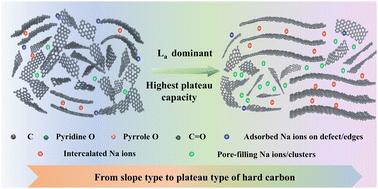
Elucidating the microstructure of hard carbon is essential for uncovering the sodium storage mechanism and constructing state-of-the-art hard carbon anodes for sodium-ion batteries. Guided by an understanding of the crystallization process and inverse materials design principles, we design hard carbon anodes with different local fragments to understand the correlation between the microstructure of hard carbon and sodium storage behavior from the commercialization perspective. The sodiation transformation of hard carbon from slope- to plateau-type is realized via a series of local structure rearrangements, including tuning of the interlayer distance, average crystallite width of graphitic domains, and defect density. We found that the increase in plateau capacity is mainly related to the transition from the critical interlayer distance to the average crystallite width of graphitic domain control, and is limited by the closed pore volume of hard carbon. During sodiation, the formation of NaF and Na2O in the slope region, as well as Na2O2 and NaO2 in the plateau region, is always accompanied by the production of Na2CO3. This work provides insights into understanding the sodium storage behavior in hard carbon anodes and defines general structural design principles for transitioning from slope-type to plateau-type hard carbon.
期刊介绍:
Energy & Environmental Science, a peer-reviewed scientific journal, publishes original research and review articles covering interdisciplinary topics in the (bio)chemical and (bio)physical sciences, as well as chemical engineering disciplines. Published monthly by the Royal Society of Chemistry (RSC), a not-for-profit publisher, Energy & Environmental Science is recognized as a leading journal. It boasts an impressive impact factor of 8.500 as of 2009, ranking 8th among 140 journals in the category "Chemistry, Multidisciplinary," second among 71 journals in "Energy & Fuels," second among 128 journals in "Engineering, Chemical," and first among 181 scientific journals in "Environmental Sciences."
Energy & Environmental Science publishes various types of articles, including Research Papers (original scientific work), Review Articles, Perspectives, and Minireviews (feature review-type articles of broad interest), Communications (original scientific work of an urgent nature), Opinions (personal, often speculative viewpoints or hypotheses on current topics), and Analysis Articles (in-depth examination of energy-related issues).



 京公网安备 11010802042870号
京ICP备2023020795号-1
京公网安备 11010802042870号
京ICP备2023020795号-1

 分享
分享
 求助内容:
求助内容: 应助结果提醒方式:
 扫码关注我们
