Michael E. Wechsler, Jared Silver, Gerhard Wolff, Robert G. Price, Rejina Verghis, Peter F. Weller, Peter A. Merkel, Paneez Khoury, the EGPA Mepolizumab Open-Label Extension Study Group
{"title":"Long-Term Safety and Efficacy of Mepolizumab in Eosinophilic Granulomatosis With Polyangiitis","authors":"Michael E. Wechsler, Jared Silver, Gerhard Wolff, Robert G. Price, Rejina Verghis, Peter F. Weller, Peter A. Merkel, Paneez Khoury, the EGPA Mepolizumab Open-Label Extension Study Group","doi":"10.1002/art.43146","DOIUrl":null,"url":null,"abstract":"<div>\n \n <section>\n \n <h3> Objective</h3>\n \n <p>Eosinophilic granulomatosis with polyangiitis (EGPA) is a rare, relapsing, inflammatory disease. Management of EGPA predominantly relies on oral corticosteroids (OCS), which are associated with many adverse effects. The phase 3 MIRRA trial demonstrated efficacy and safety of mepolizumab, anti-interleukin-5 biologic, for EGPA. This open-label extension (OLE) of MIRRA assessed long-term safety and OCS-sparing effects of mepolizumab.</p>\n </section>\n \n <section>\n \n <h3> Methods</h3>\n \n <p>The OLE (NCT03298061) was a multicenter study that enrolled patients from MIRRA who required OCS ≥5 mg/day up to six months after the end of MIRRA. All patients received mepolizumab 300 mg subcutaneously every four weeks plus standard of care until mepolizumab was discontinued or became approved and reimbursed for EGPA in the respective country. Key outcomes included adverse events (AEs) and use of OCS.</p>\n </section>\n \n <section>\n \n <h3> Results</h3>\n \n <p>One hundred patients were enrolled in the OLE. Mean (SD) and median (min–max) exposure during OLE was 38.5 (27.0) and 27.0 (1.0–89.0) months. On-treatment AEs were experienced by 98% of patients (43% treatment related; most frequent: injection site reaction [10%]) and serious AEs by 38% of patients (6% treatment related) with no new safety signals versus MIRRA identified. Median (Q1–Q3) OCS dose decreased from 10.0 (7.8–15.0) mg/day at OLE baseline to 5.0 (0.0–10.0) mg/day at study exit. Proportion of patients using OCS >7.5 mg/day decreased from 75% at baseline to 32% at study exit; 28% of patients discontinued OCS.</p>\n </section>\n \n <section>\n \n <h3> Conclusion</h3>\n \n <p>Long-term use of mepolizumab to treat EGPA was well tolerated and resulted in sustained reductions in OCS use.</p>\n \n <div>\n <figure>\n <div><picture>\n <source></source></picture><p></p>\n </div>\n </figure>\n </div>\n </section>\n </div>","PeriodicalId":129,"journal":{"name":"Arthritis & Rheumatology","volume":"77 8","pages":"1052-1062"},"PeriodicalIF":10.9000,"publicationDate":"2025-02-26","publicationTypes":"Journal Article","fieldsOfStudy":null,"isOpenAccess":false,"openAccessPdf":"https://onlinelibrary.wiley.com/doi/epdf/10.1002/art.43146","citationCount":"0","resultStr":null,"platform":"Semanticscholar","paperid":null,"PeriodicalName":"Arthritis & Rheumatology","FirstCategoryId":"3","ListUrlMain":"https://acrjournals.onlinelibrary.wiley.com/doi/10.1002/art.43146","RegionNum":1,"RegionCategory":"医学","ArticlePicture":[],"TitleCN":null,"AbstractTextCN":null,"PMCID":null,"EPubDate":"","PubModel":"","JCR":"Q1","JCRName":"RHEUMATOLOGY","Score":null,"Total":0}
引用次数: 0
Abstract
Objective
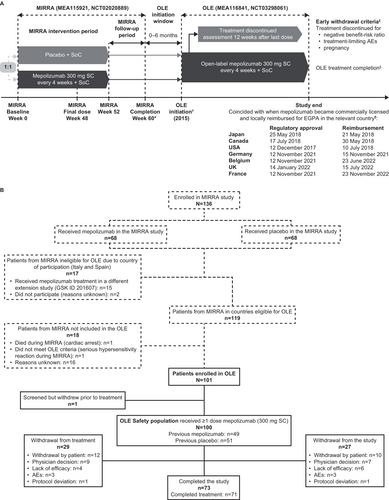
Eosinophilic granulomatosis with polyangiitis (EGPA) is a rare, relapsing, inflammatory disease. Management of EGPA predominantly relies on oral corticosteroids (OCS), which are associated with many adverse effects. The phase 3 MIRRA trial demonstrated efficacy and safety of mepolizumab, anti-interleukin-5 biologic, for EGPA. This open-label extension (OLE) of MIRRA assessed long-term safety and OCS-sparing effects of mepolizumab.
Methods
The OLE (NCT03298061) was a multicenter study that enrolled patients from MIRRA who required OCS ≥5 mg/day up to six months after the end of MIRRA. All patients received mepolizumab 300 mg subcutaneously every four weeks plus standard of care until mepolizumab was discontinued or became approved and reimbursed for EGPA in the respective country. Key outcomes included adverse events (AEs) and use of OCS.
Results
One hundred patients were enrolled in the OLE. Mean (SD) and median (min–max) exposure during OLE was 38.5 (27.0) and 27.0 (1.0–89.0) months. On-treatment AEs were experienced by 98% of patients (43% treatment related; most frequent: injection site reaction [10%]) and serious AEs by 38% of patients (6% treatment related) with no new safety signals versus MIRRA identified. Median (Q1–Q3) OCS dose decreased from 10.0 (7.8–15.0) mg/day at OLE baseline to 5.0 (0.0–10.0) mg/day at study exit. Proportion of patients using OCS >7.5 mg/day decreased from 75% at baseline to 32% at study exit; 28% of patients discontinued OCS.
Conclusion
Long-term use of mepolizumab to treat EGPA was well tolerated and resulted in sustained reductions in OCS use.
期刊介绍:
Arthritis & Rheumatology is the official journal of the American College of Rheumatology and focuses on the natural history, pathophysiology, treatment, and outcome of rheumatic diseases. It is a peer-reviewed publication that aims to provide the highest quality basic and clinical research in this field. The journal covers a wide range of investigative areas and also includes review articles, editorials, and educational material for researchers and clinicians. Being recognized as a leading research journal in rheumatology, Arthritis & Rheumatology serves the global community of rheumatology investigators and clinicians.