Sustained Interferon Signature Suppression With Anifrolumab in a Patient With STING-Associated Vasculopathy with Onset in Infancy Refractory to JAK Inhibitor and Dazukibart Therapy
Sara Alehashemi, Bjoern Buehring, Adriana A. de Jesus, Sachin Gaurav, Andre Rastegar, Alexi Baumgardner, Kip Friend, Oluwatobi T. Arisa, William D. Figg, Danielle Fink, Douglas B. Kuhns, Ben Colton, Cody J. Peer, Raphaela Goldbach-Mansky
{"title":"Sustained Interferon Signature Suppression With Anifrolumab in a Patient With STING-Associated Vasculopathy with Onset in Infancy Refractory to JAK Inhibitor and Dazukibart Therapy","authors":"Sara Alehashemi, Bjoern Buehring, Adriana A. de Jesus, Sachin Gaurav, Andre Rastegar, Alexi Baumgardner, Kip Friend, Oluwatobi T. Arisa, William D. Figg, Danielle Fink, Douglas B. Kuhns, Ben Colton, Cody J. Peer, Raphaela Goldbach-Mansky","doi":"10.1002/art.43145","DOIUrl":null,"url":null,"abstract":"<div>\n \n <section>\n \n <h3> Objective</h3>\n \n <p>The objective was to report the safety and efficacy of an anti-IFNAR1 antibody (anifrolumab) in a patient with STING-associated vasculopathy with onset in infancy (SAVI) who presented with vasculitic ulcers and systemic inflammation refractory to JAK inhibition (JAKi) and to the interferon-β–neutralizing monoclonal antibody dazukibart.</p>\n </section>\n \n <section>\n \n <h3> Methods</h3>\n \n <p>A patient with SAVI and a de novo <i>STING1</i> p.(Asn154Ser) mutation, a known pathogenic variant, and uncontrolled disease received 21 doses of dazukibart under a compassionate use investigational new drug protocol, which was followed by treatment with the anti-IFNAR1 antibody anifrolumab. Clinical and laboratory parameters, including wound healing, whole-blood type I interferon (IFN I) signature, and safety markers were closely monitored throughout both treatment periods.</p>\n </section>\n \n <section>\n \n <h3> Results</h3>\n \n <p>Despite initial reductions in C-reactive protein levels and IFN I scores following dazukibart administration, the patient experienced rebound inflammation and recurrent vasculitic lesions. Dazukibart dose adjustments failed to sustainably control IFN I signaling. Subsequent combination therapy of baricitinib and tocilizumab proved partially effective. Treatment with anifrolumab, an IFNAR1 blocker, in conjunction with tocilizumab led to sustained suppression of IFN I scores, allowed discontinuation of JAKi, and resulted in significant improvement in vasculitic wounds.</p>\n </section>\n \n <section>\n \n <h3> Conclusion</h3>\n \n <p>This case underscores the challenges in treating patients with SAVI and highlights the utility of IFN I scores as a theragnostic biomarker. Although high-dose JAKi and dazukibart failed to achieve sustained control of IFN I signaling, treatment with anifrolumab durably suppressed IFN scores and demonstrated promising efficacy, which allows for the investigation of the role of IFN I signaling in the disease pathogenesis of SAVI and other interferonopathies in future clinical trials.</p>\n </section>\n </div>","PeriodicalId":129,"journal":{"name":"Arthritis & Rheumatology","volume":"77 8","pages":"1087-1091"},"PeriodicalIF":10.9000,"publicationDate":"2025-02-25","publicationTypes":"Journal Article","fieldsOfStudy":null,"isOpenAccess":false,"openAccessPdf":"https://onlinelibrary.wiley.com/doi/epdf/10.1002/art.43145","citationCount":"0","resultStr":null,"platform":"Semanticscholar","paperid":null,"PeriodicalName":"Arthritis & Rheumatology","FirstCategoryId":"3","ListUrlMain":"https://acrjournals.onlinelibrary.wiley.com/doi/10.1002/art.43145","RegionNum":1,"RegionCategory":"医学","ArticlePicture":[],"TitleCN":null,"AbstractTextCN":null,"PMCID":null,"EPubDate":"","PubModel":"","JCR":"Q1","JCRName":"RHEUMATOLOGY","Score":null,"Total":0}
引用次数: 0
Abstract
Objective
The objective was to report the safety and efficacy of an anti-IFNAR1 antibody (anifrolumab) in a patient with STING-associated vasculopathy with onset in infancy (SAVI) who presented with vasculitic ulcers and systemic inflammation refractory to JAK inhibition (JAKi) and to the interferon-β–neutralizing monoclonal antibody dazukibart.
Methods
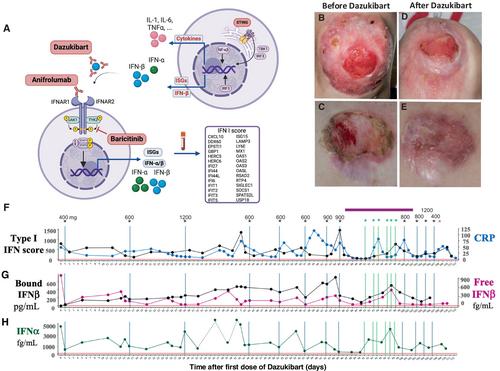
A patient with SAVI and a de novo STING1 p.(Asn154Ser) mutation, a known pathogenic variant, and uncontrolled disease received 21 doses of dazukibart under a compassionate use investigational new drug protocol, which was followed by treatment with the anti-IFNAR1 antibody anifrolumab. Clinical and laboratory parameters, including wound healing, whole-blood type I interferon (IFN I) signature, and safety markers were closely monitored throughout both treatment periods.
Results
Despite initial reductions in C-reactive protein levels and IFN I scores following dazukibart administration, the patient experienced rebound inflammation and recurrent vasculitic lesions. Dazukibart dose adjustments failed to sustainably control IFN I signaling. Subsequent combination therapy of baricitinib and tocilizumab proved partially effective. Treatment with anifrolumab, an IFNAR1 blocker, in conjunction with tocilizumab led to sustained suppression of IFN I scores, allowed discontinuation of JAKi, and resulted in significant improvement in vasculitic wounds.
Conclusion
This case underscores the challenges in treating patients with SAVI and highlights the utility of IFN I scores as a theragnostic biomarker. Although high-dose JAKi and dazukibart failed to achieve sustained control of IFN I signaling, treatment with anifrolumab durably suppressed IFN scores and demonstrated promising efficacy, which allows for the investigation of the role of IFN I signaling in the disease pathogenesis of SAVI and other interferonopathies in future clinical trials.
期刊介绍:
Arthritis & Rheumatology is the official journal of the American College of Rheumatology and focuses on the natural history, pathophysiology, treatment, and outcome of rheumatic diseases. It is a peer-reviewed publication that aims to provide the highest quality basic and clinical research in this field. The journal covers a wide range of investigative areas and also includes review articles, editorials, and educational material for researchers and clinicians. Being recognized as a leading research journal in rheumatology, Arthritis & Rheumatology serves the global community of rheumatology investigators and clinicians.